
We read your photo as:
What combination of goods maximizes the consumer's satisfaction?
ScanSolve AI Answer
Step-by-step solution
12 steps|
| Quantity | Total Utility of Brownies | Marginal Utility of Brownies | MU/P for Brownies () | Total Utility of Cookies | Marginal Utility of Cookies | MU/P for Cookies () | Total Utility of Pieces of Pie | Marginal Utility of Pieces of Pie | MU/P for Pieces of Pie () |
|---|---|---|---|---|---|---|---|---|---|
| 0 | 0 | - | - | 0 | - | - | 0 | - | - |
| 1 | 9 | 9 | 4.5 | 16 | 16 | 4 | 27 | 27 | 3.375 |
| 2 | 17 | 8 | 4 | 33 | 17 | 4.25 | 51 | 24 | 3 |
| 3 | 24 | 7 | 3.5 | 49 | 16 | 4 | 75 | 24 | 3 |
| 4 | 30 | 6 | 3 | 61 | 12 | 3 | 99 | 24 | 3 |
| 5 | 34 | 4 | 2 | 69 | 8 | 2 | 109 | 10 | 1.25 |
| 6 | 36 | 2 | 1 | 73 | 4 | 1 | 113 | 4 | 0.5 |
| 7 | 36 | 0 | 0 | 72 | -1 | -0.25 | 110 | -3 | -0.375 |
a) What combination of goods maximizes the consumer's satisfaction?
Calculate the Marginal Utility (MU) for each additional unit of each good.
. For example, for the 1st brownie, . For the 2nd brownie, .
Calculate the Marginal Utility per Dollar (MU/P) for each unit of each good.
. Given prices are
P_B = \2P_C = $4P_P = $8$.
The table above shows these calculations.Allocate the budget of $40 by purchasing the good that offers the highest MU/P at each step, until the budget is exhausted.
- Budget: $40
- Highest MU/P is 4.5 (1st Brownie). Buy 1 Brownie.
- Cost: 38.
- Budget: $38
- Highest MU/P is 4.25 (2nd Cookies). Buy 1 Bag of Cookies.
- Cost: 34.
- Budget: $34
- Highest MU/P is 4 (1st Cookies, 2nd Brownie). Let's buy 1st Cookies.
- Cost: 30. (Now 1 Brownie, 2 Cookies)
- Budget: $30
- Highest MU/P is 4 (2nd Brownie, 3rd Cookies). Let's buy 2nd Brownie.
- Cost: 28. (Now 2 Brownies, 2 Cookies)
- Budget: $28
- Highest MU/P is 4 (3rd Cookies). Buy 1 Bag of Cookies.
- Cost: 24. (Now 2 Brownies, 3 Cookies)
- Budget: $24
- Highest MU/P is 3.5 (3rd Brownie). Buy 1 Brownie.
- Cost: 22. (Now 3 Brownies, 3 Cookies)
- Budget: $22
- Highest MU/P is 3.375 (1st Pie). Buy 1 Piece of Pie.
- Cost: 14. (Now 3 Brownies, 3 Cookies, 1 Pie)
- Budget: $14
- Highest MU/P is 3 (4th Brownie, 4th Cookies, 2nd Pie, 3rd Pie, 4th Pie). Let's pick 4th Brownie.
- Cost: 12. (Now 4 Brownies, 3 Cookies, 1 Pie)
- Budget: $12
- Highest MU/P is 3 (4th Cookies, 2nd Pie, 3rd Pie, 4th Pie). Let's pick 4th Cookies.
- Cost: 8. (Now 4 Brownies, 4 Cookies, 1 Pie)
- Budget: $8
- Highest MU/P is 3 (2nd Pie, 3rd Pie, 4th Pie). Let's pick 2nd Pie.
- Cost: 0. (Now 4 Brownies, 4 Cookies, 2 Pies)
At this point, the budget is exhausted, and the MU/P for the last unit purchased of each good is 3.
For 4th Brownie: .
For 4th Cookies: .
For 2nd Pie: .
The equimarginal principle is satisfied.The combination of goods that maximizes the consumer's satisfaction is:
.b) What is the total utility received from this combination?
- Budget: $40
Sum the total utility for each good at the quantities determined in part (a).
Total Utility from 4 Brownies ( at Q=4) = 30
Total Utility from 4 Bags of Cookies ( at Q=4) = 61
Total Utility from 2 Pieces of Pie ( at Q=2) = 51Calculate the total utility.
The total utility received from this combination is .
c) If the price of pies fell to $6 a piece, what would be the new combination that would maximize the consumer's satisfaction?
Recalculate MU/P for Pieces of Pie with the new price
P_P = \6$.The MU for pie remains the same.
Quantity New () 1 27 4.5 2 24 4 3 24 4 4 24 4 5 10 1.67 6 4 0.67 7 -3 -0.5 Re-allocate the budget of $40 using the updated MU/P for pie.
- Budget: $40
- Highest MU/P is 4.5 (1st Brownie, 1st Pie). Let's buy 1st Brownie.
- Cost: 38.
- Budget: $38
- Highest MU/P is 4.5 (1st Pie). Buy 1 Piece of Pie.
- Cost: 32. (Now 1 Brownie, 1 Pie)
- Budget: $32
- Highest MU/P is 4.25 (2nd Cookies). Buy 1 Bag of Cookies.
- Cost: 28. (Now 1 Brownie, 1 Cookies, 1 Pie)
- Budget: $28
- Highest MU/P is 4 (1st Cookies, 2nd Brownie, 2nd Pie, 3rd Pie, 4th Pie). Let's buy 1st Cookies.
- Cost: 24. (Now 1 Brownie, 2 Cookies, 1 Pie)
- Budget: $24
- Highest MU/P is 4 (2nd Brownie, 2nd Pie, 3rd Pie, 4th Pie). Let's buy 2nd Brownie.
- Cost: 22. (Now 2 Brownies, 2 Cookies, 1 Pie)
- Budget: $22
- Highest MU/P is 4 (2nd Pie, 3rd Pie, 4th Pie, 3rd Cookies). Let's buy 2nd Pie.
- Cost: 16. (Now 2 Brownies, 2 Cookies, 2 Pies)
- Budget: $16
- Highest MU/P is 4 (3rd Pie, 4th Pie, 3rd Cookies). Let's buy 3rd Pie.
- Cost: 10. (Now 2 Brownies, 2 Cookies, 3 Pies)
- Budget: $10
- Highest MU/P is 4 (4th Pie, 3rd Cookies). Let's buy 4th Pie.
- Cost: 4. (Now 2 Brownies, 2 Cookies, 4 Pies)
- Budget: $4
- Highest MU/P is 4 (3rd Cookies). Buy 1 Bag of Cookies.
- Cost: 0. (Now 2 Brownies, 3 Cookies, 4 Pies)
At this point, the budget is exhausted.
For 2nd Brownie: .
For 3rd Cookies: .
For 4th Pie: .
The equimarginal principle is satisfied.The new combination that maximizes the consumer's satisfaction is:
.That's 2 down. 3 left today — send the next one.Step 1: Calculate Marginal Utility (MU) and Marginal Utility per Dollar (MU/P) for each good.
The prices are: Brownie () = P_C4, Piece of Pie () = 40.Quantity 0 0 - - 0 - - 0 - - 1 9 9 4.5 16 16 4 27 27 3.375 2 17 8 4 33 17 4.25 51 24 3 3 24 7 3.5 49 16 4 75 24 3 4 30 6 3 61 12 3 99 24 3 5 34 4 2 69 8 2 109 10 1.25 6 36 2 1 73 4 1 113 4 0.5 7 36 0 0 72 -1 -0.25 110 -3 -0.375 a) What combination of goods maximizes the consumer's satisfaction?
- Budget: $40
Allocate the MU_B/P_B = MU_C/P_C = MU_P/P_P$) is met as closely as possible when the budget is exhausted.
- Buy 1st Brownie (). Cost: 38. (B=1)
- Buy 1st Bag of Cookies (). Cost: 34. (B=1, C=1)
- Buy 1st Piece of Pie (). Cost: 26. (B=1, C=1, P=1)
- Buy 2nd Brownie (). Cost: 24. (B=2, C=1, P=1)
- Buy 2nd Bag of Cookies (). Cost: 20. (B=2, C=2, P=1)
- Buy 3rd Bag of Cookies (). Cost: 16. (B=2, C=3, P=1)
- Buy 3rd Brownie (). Cost: 14. (B=3, C=3, P=1)
- Buy 2nd Piece of Pie (). Cost: 6. (B=3, C=3, P=2)
- Buy 4th Brownie (). Cost: 4. (B=4, C=3, P=2)
- Buy 4th Bag of Cookies (). Cost: 0. (B=4, C=4, P=2)
The budget is exhausted, and the MU/P for the last unit of each good purchased is 3.
The combination of goods that maximizes the consumer's satisfaction is .
b) What is the total utility received from this combination?
Sum the total utility for the quantities determined in part (a).
Total Utility from 4 Brownies ( at Q=4) = 30
Total Utility from 4 Bags of Cookies ( at Q=4) = 61
Total Utility from 2 Pieces of Pie ( at Q=2) = 51Calculate the total utility.
The total utility received from this combination is .
c) If the price of pies fell to $6 a piece, what would be the new combination that would maximize the consumer's satisfaction?
Recalculate the Marginal Utility per Dollar (MU/P) for Pieces of Pie with the new price
P_P = \6$.The Marginal Utility (MU) values for pie remain the same as in the table from part (a).
Quantity New () 1 27 2 24 3 24 4 24 5 10 6 4 7 -3 Re-allocate the budget of $40 by purchasing the good that offers the highest MU/P at each step, until the budget is exhausted, ensuring the equimarginal principle is met.
(Refer to the MU/P values for brownies and cookies from the table in part (a), and the new MU/P values for pie above).
- Buy 1st Brownie (). Cost: 38. (Current: 1B)
- Buy 1st Piece of Pie (). Cost: 32. (Current: 1B, 1P)
- Buy 2nd Bag of Cookies (). Cost: 28. (Current: 1B, 1C, 1P)
- Buy 2nd Brownie (). Cost: 26. (Current: 2B, 1C, 1P)
- Buy 1st Bag of Cookies (). Cost: 22. (Current: 2B, 2C, 1P)
- Buy 2nd Piece of Pie (). Cost: 16. (Current: 2B, 2C, 2P)
- Buy 3rd Piece of Pie (). Cost: 10. (Current: 2B, 2C, 3P)
- Buy 4th Piece of Pie (). Cost: 4. (Current: 2B, 2C, 4P)
- Buy 3rd Bag of Cookies (). Cost: 0. (Current: 2B, 3C, 4P)
At this point, the budget is exhausted. The MU/P for the last unit of each good purchased is 4 (, , ).
The new combination that maximizes the consumer's satisfaction is .
Still stuck on this one?
Ask a follow-up, and the answer starts from this question.
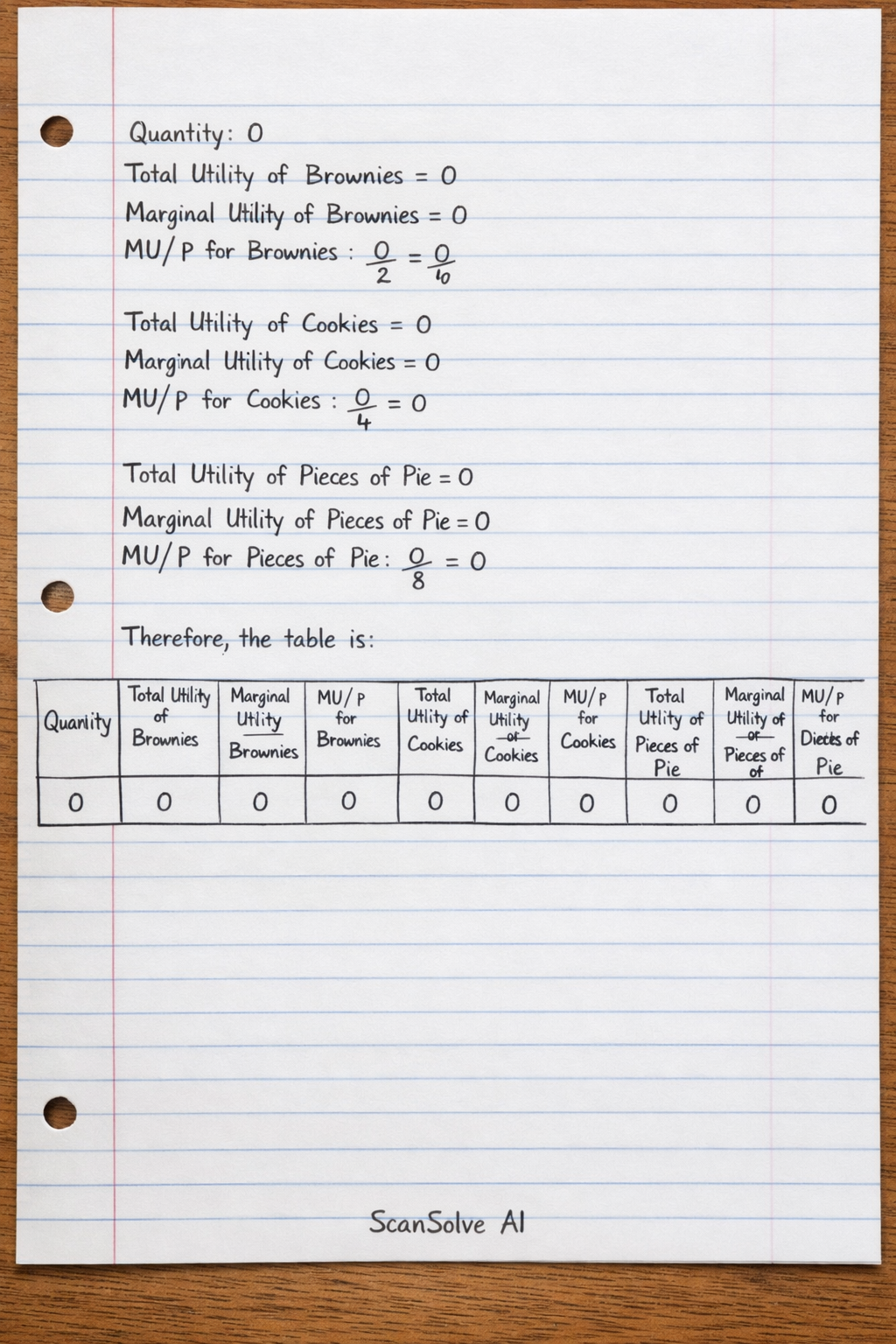
Handwritten Step-by-Step Solution
Get this as a handwritten image on WhatsApp — like a tutor wrote it for you.
Try on WhatsApp