
We read your photo as:
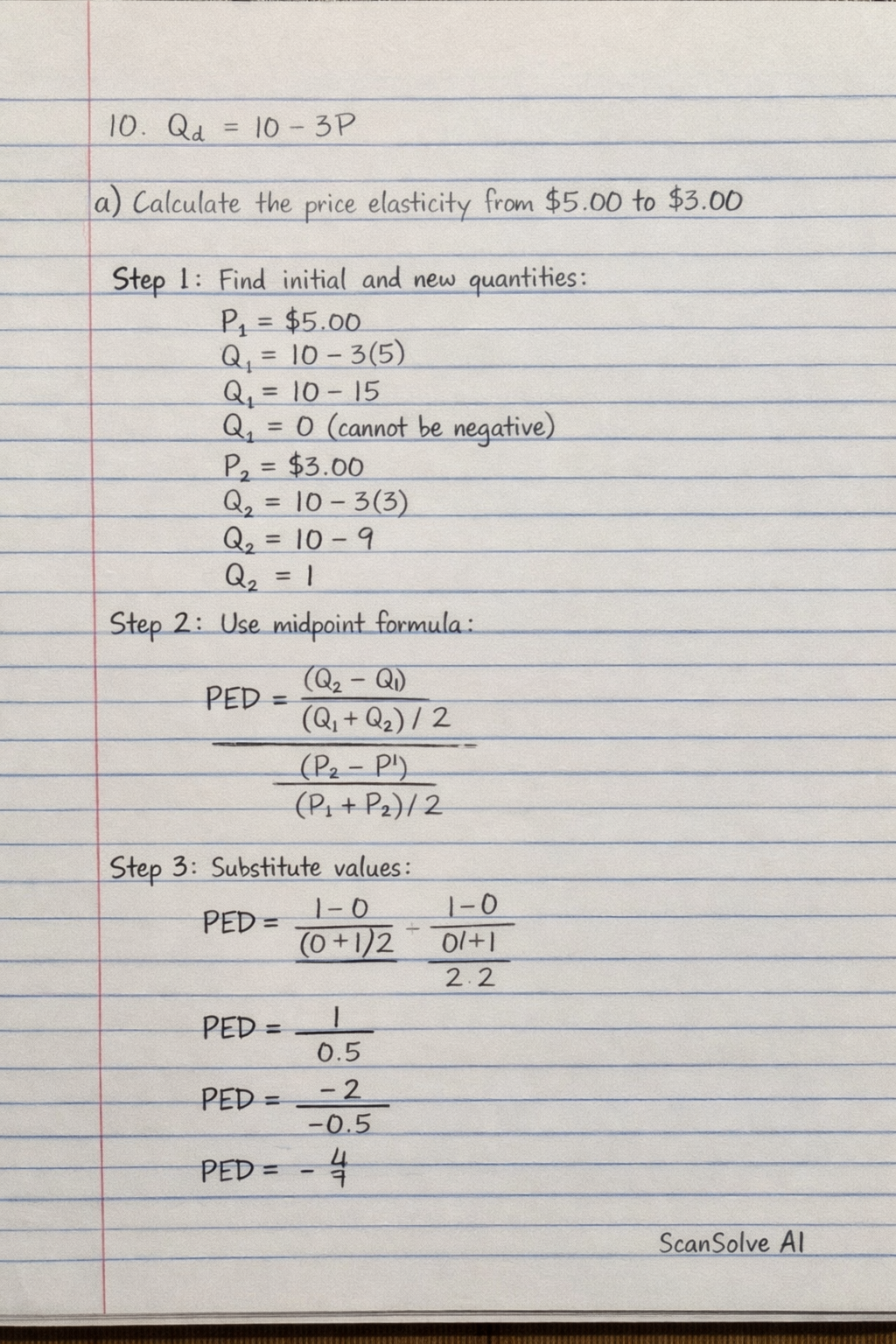
Consider a demand function: Qd = 10−3P a) Determine and interpret the price elasticity for a price change from 5.00 to 3.00. b) To boost revenue should this firm increase or decrease its price. Explain.
ScanSolve AI Answer
Answer
Step-by-step solution
4 stepshere are the solutions for questions 10 and 11.
10. Consider a demand function:
Part a· 4 steps
Determine and interpret the price elasticity for a price change from \5.00$3.00$.
Calculate the initial and new quantities demanded.
- Initial Price () =
\5.00$ Since quantity demanded cannot be negative, at a price of\5.00Q_1 = 0$. - New Price () =
\3.00$
- Initial Price () =
Use the midpoint formula for price elasticity of demand (PED).
Substitute the values into the formula.
Interpret the elasticity value.
The absolute value of the price elasticity of demand is . Since , the demand is elastic. This means that a 1% change in price leads to a 4% change in quantity demanded in the opposite direction.
The price elasticity of demand is . Demand is elastic.
Part b
To boost revenue should this firm increase or decrease its price. Explain.
To boost revenue, the firm should decrease its price.
Since the demand is elastic (PED > 1 in absolute terms), a decrease in price will lead to a proportionally larger increase in the quantity demanded, which will result in an overall increase in total revenue.
11. Distinguish between: Total utility, Marginal utility and The law of Diminishing Marginal utility.
- Total Utility: The overall satisfaction or happiness a consumer receives from consuming a specific quantity of a good or service. It represents the sum of all marginal utilities from each unit consumed.
- Marginal Utility: The additional satisfaction or benefit a consumer gains from consuming one more unit of a good or service. It is the change in total utility resulting from a one-unit change in consumption.
- Law of Diminishing Marginal Utility: This economic principle states that as a consumer consumes more and more units of a specific good or service, the additional satisfaction (marginal utility) derived from each successive unit tends to decrease.
Try one yourself
A new problem that tests the same skill.
Still stuck on this one?
Ask a follow-up, and the answer starts from this question.
Handwritten Step-by-Step Solution
Get this as a handwritten image on WhatsApp — like a tutor wrote it for you.
Try on WhatsApp