
We read your photo as:
Distinguish between "installed capacity," "available capacity," and "capacity factor." Using Nigeria's electricity sector as an example, explain why these three figures are vastly different.
ScanSolve AI Answer
Here are the answers to the questions:
Q1. Distinguish between "installed capacity," "available capacity," and "capacity factor." Using Nigeria's electricity sector as an example, explain why these three figures are vastly different.
- Installed Capacity: This is the maximum potential output of a power plant or an entire electricity system, as designed and rated by the manufacturer. It represents the total nameplate capacity if all generating units were operating at full power under ideal conditions.
- Available Capacity: This is the actual power that can be generated by a power plant or system at any given time, taking into account operational constraints such as maintenance, equipment breakdowns, fuel shortages, or grid limitations. It is always less than or equal to the installed capacity.
- Capacity Factor: This is a measure of the actual output over a period compared to the maximum possible output if the plant operated at its full installed capacity for that entire period. It is calculated as:
In Nigeria's electricity sector, these three figures are vastly different due to several systemic challenges:
- Gas Supply Shortages: Many of Nigeria's power plants are gas-fired. Inadequate gas infrastructure and frequent disruptions in gas supply mean that plants often cannot run at their full installed capacity, significantly reducing their available capacity.
- Aging Infrastructure and Maintenance Issues: Many power plants and transmission lines are old and poorly maintained, leading to frequent breakdowns and forced outages. This further reduces the available capacity and the overall capacity factor.
- Grid Instability and Constraints: The national grid often cannot evacuate all the power that could potentially be generated. Plants may be forced to reduce output (load shedding) even if they have the available capacity, leading to a lower capacity factor.
- Operational Inefficiencies: Issues like vandalism, lack of spare parts, and operational mismanagement also contribute to plants not running optimally, thus lowering both available capacity and capacity factor far below the installed capacity.
Q2. Explain the principle of a Combined Cycle Gas Turbine (CCGT) and state why it is considered more efficient than a simple-cycle gas turbine.
A Combined Cycle Gas Turbine (CCGT) operates by integrating two power generation cycles: a gas turbine cycle and a steam turbine cycle. First, a gas turbine compresses air, mixes it with fuel, ignites it, and the hot combustion gases expand through a turbine to generate electricity. The hot exhaust gases from the gas turbine, instead of being released directly into the atmosphere, are then directed to a Heat Recovery Steam Generator (HRSG). In the HRSG, these hot gases heat water to produce high-pressure steam, which then drives a steam turbine to generate additional electricity.
CCGTs are considered more efficient than simple-cycle gas turbines because they effectively recover and utilize the waste heat from the gas turbine's exhaust. A simple-cycle gas turbine exhausts its hot gases, losing a significant amount of thermal energy. By using this otherwise wasted heat to generate more electricity via a steam turbine, the CCGT system extracts more useful work from the same amount of fuel, significantly increasing its overall thermal efficiency (often exceeding 60% compared to 30-40% for simple-cycle gas turbines).
Q3. List three merits and three limitations of nuclear power as a source of base-load electricity.
Three merits of nuclear power as a source of base-load electricity:
- Low Greenhouse Gas Emissions: Nuclear power plants produce virtually no greenhouse gas emissions during operation, contributing to climate change mitigation.
- High Power Output and Reliability: Nuclear plants can generate a large amount of electricity continuously for long periods (base-load), with high capacity factors, providing stable and reliable power regardless of weather conditions.
- High Fuel Density: A small amount of nuclear fuel (uranium) can produce an enormous amount of energy, making it a very energy-dense fuel source.
Three limitations of nuclear power as a source of base-load electricity:
- High Capital Costs: The construction of nuclear power plants involves extremely high upfront capital investments and long construction times.
- Radioactive Waste Management: Nuclear power produces radioactive waste that remains hazardous for thousands of years, requiring complex and expensive long-term storage and disposal solutions.
- Safety Concerns and Accident Risk: There is a public perception and actual risk of severe accidents (e.g., Chernobyl, Fukushima) with potentially catastrophic environmental and human health consequences, requiring stringent safety regulations and security measures.
Q4. Define "energy intermittency" and describe two technological solutions that can mitigate its impact on grid stability.
Energy intermittency refers to the variability and unpredictability of power generation from certain renewable energy sources, primarily solar and wind power. Their output fluctuates based on natural conditions like sunlight intensity, cloud cover, and wind speed, making it challenging to match supply precisely with demand and maintain grid stability.
Two technological solutions that can mitigate its impact on grid stability are:
- Energy Storage Systems: Technologies like large-scale battery storage (e.g., lithium-ion batteries, flow batteries) or pumped-hydro storage can store excess electricity generated during periods of high renewable output and low demand. This stored energy can then be discharged back into the grid during periods of low renewable output or high demand, smoothing out fluctuations and providing dispatchable power.
- Smart Grids and Advanced Grid Management: Implementing smart grid technologies involves using advanced sensors, communication networks, and control systems to monitor and manage electricity supply and demand in real-time. This allows for better forecasting of renewable output, dynamic load management (demand-side response), and optimized dispatch of conventional power plants, enabling the grid to more effectively integrate and balance intermittent renewable sources.
Still stuck on this one?
Ask a follow-up, and the answer starts from this question.
More Economics Questions
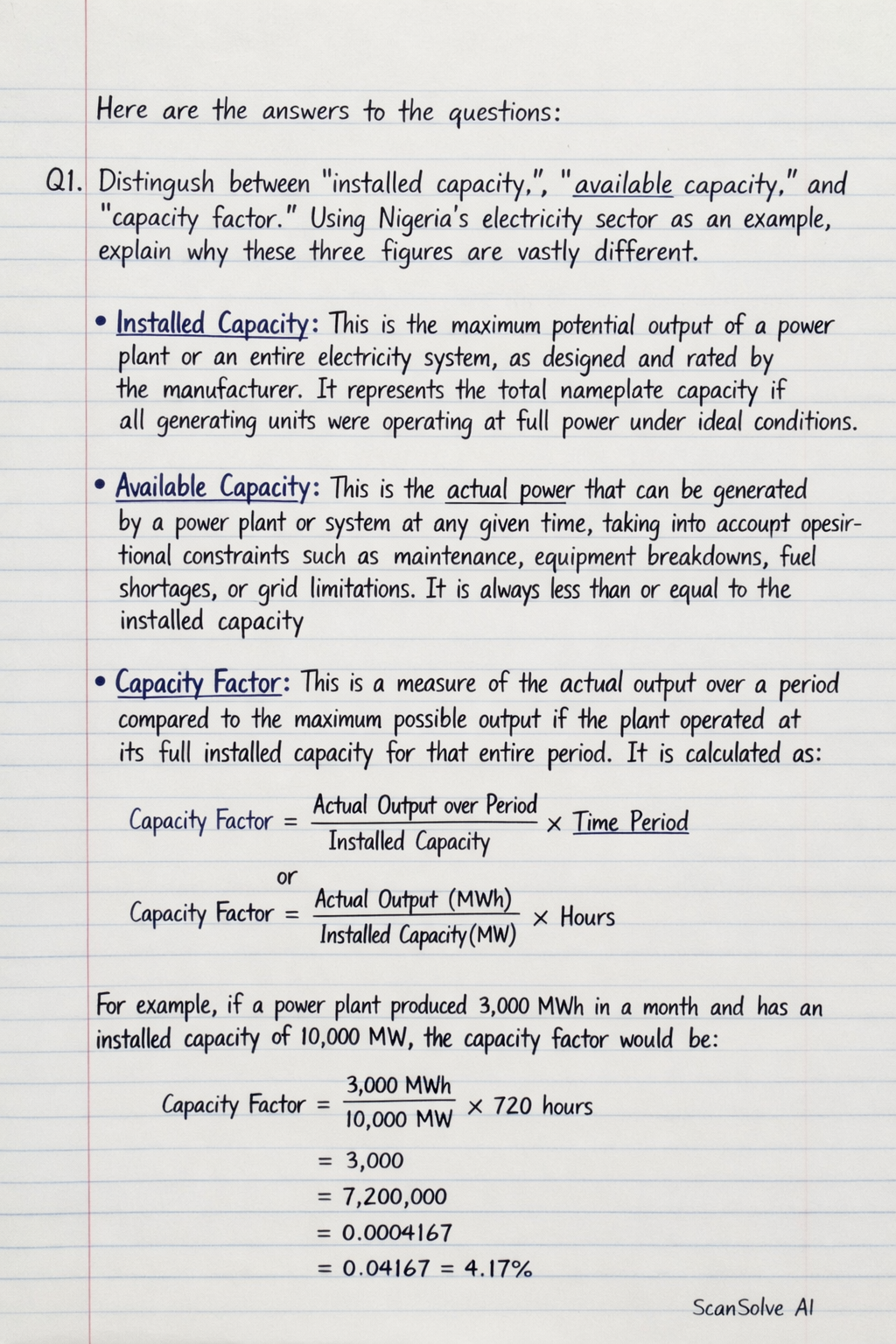
Handwritten Step-by-Step Solution
Get this as a handwritten image on WhatsApp — like a tutor wrote it for you.
Try on WhatsApp