
We read your photo as:
Identify the given exchange rate.
ScanSolve AI Answer
Step-by-step solution
7 stepsHere are the solutions to your questions:
1.3.1 Convert R14 800 to US Dollars (USD).
Identify the given exchange rate.
The exchange rate is .
Divide the Rand amount by the exchange rate to convert to USD.
R14 800 is approximately .
1.3.2 Determine the price of the laptop in South African rand.
Identify the price of the laptop in USD and the new exchange rate.
Laptop price .
New exchange rate .Multiply the USD amount by the new exchange rate to convert to Rand.
The price of the laptop in South African rand is .
1.3.3 Explain why a weak rand affects South African consumers buying imported goods.
A weak rand means that South African consumers need to spend more Rands to purchase the same amount of foreign currency (like USD). This makes imported goods, which are priced in foreign currency, more expensive when converted back to Rands, reducing the purchasing power of consumers.2.1 Explain the term tariff.
A tariff is a charge or fee that is applied to a specific service or product. In the context of telecommunications, it refers to the pricing structure for calls, data, or other services.2.2 Give an advantage of option A.
An advantage of Tariff Option A (Contract) is that it offers a predictable monthly cost (R220) for a set amount of usage (300 minutes), making it easier for Lelo to budget if their call usage is consistent and within the included minutes.2.3 Calculate the total monthly cost for option B if Lelo uses 250 minutes of calls and identify the option which is cheaper for using the 250 minutes.
Calculate the cost for Tariff Option A for 250 minutes.
Tariff Option A includes 300 minutes for a fixed monthly fee of R220. Since 250 minutes is less than 300 minutes, there are no extra call costs.
Calculate the cost for Tariff Option B for 250 minutes.
Tariff Option B has no monthly fee, and calls cost R2.30 per minute.
Compare the costs and identify the cheaper option.
Comparing (Option A) and (Option B), Option A is cheaper.
The total monthly cost for option B is .
The cheaper option for using 250 minutes is .2.4 Explain how choosing the wrong tariff can affect Lelo's monthly budget.
Choosing the wrong tariff can lead to unnecessary expenses and strain Lelo's monthly budget. For example, if Lelo chooses a contract with a high fixed fee but uses very few minutes, they would be paying for services they don't use. Conversely, if Lelo chooses a pay-as-you-go option but makes many calls, the per-minute costs could accumulate rapidly, resulting in a much higher bill than a contract with included minutes. This can leave less money for other essential expenses.
Still stuck on this one?
Ask a follow-up, and the answer starts from this question.
More Economics Questions
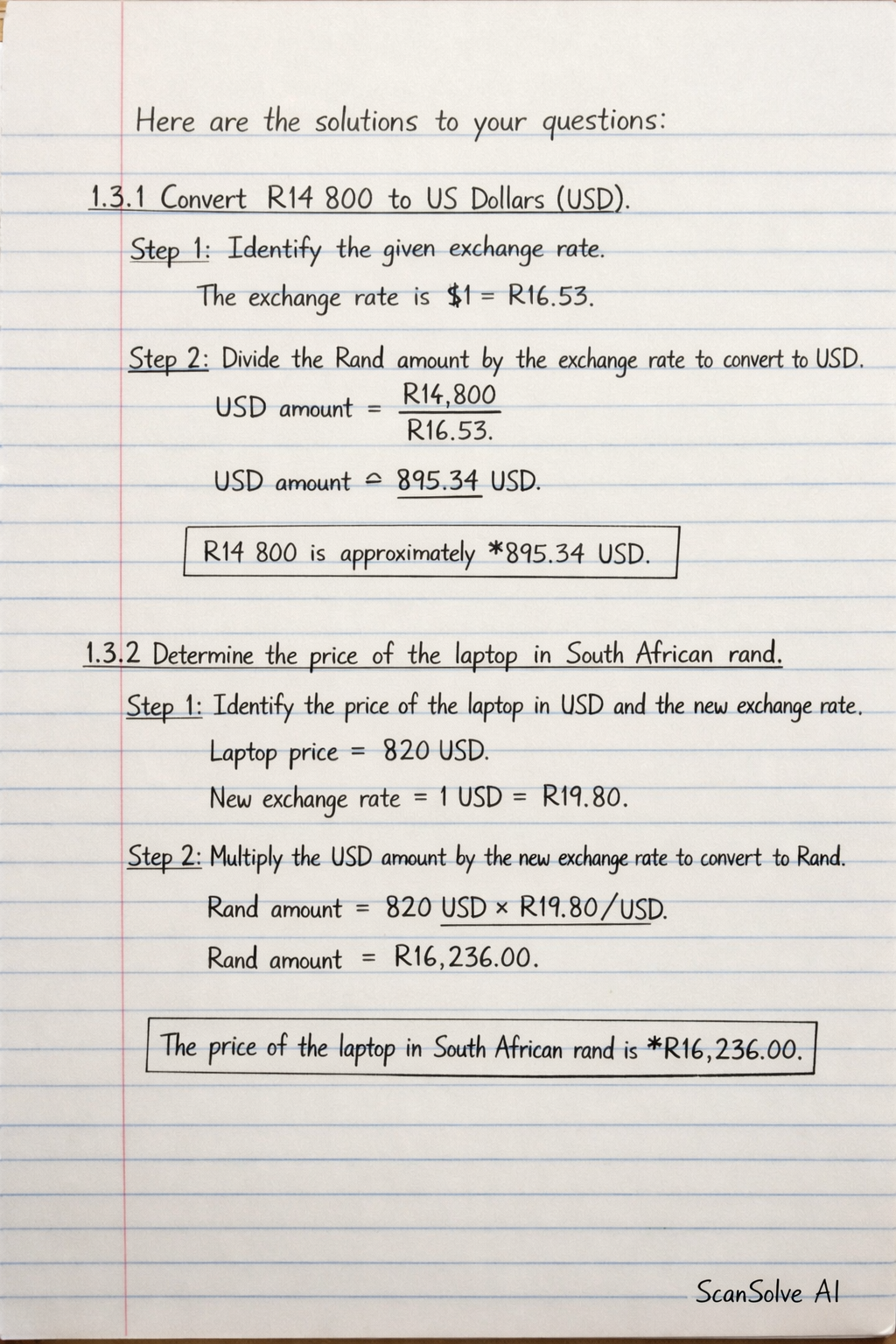
Handwritten Step-by-Step Solution
Get this as a handwritten image on WhatsApp — like a tutor wrote it for you.
Try on WhatsApp