

This economics question tests your understanding of economic models and analysis. The step-by-step answer below applies the relevant framework and explains the reasoning.
ScanSolve AI Answer
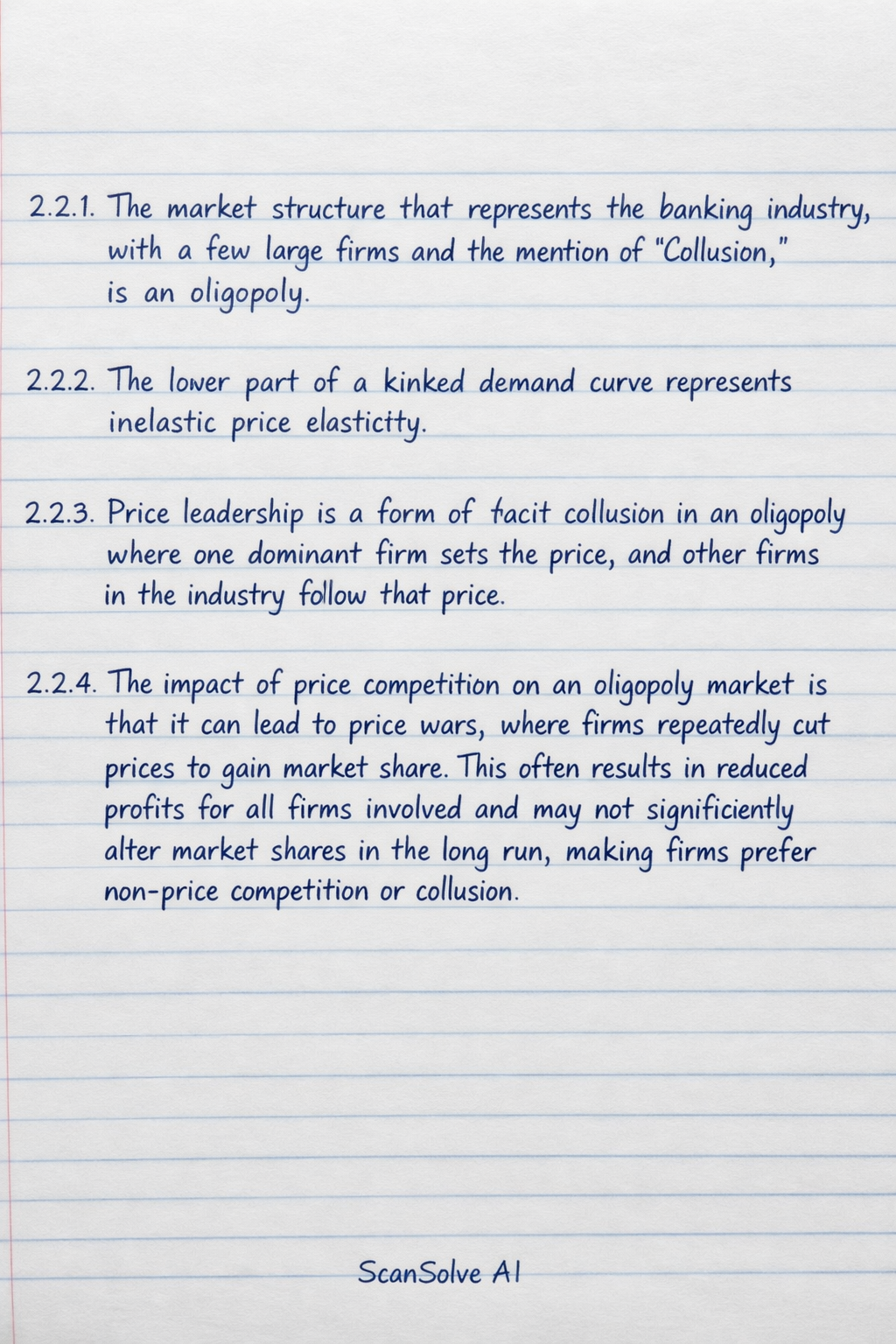
Here are the answers to the questions based on the provided information: 2.2.1 The market structure that represents the banking industry, with a few large firms and the mention of "Collusion," is an oligopoly. 2.2.2 The lower part of a kinked demand curve represents inelastic price elasticity. 2.2.3 Price leadership is a form of tacit collusion in an oligopoly where one dominant firm sets the price, and other firms in the industry follow that price. 2.2.4 The impact of price competition on an oligopoly market is that it can lead to price wars, where firms repeatedly cut prices to gain market share. This often results in reduced profits for all firms involved and may not significantly alter market shares in the long run, making firms prefer non-price competition or collusion. 2.2.5 Firms operating in an oligopoly market increase their market share primarily through non-price competition. This includes: • Advertising and branding: To create product differentiation and customer loyalty. • Product differentiation: By improving quality, features, design, or offering unique services. • Sales promotion: Such as loyalty programs, special offers, or discounts. • Research and development (R&D): To innovate and introduce new or improved products. • Mergers and acquisitions: To absorb competitors and expand their market presence. 2.3 Oligopolies tend to sell at the market price due to the dynamics of the kinked demand curve model. Graph Description: The graph has Price (P) on the vertical axis and Quantity (Q) on the horizontal axis. The demand curve (D) is kinked at the prevailing market price and quantity. Above the kink, the demand curve is relatively elastic*. Below the kink, the demand curve is relatively inelastic*. The marginal revenue (MR) curve has a vertical discontinuity (a gap) directly below the kink in the demand curve. The marginal cost (MC) curve typically passes through this vertical gap in the MR curve. Explanation: If an oligopolist raises its price* above the market price (the kink), other firms are unlikely to follow, as they can gain market share by keeping their prices stable. The firm raising its price will face an elastic demand and lose a significant number of customers, leading to a drop in revenue. If an oligopolist lowers its price* below the market price (the kink), other firms are likely to follow suit to avoid losing their customers. The firm lowering its price will face an inelastic demand, gaining only a small increase in sales but experiencing a significant reduction in overall revenue and profit. Because both raising and lowering prices from the kink lead to undesirable outcomes (loss of revenue/profit), firms in an oligopoly have a strong incentive to maintain the stable market price* at the kink. 2.4 Collusion can negatively affect the economy in several ways: • Higher prices for consumers: Colluding firms agree to set prices above competitive levels, forcing consumers to pay more for goods and services. • Reduced output: Firms may restrict supply to maintain higher prices, leading to a scarcity of goods and services. • Reduced consumer choice: Collusion can limit product variety and innovation as firms have less incentive to compete on these fronts. • Inefficiency: Without competitive pressure, colluding firms have less motivation to operate efficiently or invest in cost-saving technologies. • Unfair distribution of wealth: Profits are concentrated among the colluding firms at the expense of consumers and potentially smaller, non-colluding businesses. • Barriers to entry: Collusion can create significant barriers for new firms trying to enter the market, stifling competition and innovation. Last free one today — make it count tomorrow, or type /upgrade for unlimited.