
We read your photo as:
Using appropriate diagrams and explanation distinguish clearly between Total Fixed Cost (TFC) and Total Variable Cost (TVC).
Economics
ScanSolve AI Answer
Step-by-step solution
2 stepsB)
Distinguish between Total Fixed Cost (TFC) and Total Variable Cost (TVC).
- Total Fixed Cost (TFC) refers to costs that do not change with the level of output in the short run. These costs must be paid even if no production occurs. For example, rent for a factory building.
- Total Variable Cost (TVC) refers to costs that vary directly with the level of output. These costs are zero when no output is produced and increase as production increases. For example, the cost of raw materials.
Describe the diagrams for TFC and TVC.
- TFC Diagram: When plotted on a graph with Quantity (Q) on the x-axis and Cost on the y-axis, the TFC curve is a horizontal line. This indicates that TFC remains constant regardless of the quantity produced.
- TVC Diagram: On the same type of graph, the TVC curve is an upward-sloping curve that starts from the origin $(0,0)$. It typically increases at a decreasing rate initially, then increases at an increasing rate, reflecting the law of diminishing returns.
Was this helpful?
Still stuck on this one?
Ask a follow-up, and the answer starts from this question.
Got a different question?Ask your own question
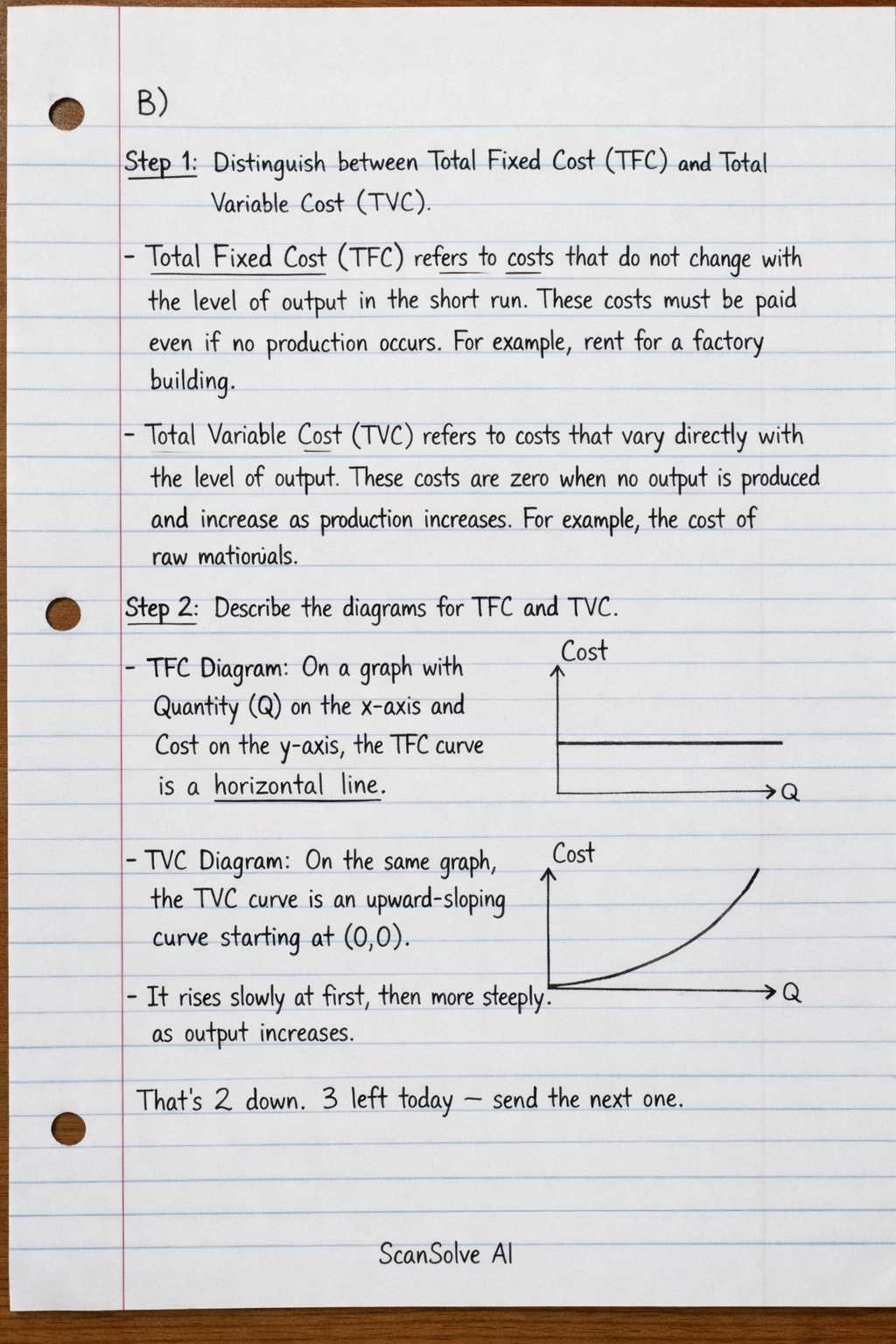
Handwritten Step-by-Step Solution
Get this as a handwritten image on WhatsApp — like a tutor wrote it for you.
Try on WhatsApp