ScanSolve logoScanSolve
Toggle sidebar
  • Homework
  • Tutor
  • Humanizer
  • AI Detector
  • Questions
  • Blog
  • History
  • Mobile App

  • Homework
  • Tutor
  • Humanizer
  • AI Detector

  • Questions
  • Math homework helpMath
    Physics homework helpPhysics
    Chemistry homework helpChemistry
    Biology homework helpBiology
    Computer Science homework helpComputer Science
    History homework helpHistory
    More homework helpMore
  • Blog
  • History

  • Mobile App
ScanSolvePLUS
  • Unlimited answers
  • ScanSolve AI Pro
Start Free Trial →
Try on WhatsApp
Home > English Homework Help > Solution

1. (a) Seven literary forms used in the writing of the Bible are:

Asked on March 28, 2026|English

This English question involves literary analysis, grammar, or writing skills. The detailed response below provides a well-structured answer with supporting evidence and clear explanations.

ScanSolve AI AnswerAnswered on March 28, 2026
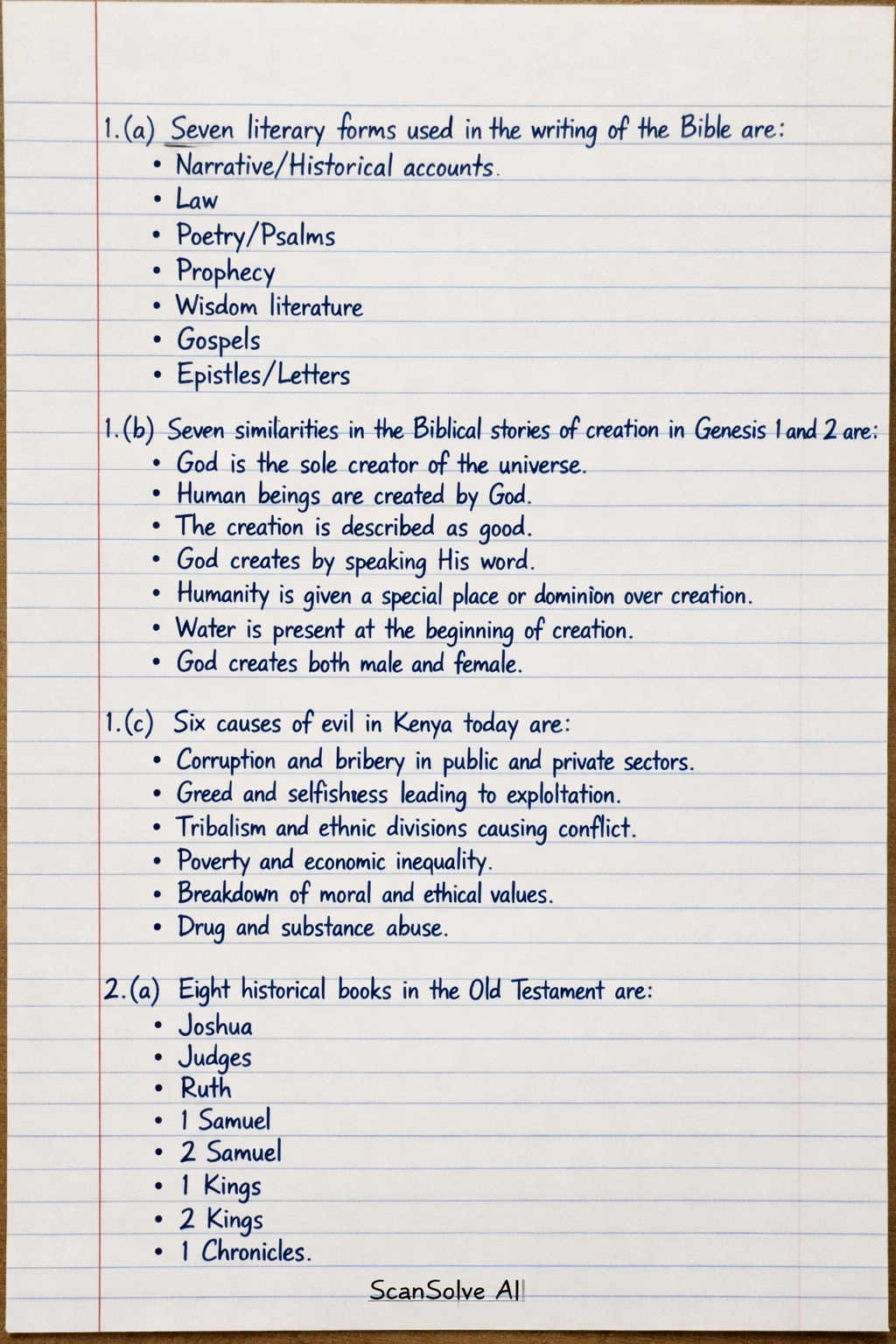
1. (a) Seven literary forms used in the writing of the Bible are: • Narrative/Historical accounts • Law • Poetry/Psalms • Prophecy • Wisdom literature • Gospels • Epistles/Letters 1. (b) Seven similarities in the Biblical stories of creation in Genesis 1 and 2 are: • God is the sole creator of the universe. • Human beings are created by God. • The creation is described as good. • God creates by speaking His word. • Humanity is given a special place or dominion over creation. • Water is present at the beginning of creation. • God creates both male and female. 1. (c) Six causes of evil in Kenya today are: • Corruption and bribery in public and private sectors. • Greed and selfishness leading to exploitation. • Tribalism and ethnic divisions causing conflict. • Poverty and economic inequality. • Breakdown of moral and ethical values. • Drug and substance abuse. 2. (a) Eight historical books in the Old Testament are: • Joshua • Judges • Ruth • 1 Samuel • 2 Samuel • 1 Kings • 2 Kings • 1 Chronicles 2. (b) Seven reasons why the Bible is referred to as a library of books are: • It is a collection of many individual books. • These books were written by different authors. • The books were written over a long period of time, spanning centuries. • They were written in different geographical locations. • The Bible contains various literary forms or genres. • It covers a wide range of themes and subjects. • The original texts were written in different languages (Hebrew, Aramaic, Greek). 2. (c) Five different occasions when Christians use the Bible are: • During church services for preaching and teaching. • For personal devotion and Bible study. • To seek guidance and wisdom in daily life. • For evangelism and missionary work. • To find comfort and encouragement during difficult times. 3. (a) Four ways in which God demonstrated His concern for the Israelites during the Exodus are: • God delivered them from slavery in Egypt through the ten plagues and the parting of the Red Sea, ensuring their freedom. • He provided them with daily sustenance, such as manna and quail for food, and water from a rock, preventing starvation and thirst in the wilderness. • God guided them through the wilderness with a pillar of cloud by day and a pillar of fire by night, showing them the way and protecting them. • He gave them the Ten Commandments and other laws at Mount Sinai, establishing a covenant and providing a moral framework for their new nation. 3. (b) The Israelites worshipped God when they were in the wilderness through: • Offering various sacrifices and burnt offerings at the Tabernacle, as commanded by God. • Observing the Sabbath day as a day of rest and worship. • Celebrating religious festivals such as Passover, the Feast of Unleavened Bread, and the Feast of Tabernacles. • Following the instructions and laws given by God through Moses, which included specific rituals and ceremonies. • Through prayer and praise, acknowledging God's presence and power in their lives. 3. (c) Seven challenges that Christians face while practicing their faith in Kenya today are: • Corruption and bribery, which tempt believers to compromise their integrity. • Materialism and consumerism, leading to a focus on worldly possessions over spiritual values. • Tribalism and ethnic divisions, which undermine unity within the church and society. • Poverty and economic hardship, making it difficult for some to meet basic needs and contribute to the church. • False teachings and cults that mislead believers and distort Christian doctrine. • Secularism and moral decay, challenging traditional Christian values and ethics. • Hypocrisy among some church leaders and members, which can cause disillusionment. 4. (a) Six characteristics of true prophets in the Old Testament are: • They were called directly by God and received their message from Him. • They spoke God's word faithfully, often beginning with "Thus says the Lord." • They often faced opposition, persecution, and suffering for delivering God's message. • They lived exemplary lives, demonstrating moral uprightness and obedience to God. • Their prophecies often came true, validating their divine calling. • They challenged injustice, idolatry, and social evils in society. 4. (b) Four ways in which the rich oppressed the poor during the time of Prophet Amos are: • They exploited the poor through unjust weights and measures when selling goods, cheating them out of their rightful earnings. • They took bribes and perverted justice in the courts, ensuring that legal rulings favored the wealthy and condemned the innocent poor. • They enslaved the poor for small debts, forcing them into servitude and depriving them of their freedom and dignity. • They charged exorbitant interest rates on loans, trapping the poor in cycles of debt and further impoverishing them. 4. (c) Six reasons why Christians find it difficult to help the needy in society today are: • Lack of personal resources or financial constraints, as many Christians themselves face economic challenges. • Selfishness and greed, where individuals prioritize their own needs and desires over helping others. • Lack of compassion or empathy towards the suffering of others. • Fear of being exploited or taken advantage of by those claiming to be needy. • The overwhelming scale of need in society, making individual efforts seem insignificant. • Distrust of charitable organizations or concerns about how donations are utilized. 5. (a) Six reasons why

Related English Questions

  • 9. With the aid of "The Concubine" by Elechi Amadi, here are five ideas communicated in the novel and their relevance to...
  • Your poem must only have 3 stanzas**.
  • A noun is a word that names a person, place, thing, or idea. For example, teacher, city, book, and happiness are all nou...
  • I snaped and send a reading passage with multiple Choice questions and you didn't solve it . Why ?
  • The question is incomplete. Please provide the full question or the rest of the sentence for "Bhola Grandpa was returnin...
  • How do I scan English Questions and send
See all English questions

This step-by-step solution was generated by ScanSolve AI. Need help with more english problems? Browse English solutions or ask your own question.

Home›English Homework Help›1. (a) Seven literary forms used in the writing of the Bible…
Q

1. (a) Seven literary forms used in the writing of the Bible are:

March 28, 2026|English
1. (a) Seven literary forms used in the writing of the Bible are:

1. (a) Seven literary forms used in the writing of the Bible are:

ScanSolve AI

ScanSolve AI Answer

Answered on March 28, 2026

1. (a) Seven literary forms used in the writing of the Bible are: • Narrative/Historical accounts • Law • Poetry/Psalms • Prophecy • Wisdom literature • Gospels • Epistles/Letters

1. (b) Seven similarities in the Biblical stories of creation in Genesis 1 and 2 are: • God is the sole creator of the universe. • Human beings are created by God. • The creation is described as good. • God creates by speaking His word. • Humanity is given a special place or dominion over creation. • Water is present at the beginning of creation. • God creates both male and female.

1. (c) Six causes of evil in Kenya today are: • Corruption and bribery in public and private sectors. • Greed and selfishness leading to exploitation. • Tribalism and ethnic divisions causing conflict. • Poverty and economic inequality. • Breakdown of moral and ethical values. • Drug and substance abuse.

2. (a) Eight historical books in the Old Testament are: • Joshua • Judges • Ruth • 1 Samuel • 2 Samuel • 1 Kings • 2 Kings • 1 Chronicles

2. (b) Seven reasons why the Bible is referred to as a library of books are: • It is a collection of many individual books. • These books were written by different authors. • The books were written over a long period of time, spanning centuries. • They were written in different geographical locations. • The Bible contains various literary forms or genres. • It covers a wide range of themes and subjects. • The original texts were written in different languages (Hebrew, Aramaic, Greek).

2. (c) Five different occasions when Christians use the Bible are: • During church services for preaching and teaching. • For personal devotion and Bible study. • To seek guidance and wisdom in daily life. • For evangelism and missionary work. • To find comfort and encouragement during difficult times.

3. (a) Four ways in which God demonstrated His concern for the Israelites during the Exodus are: • God delivered them from slavery in Egypt through the ten plagues and the parting of the Red Sea, ensuring their freedom. • He provided them with daily sustenance, such as manna and quail for food, and water from a rock, preventing starvation and thirst in the wilderness. • God guided them through the wilderness with a pillar of cloud by day and a pillar of fire by night, showing them the way and protecting them. • He gave them the Ten Commandments and other laws at Mount Sinai, establishing a covenant and providing a moral framework for their new nation.

3. (b) The Israelites worshipped God when they were in the wilderness through: • Offering various sacrifices and burnt offerings at the Tabernacle, as commanded by God. • Observing the Sabbath day as a day of rest and worship. • Celebrating religious festivals such as Passover, the Feast of Unleavened Bread, and the Feast of Tabernacles. • Following the instructions and laws given by God through Moses, which included specific rituals and ceremonies. • Through prayer and praise, acknowledging God's presence and power in their lives.

3. (c) Seven challenges that Christians face while practicing their faith in Kenya today are: • Corruption and bribery, which tempt believers to compromise their integrity. • Materialism and consumerism, leading to a focus on worldly possessions over spiritual values. • Tribalism and ethnic divisions, which undermine unity within the church and society. • Poverty and economic hardship, making it difficult for some to meet basic needs and contribute to the church. • False teachings and cults that mislead believers and distort Christian doctrine. • Secularism and moral decay, challenging traditional Christian values and ethics. • Hypocrisy among some church leaders and members, which can cause disillusionment.

4. (a) Six characteristics of true prophets in the Old Testament are: • They were called directly by God and received their message from Him. • They spoke God's word faithfully, often beginning with "Thus says the Lord." • They often faced opposition, persecution, and suffering for delivering God's message. • They lived exemplary lives, demonstrating moral uprightness and obedience to God. • Their prophecies often came true, validating their divine calling. • They challenged injustice, idolatry, and social evils in society.

4. (b) Four ways in which the rich oppressed the poor during the time of Prophet Amos are: • They exploited the poor through unjust weights and measures when selling goods, cheating them out of their rightful earnings. • They took bribes and perverted justice in the courts, ensuring that legal rulings favored the wealthy and condemned the innocent poor. • They enslaved the poor for small debts, forcing them into servitude and depriving them of their freedom and dignity. • They charged exorbitant interest rates on loans, trapping the poor in cycles of debt and further impoverishing them.

4. (c) Six reasons why Christians find it difficult to help the needy in society today are: • Lack of personal resources or financial constraints, as many Christians themselves face economic challenges. • Selfishness and greed, where individuals prioritize their own needs and desires over helping others. • Lack of compassion or empathy towards the suffering of others. • Fear of being exploited or taken advantage of by those claiming to be needy. • The overwhelming scale of need in society, making individual efforts seem insignificant. • Distrust of charitable organizations or concerns about how donations are utilized.

5. (a) Six reasons why

Need help with your own homework?

Get instant step-by-step solutions to any question. Free to start.

Ask Your Question
Handwritten step-by-step solution

Handwritten Step-by-Step Solution

Get this solution as a handwritten image on WhatsApp — just like a tutor wrote it for you.

Try on WhatsApp

More English Questions

9. With the aid of "The Concubine" by Elechi Amadi, here are five ideas communicated in the novel an…Your poem must only have 3 stanzas**.A noun is a word that names a person, place, thing, or idea. For example, teacher, city, book, and h…I snaped and send a reading passage with multiple Choice questions and you didn't solve it . Why ?The question is incomplete. Please provide the full question or the rest of the sentence for "Bhola…How do I scan English Questions and send
See all Englishquestions →