ScanSolve logoScanSolve
Toggle sidebar
  • Homework
  • Tutor
  • Humanizer
  • AI Detector
  • Questions
  • Blog
  • History
  • Mobile App

  • Homework
  • Tutor
  • Humanizer
  • AI Detector

  • Questions
  • Math homework helpMath
    Physics homework helpPhysics
    Chemistry homework helpChemistry
    Biology homework helpBiology
    Computer Science homework helpComputer Science
    History homework helpHistory
    More homework helpMore
  • Blog
  • History

  • Mobile App
ScanSolvePLUS
  • Unlimited answers
  • ScanSolve AI Pro
Start Free Trial →
Try on WhatsApp
Home > English Homework Help > Solution

1. a. State any three differences between an academic essay and a fictional essay. b. What is the difference between note-taking and note-making? c. Explain three reasons why it is important for distance learners to take or make notes. d. Why do we refer to listening and speaking skills as primary language skills?

Asked on March 26, 2026|English

This English question involves literary analysis, grammar, or writing skills. The detailed response below provides a well-structured answer with supporting evidence and clear explanations.

ScanSolve AI AnswerAnswered on March 26, 2026
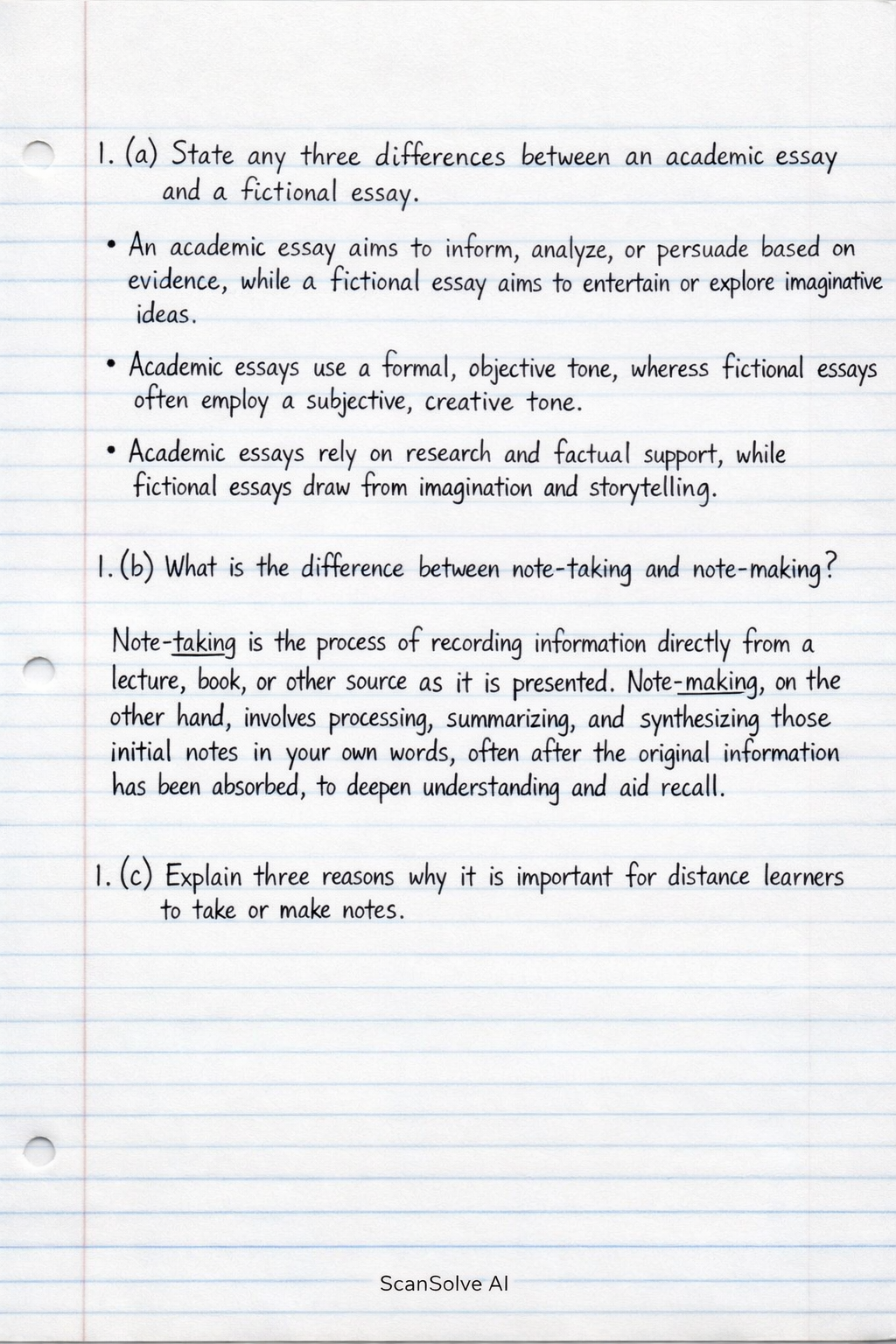
1. (a) State any three differences between an academic essay and a fictional essay. • An academic essay aims to inform, analyze, or persuade based on evidence, while a fictional essay aims to entertain or explore imaginative ideas. • Academic essays use a formal, objective tone, whereas fictional essays often employ a subjective, creative tone. • Academic essays rely on research and factual support, while fictional essays draw from imagination and storytelling. 1. (b) What is the difference between note-taking and note-making? Note-taking is the process of recording information directly from a lecture, book, or other source as it is presented. Note-making, on the other hand, involves processing, summarizing, and synthesizing those initial notes in your own words, often after the original information has been absorbed, to deepen understanding and aid recall. 1. (c) Explain three reasons why it is important for distance learners to take or make notes. • Enhanced Retention: Note-taking and note-making help distance learners actively engage with the material, improving memory and recall of key information. • Improved Understanding: The act of summarizing and rephrasing information in notes forces learners to process and comprehend complex concepts more thoroughly. • Effective Revision: Well-organized notes serve as personalized study guides, making it easier for distance learners to review material and prepare for assessments without needing to revisit original sources. 1. (d) Why do we refer to listening and speaking skills as primary language skills? Listening and speaking are referred to as primary language skills because they are typically acquired first in natural language development. They are fundamental for basic human communication and form the foundation upon which reading and writing skills are later developed. 2. Describe four reading faults that adversely affect students' reading. • Subvocalization: This is the habit of silently pronouncing words while reading. It slows down reading speed because the reader can only read as fast as they can "speak" the words in their head, hindering comprehension of larger chunks of text. • Regression: This fault involves rereading words or sentences unnecessarily. It disrupts the flow of reading, wastes time, and can indicate a lack of concentration or confidence in understanding the text the first time. • Fixation: Readers with this fault focus on individual words rather than groups of words or phrases. This narrow focus significantly reduces reading speed and can impede overall comprehension by breaking the natural flow of ideas. • Lack of Vocabulary: An insufficient vocabulary means encountering many unfamiliar words, which forces the reader to stop, guess, or look up meanings. This constant interruption breaks concentration and severely slows down reading pace and comprehension. 3. (a) Give five reasons why, as a distance learner, you should engage in extensive reading. • Broadens Knowledge: Extensive reading exposes distance learners to a wide range of topics and perspectives, expanding their general knowledge base. • Improves Vocabulary: Regular exposure to diverse texts naturally increases a learner's vocabulary, enhancing their ability to understand and express complex ideas. • Enhances Comprehension Skills: Reading extensively helps develop the ability to grasp main ideas, identify supporting details, and understand complex sentence structures more effectively. • Develops Critical Thinking: Engaging with various texts encourages distance learners to analyze, evaluate, and synthesize information, fostering stronger critical thinking skills. • Boosts Academic Performance: A strong reading habit contributes to better understanding of course materials, improved essay writing, and overall higher academic achievement. 3. (b) State three features of a discourse community. • Shared Goals: Members of a discourse community have common objectives or purposes that guide their communication and activities. • Specific Genres: They utilize particular forms of communication (e.g., research papers, lab reports, memos) that are recognized and understood within the community. • Specialized Lexis: They employ a specific vocabulary, jargon, or terminology that is unique to their field or area of interest. 3. c) Identify any two elements of communication. • Sender: The individual or entity who initiates the communication and transmits the message. • Receiver: The individual or entity to whom the message is directed and who interprets it. 4. With an example each, explain any three English sentences according to structure. • Simple Sentence: A simple sentence contains one independent clause, meaning it has a single subject and a single predicate, expressing a complete thought. Example: The cat slept. • Compound Sentence: A compound sentence consists of two or more independent clauses, usually joined by a coordinating conjunction (e.g., and, but, or) or a semicolon. Each clause can stand alone as a complete sentence. Example: The sun rose, and the birds began to sing. • Complex Sentence: A complex sentence contains one independent clause and at least one dependent (subordinate) clause. The dependent clause cannot stand alone as a complete thought and relies on the independent clause for meaning. Example: Although it was raining, we decided to go for a walk. 5. Briefly explain the following types of writing: A. Descriptive Descriptive writing aims to create a vivid picture or sensory experience for the reader by using detailed observations and imagery. It focuses on describing people, places, objects, or events in a way that appeals to the five senses. B. Narrative Narrative writing tells a story, presenting a sequence of events, often involving characters, a plot, a setting, and a conflict. Its primary purpose is to entertain, inform, or persuade through storytelling. C. Expository Expository writing aims to explain, inform, or clarify a topic. It presents facts, evidence, and logical reasoning in a clear and objective manner, without expressing personal opinions or trying to persuade the reader.

Related English Questions

  • 9. With the aid of "The Concubine" by Elechi Amadi, here are five ideas communicated in the novel and their relevance to...
  • Your poem must only have 3 stanzas**.
  • A noun is a word that names a person, place, thing, or idea. For example, teacher, city, book, and happiness are all nou...
  • 1. (a) Seven literary forms used in the writing of the Bible are:
  • I snaped and send a reading passage with multiple Choice questions and you didn't solve it . Why ?
  • The question is incomplete. Please provide the full question or the rest of the sentence for "Bhola Grandpa was returnin...
See all English questions

This step-by-step solution was generated by ScanSolve AI. Need help with more english problems? Browse English solutions or ask your own question.

Home›English Homework Help›1. a. State any three differences between an academic essay…
Q

1. a. State any three differences between an academic essay and a fictional essay. b. What is the difference between note-taking and note-making? c. Explain three reasons why it is important for distance learners to take or make notes. d. Why do we refer to listening and speaking skills as primary language skills?

March 26, 2026|English
1. a. State any three differences between an academic essay and a fictional essay. b. What is the difference between note-taking and note-making? c. Explain three reasons why it is important for distance learners to take or make notes. d. Why do we refer to listening and speaking skills as primary language skills?

1. a. State any three differences between an academic essay and a fictional essay. b. What is the difference between note-taking and note-making? c. Explain three reasons why it is important for distance learners to take or make notes. d. Why do we refer to listening and speaking skills as primary language skills?

ScanSolve AI

ScanSolve AI Answer

Answered on March 26, 2026

1. (a) State any three differences between an academic essay and a fictional essay.

• An academic essay aims to inform, analyze, or persuade based on evidence, while a fictional essay aims to entertain or explore imaginative ideas. • Academic essays use a formal, objective tone, whereas fictional essays often employ a subjective, creative tone. • Academic essays rely on research and factual support, while fictional essays draw from imagination and storytelling.

1. (b) What is the difference between note-taking and note-making?

Note-taking is the process of recording information directly from a lecture, book, or other source as it is presented. Note-making, on the other hand, involves processing, summarizing, and synthesizing those initial notes in your own words, often after the original information has been absorbed, to deepen understanding and aid recall.

1. (c) Explain three reasons why it is important for distance learners to take or make notes.

• Enhanced Retention: Note-taking and note-making help distance learners actively engage with the material, improving memory and recall of key information. • Improved Understanding: The act of summarizing and rephrasing information in notes forces learners to process and comprehend complex concepts more thoroughly. • Effective Revision: Well-organized notes serve as personalized study guides, making it easier for distance learners to review material and prepare for assessments without needing to revisit original sources.

1. (d) Why do we refer to listening and speaking skills as primary language skills?

Listening and speaking are referred to as primary language skills because they are typically acquired first in natural language development. They are fundamental for basic human communication and form the foundation upon which reading and writing skills are later developed.

2. Describe four reading faults that adversely affect students' reading.

• Subvocalization: This is the habit of silently pronouncing words while reading. It slows down reading speed because the reader can only read as fast as they can "speak" the words in their head, hindering comprehension of larger chunks of text. • Regression: This fault involves rereading words or sentences unnecessarily. It disrupts the flow of reading, wastes time, and can indicate a lack of concentration or confidence in understanding the text the first time. • Fixation: Readers with this fault focus on individual words rather than groups of words or phrases. This narrow focus significantly reduces reading speed and can impede overall comprehension by breaking the natural flow of ideas. • Lack of Vocabulary: An insufficient vocabulary means encountering many unfamiliar words, which forces the reader to stop, guess, or look up meanings. This constant interruption breaks concentration and severely slows down reading pace and comprehension.

3. (a) Give five reasons why, as a distance learner, you should engage in extensive reading.

• Broadens Knowledge: Extensive reading exposes distance learners to a wide range of topics and perspectives, expanding their general knowledge base. • Improves Vocabulary: Regular exposure to diverse texts naturally increases a learner's vocabulary, enhancing their ability to understand and express complex ideas. • Enhances Comprehension Skills: Reading extensively helps develop the ability to grasp main ideas, identify supporting details, and understand complex sentence structures more effectively. • Develops Critical Thinking: Engaging with various texts encourages distance learners to analyze, evaluate, and synthesize information, fostering stronger critical thinking skills. • Boosts Academic Performance: A strong reading habit contributes to better understanding of course materials, improved essay writing, and overall higher academic achievement.

3. (b) State three features of a discourse community.

• Shared Goals: Members of a discourse community have common objectives or purposes that guide their communication and activities. • Specific Genres: They utilize particular forms of communication (e.g., research papers, lab reports, memos) that are recognized and understood within the community. • Specialized Lexis: They employ a specific vocabulary, jargon, or terminology that is unique to their field or area of interest.

3. c) Identify any two elements of communication.

• Sender: The individual or entity who initiates the communication and transmits the message. • Receiver: The individual or entity to whom the message is directed and who interprets it.

4. With an example each, explain any three English sentences according to structure.

• Simple Sentence: A simple sentence contains one independent clause, meaning it has a single subject and a single predicate, expressing a complete thought. Example: The cat slept. • Compound Sentence: A compound sentence consists of two or more independent clauses, usually joined by a coordinating conjunction (e.g., and, but, or) or a semicolon. Each clause can stand alone as a complete sentence. Example: The sun rose, and the birds began to sing. • Complex Sentence: A complex sentence contains one independent clause and at least one dependent (subordinate) clause. The dependent clause cannot stand alone as a complete thought and relies on the independent clause for meaning. Example: Although it was raining, we decided to go for a walk.

5. Briefly explain the following types of writing:

A. Descriptive Descriptive writing aims to create a vivid picture or sensory experience for the reader by using detailed observations and imagery. It focuses on describing people, places, objects, or events in a way that appeals to the five senses.

B. Narrative Narrative writing tells a story, presenting a sequence of events, often involving characters, a plot, a setting, and a conflict. Its primary purpose is to entertain, inform, or persuade through storytelling.

C. Expository Expository writing aims to explain, inform, or clarify a topic. It presents facts, evidence, and logical reasoning in a clear and objective manner, without expressing personal opinions or trying to persuade the reader.

Need help with your own homework?

Get instant step-by-step solutions to any question. Free to start.

Ask Your Question
Handwritten step-by-step solution

Handwritten Step-by-Step Solution

Get this solution as a handwritten image on WhatsApp — just like a tutor wrote it for you.

Try on WhatsApp

More English Questions

9. With the aid of "The Concubine" by Elechi Amadi, here are five ideas communicated in the novel an…Your poem must only have 3 stanzas**.A noun is a word that names a person, place, thing, or idea. For example, teacher, city, book, and h…1. (a) Seven literary forms used in the writing of the Bible are:I snaped and send a reading passage with multiple Choice questions and you didn't solve it . Why ?The question is incomplete. Please provide the full question or the rest of the sentence for "Bhola…
See all Englishquestions →