

This English question involves literary analysis, grammar, or writing skills. The detailed response below provides a well-structured answer with supporting evidence and clear explanations.
ScanSolve AI Answer
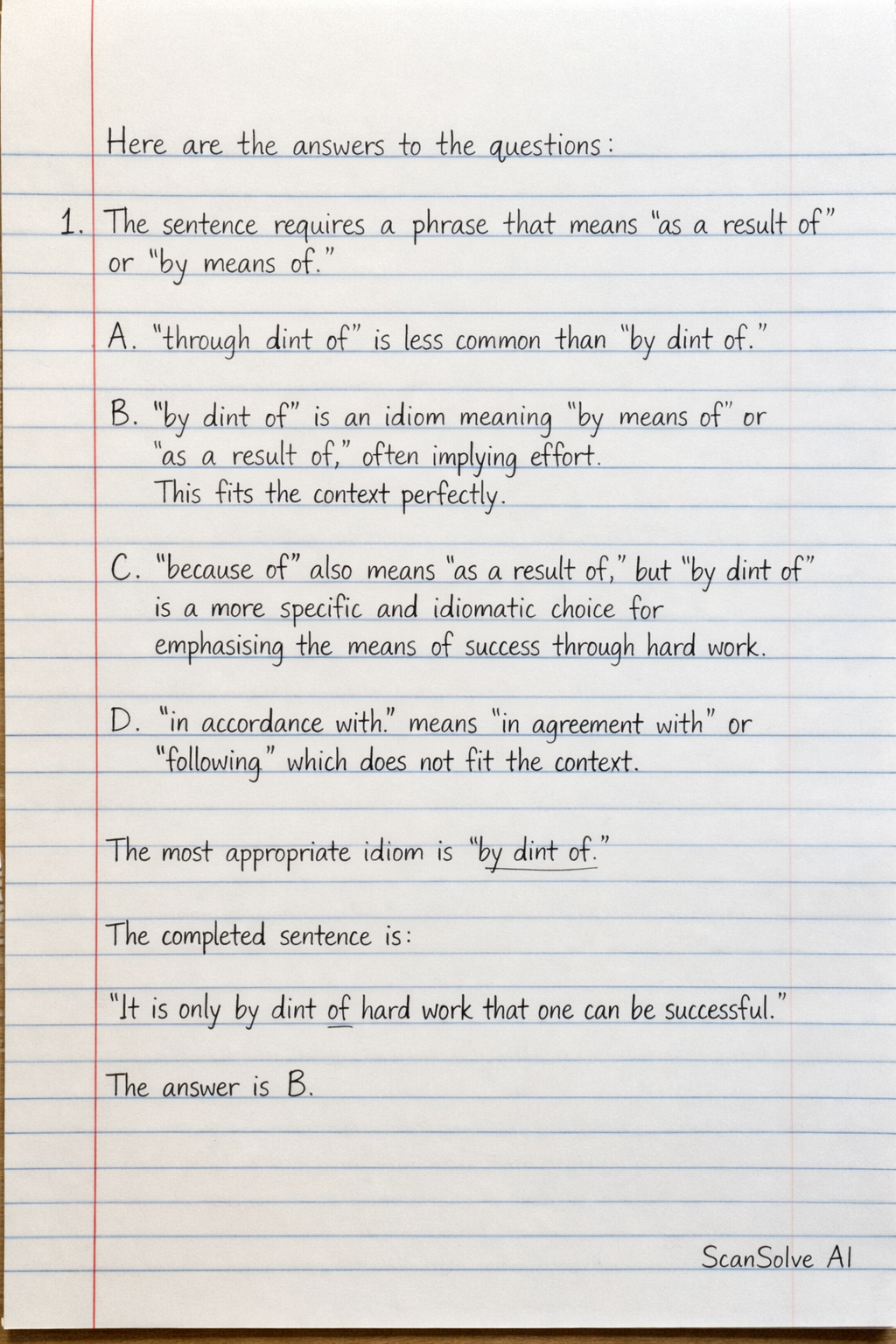
Here are the answers to the questions: 1. The sentence requires a phrase that means "as a result of" or "by means of." A. "through dint of" is less common than "by dint of." B. "by dint of" is an idiom meaning "by means of" or "as a result of," often implying effort. This fits the context perfectly. C. "because of" also means "as a result of," but "by dint of" is a more specific and idiomatic choice for emphasizing the means of success through hard work. D. "in accordance with" means "in agreement with" or "following," which does not fit the context. The most appropriate idiom is "by dint of." The completed sentence is: "It is only by dint of hard work that one can be successful." The answer is B. 2. The sentence expresses a contrast: despite having challenges, she succeeded smoothly. A. "despite of" is grammatically incorrect. The correct form is "despite" (without "of"). B. "in spite of" is a correct idiom meaning "notwithstanding" or "regardless of," which conveys the necessary contrast. C. "in front of" means "before" or "ahead of" and does not fit the context of contrast. D. "because of" indicates a cause, implying the challenges caused* her smooth sailing, which is the opposite of the intended meaning. The correct phrase to express contrast is "in spite of." The completed sentence is: "In spite of all her challenges, she was able to sail through smoothly." The answer is B.