
We read your photo as:
The setting of this extract is a classroom or school hall where a debate is taking place. This is indicated by Mr. M calling for order, ringing a school bell, and referring to a dictionary on
ScanSolve AI Answer
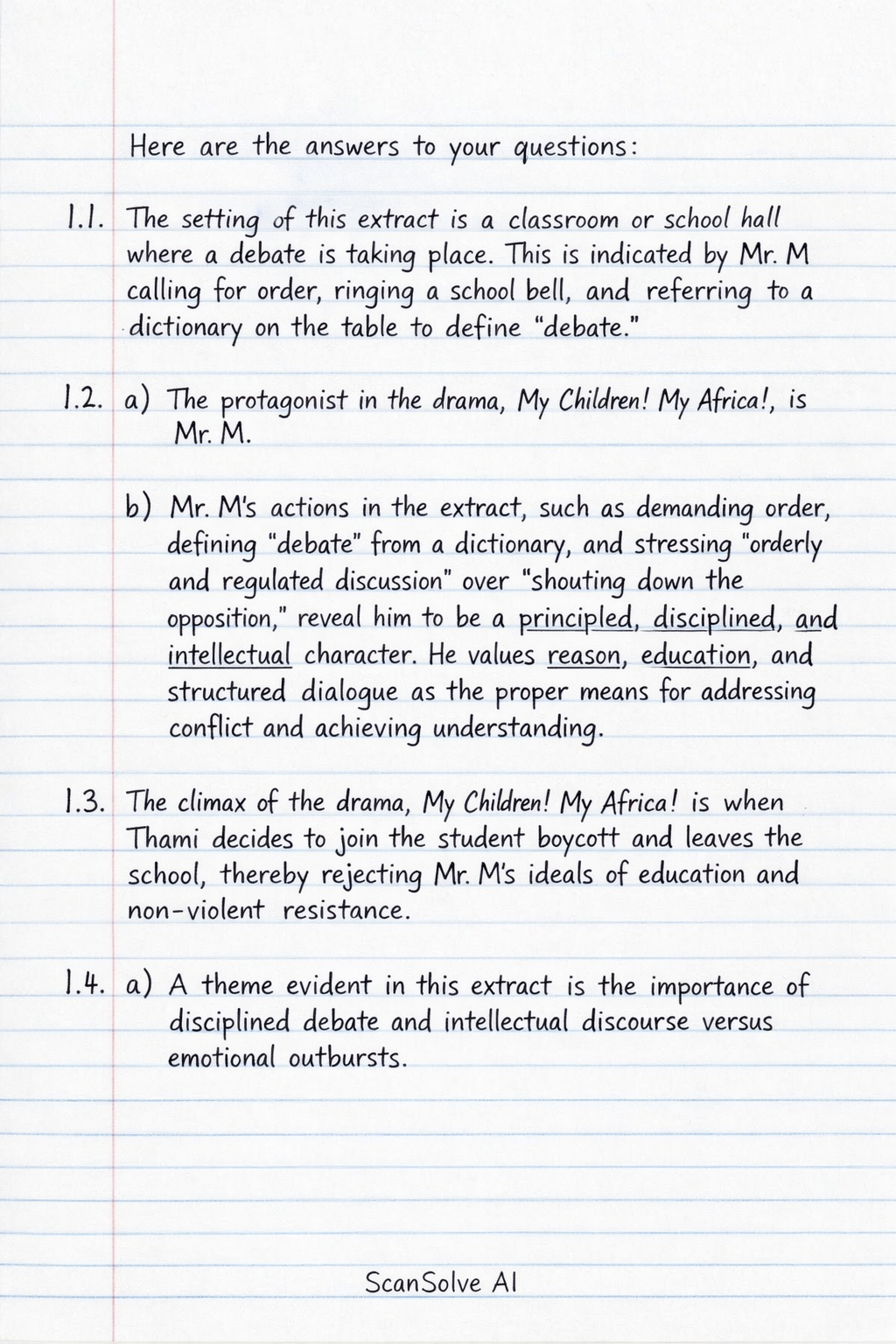
Here are the answers to your questions:
1.1. The setting of this extract is a classroom or school hall where a debate is taking place. This is indicated by Mr. M calling for order, ringing a school bell, and referring to a dictionary on the table to define "debate."
1.2. a) The protagonist in the drama, My Children! My Africa!, is Mr. M.
b) Mr. M's actions in the extract, such as demanding order, defining "debate" from a dictionary, and emphasizing "orderly and regulated discussion" over "shouting down the opposition," reveal him to be a principled, disciplined, and intellectual character. He values reason, education, and structured dialogue as the proper means for addressing conflict and achieving understanding.
1.3. The climax of the drama My Children! My Africa! is when Thami decides to join the student boycott and leaves the school, thereby rejecting Mr. M's ideals of education and non-violent resistance.
1.4. a) A theme evident in this extract is the importance of disciplined debate and intellectual discourse versus emotional outbursts.
b) This theme is central to the entire drama. Mr. M consistently advocates for education, dialogue, and non-violent resistance as the path to liberation, representing an older, more patient ideology. In contrast, Thami and the youth become increasingly frustrated with this approach, believing that direct action and confrontation are necessary for change. The play explores the tragic consequences of this ideological clash between generations, where the pursuit of justice through different means ultimately leads to misunderstanding and violence.
1.5. Thami's anger with Mr. M stems from Mr. M's unwavering belief in education and non-violence as the primary tools for change, which Thami perceives as too slow and ineffective in the face of apartheid's injustices. Thami feels Mr. M does not understand the urgency and frustration of the youth.
- This anger causes Thami to reject Mr. M's teachings and join the student boycott, leading him to abandon his education and align with more radical activism.
- For Mr. M, Thami's rejection is a profound personal and ideological blow, making him feel isolated and that his life's work has been futile. This despair contributes to his tragic end, as he is ultimately killed by the community who view him as a traitor.
1.6. Yes, the title of the drama, My Children! My Africa!, strongly relates to the message of the book.
- "My Children!" reflects Mr. M's deep, paternalistic love and concern for the youth, particularly Thami and Isabel, whom he sees as his intellectual heirs and the future of the nation. He wants to guide them towards a better future.
- "My Africa!" signifies his profound love for his country and his vision for a liberated South Africa achieved through education and peaceful means.
- The title encapsulates the central conflict: Mr. M's struggle to impart his vision to "his children" for "his Africa," and the tragic failure of this vision as the youth choose a different, more violent path, leading to the destruction of both his ideals and ultimately, himself. It highlights the generational divide and the lament for a lost future.
Still stuck on this one?
Ask a follow-up, and the answer starts from this question.
More English Questions
Handwritten Step-by-Step Solution
Get this as a handwritten image on WhatsApp — like a tutor wrote it for you.
Try on WhatsApp