

This English question involves literary analysis, grammar, or writing skills. The detailed response below provides a well-structured answer with supporting evidence and clear explanations.
ScanSolve AI Answer
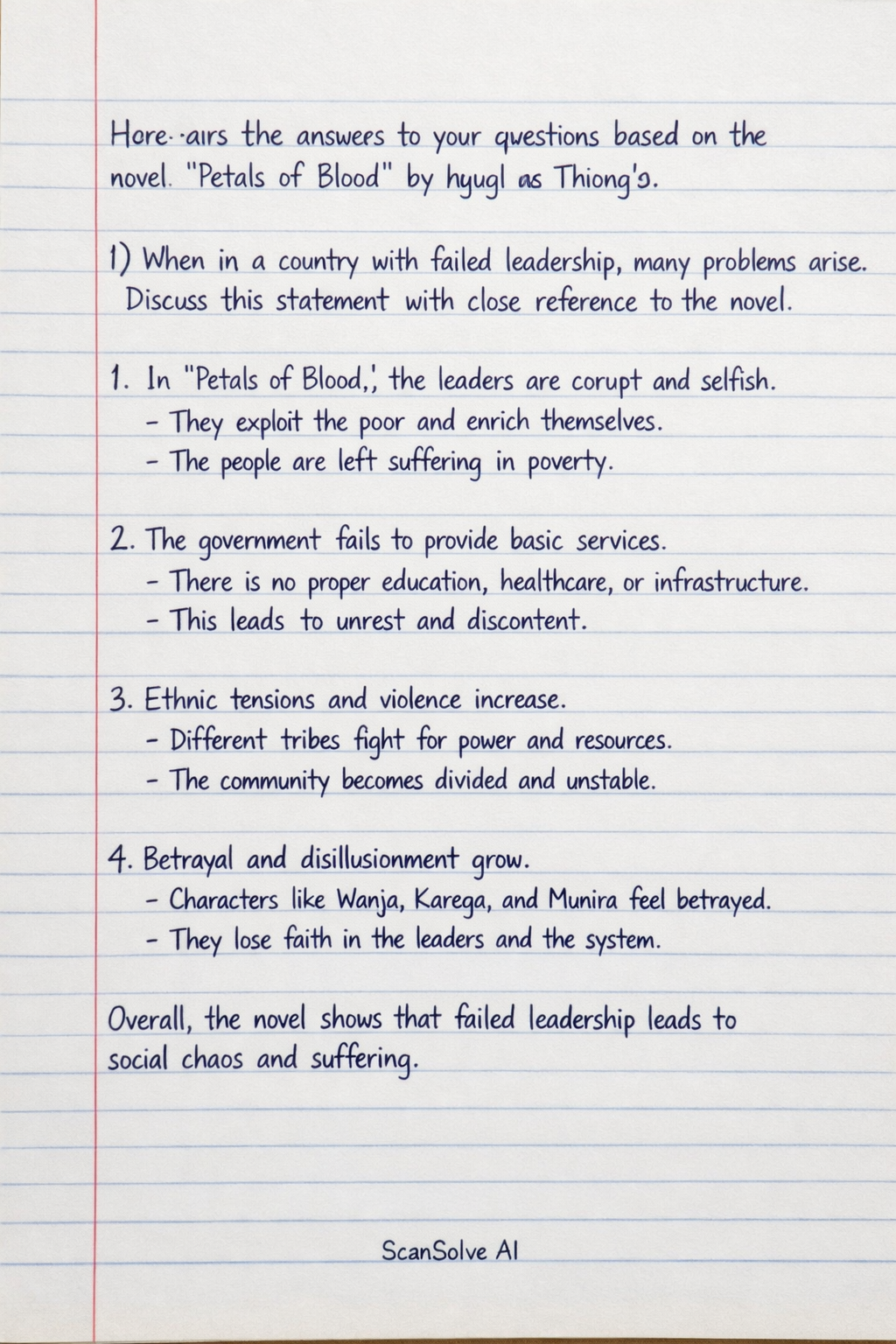
Here are the answers to your questions based on the novel Petals of Blood by Ngũgĩ wa Thiong'o. 1) When in a country with failed leadership, many problems arise. Discuss this statement with close reference to the novel. Petals of Blood vividly illustrates how failed leadership in post-independence Kenya leads to widespread suffering and societal decay. The novel portrays a ruling elite, represented by characters like Kimeria, Mchui, and Mzigo, who are self-serving and corrupt, perpetuating the exploitation that began under colonialism. These leaders prioritize personal wealth accumulation through land grabbing, unfair business practices, and political manipulation, neglecting the needs of the common people. This failed leadership results in the impoverishment of rural communities like Ilmorog, leading to drought, famine, and forced migration as people seek survival. The promises of independence are betrayed, replaced by a new form of oppression where the masses are exploited by their own countrymen, demonstrating that a lack of ethical and responsible governance inevitably breeds widespread social and economic problems. 2) Discuss how revenge influences characters such in the case of Munira or Wanja using examples from the text. Revenge is a powerful and destructive force that significantly influences several characters in Petals of Blood. Munira, driven by jealousy, resentment, and a twisted sense of moral righteousness, seeks retribution against Karega and Wanja. His long-standing envy of Karega's charisma and his unrequited desire for Wanja culminate in his act of setting fire to the brewery, believing he is purging immorality and enacting divine justice. This act of revenge, fueled by his personal failures and religious fanaticism, leads to the deaths of Kimeria, Mchui, and Mzigo. Similarly, Wanja is influenced by a desire for revenge against the men who have exploited and betrayed her throughout her life, particularly Kimeria and Munira. Her transformation from a victim to an active participant in the brewery fire can be seen as an act of reclaiming agency and exacting vengeance against the symbols of her oppression and the patriarchal system that commodified her. Both characters' actions, though stemming from different motivations, highlight how revenge can lead to drastic and often tragic consequences. 3) Greed is dehumanizing. Drawing illustrations from the text, write an essay supporting this statement. Greed is a central theme in Petals of Blood, depicted as a profoundly dehumanizing force that corrupts individuals and society. The novel illustrates how the insatiable desire for wealth and power strips characters of their empathy, morality, and ultimately, their humanity. The triumvirate of Kimeria, Mchui, and Mzigo epitomizes this dehumanization. Their relentless pursuit of profit leads them to exploit the land and labor of the people of Ilmorog, turning fertile ground into barren fields and human beings into mere cogs in their capitalist machinery. They engage in land grabbing, establish exploitative businesses like the brewery, and manipulate political systems, all for personal gain. This greed blinds them to the suffering they inflict, reducing their fellow citizens to disposable resources. Furthermore, greed fosters a culture of betrayal and moral decay. Kimeria's betrayal of his Mau Mau comrades, including Abdulla, for personal advancement, demonstrates how greed can sever bonds of loyalty and solidarity. The commodification of human relationships is also evident, particularly through Wanja's experiences, where her body and labor are treated as commodities by greedy men, stripping her of dignity and agency. The pursuit of material wealth replaces traditional communal values, leading to a breakdown of social cohesion and a sense of alienation among the populace. The novel suggests that when individuals are consumed by greed, they lose their capacity for compassion and justice, becoming mere instruments of their own avarice, thereby illustrating the profound dehumanizing impact of this vice on both the individual and the collective. Send me the next one 📸