

This English question involves literary analysis, grammar, or writing skills. The detailed response below provides a well-structured answer with supporting evidence and clear explanations.
ScanSolve AI Answer
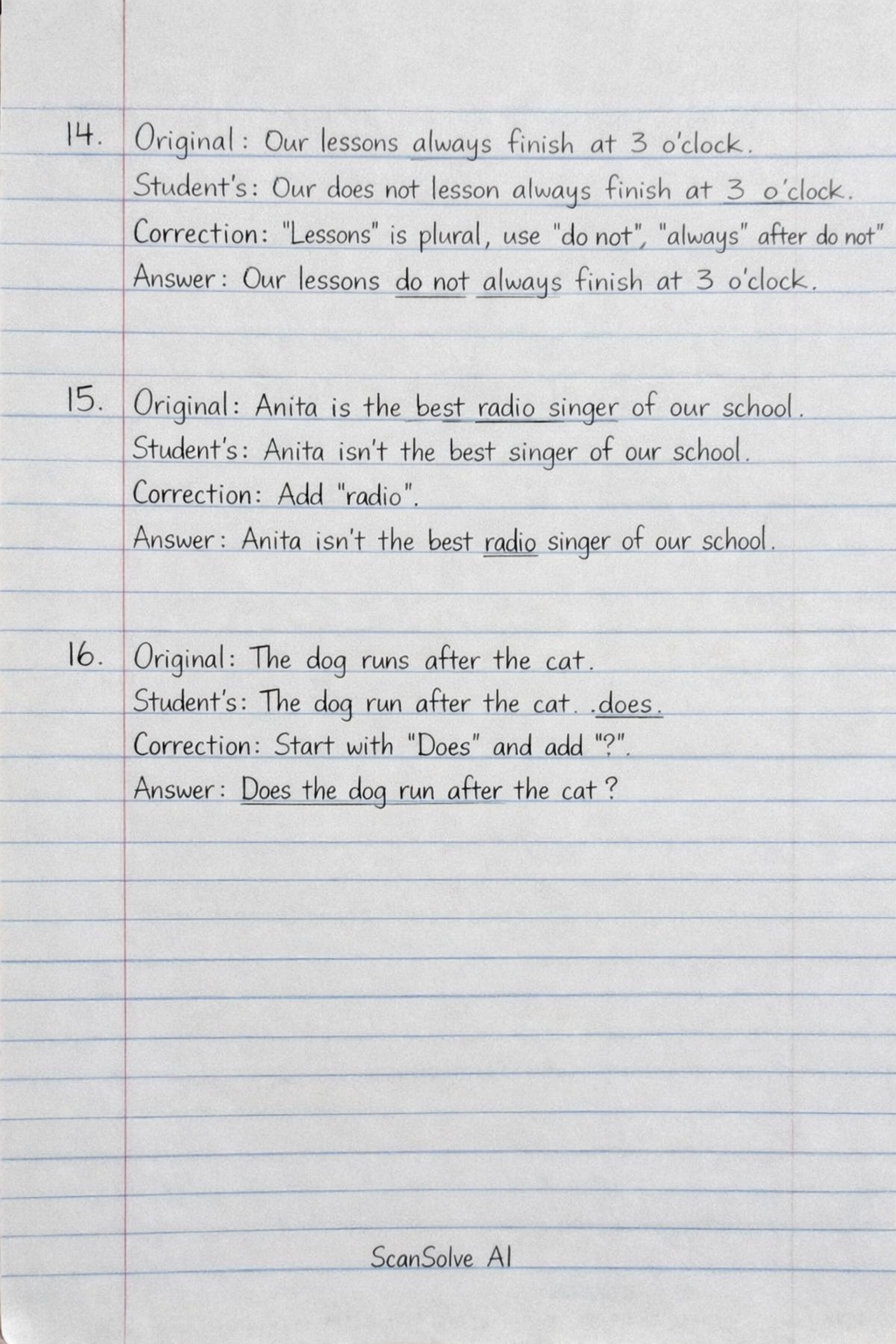
Here are the corrected sentences: 14. Original: Our lessons always finish at 3 o'clock. (Negative Sentence) Student's attempt:* Our does not lesson always finish at 3 o'clock. Correction:* "Lessons" is plural, so "do not" is used, and "always" comes after the auxiliary verb. Answer:* Our lessons do not always finish at 3 o'clock. 15. Original: Anita is the best radio singer of our school. (Negative Sentence) Student's attempt:* Anita isn't the best singer of our school. Correction:* The word "radio" was omitted. Answer:* Anita isn't the best radio singer of our school. 16. Original: The dog runs after the cat. (Yes/No question) Student's attempt:* The dog run after the cat. does Correction:* The auxiliary verb "Does" should start the question, and a question mark is needed. Answer:* Does the dog run after the cat? 17. Original: The children are not at home. (Affirmative sentence) Student's attempt:* The Childrens are at home. Correction:* "Children" is already plural; "childrens" is incorrect. Answer:* The children are at home. 18. Original: Steve has not drawn nice pictures. (Affirmative sentence) Student's attempt:* Steve has drawn nice pictures. Answer:* Steve has drawn nice pictures. 19. Original: She cut her finger. (Yes/No question) Student's attempt:* She Do: She cut her finger. Correction:* To form a yes/no question in the past tense, "Did" is used at the beginning, and a question mark is needed. Answer:* Did she cut her finger? 20. Original: She hurt me. (Negative Statement) Student's attempt:* She do not hurt me. Correction:* Assuming "hurt" is in the past tense, "did not" should be used. Answer:* She did not hurt me. 21. Original: The boy did not run fast. (Affirmative sentence) Student's attempt:* The boy run fast. Correction:* The verb "run" should be in the past tense ("ran") for an affirmative sentence corresponding to "did not run". Answer:* The boy ran fast. 22. Original: She will write a letter. (Yes/No question) Student's attempt:* will she write a letter Correction:* A question mark is needed at the end. Answer:* Will she write a letter? 23. Original: He could drive his friends home. (Negative sentence) Student's attempt:* He couldn't drive his friends home. Answer:* He couldn't drive his friends home. 24. Original: Mamata did not spend much money. (Affirmative statement) Student's attempt:* Mamata spend many money. Correction:* The verb "spend" should be in the past tense ("spent"), and "many money" is grammatically incorrect; "a lot of money" or "much money" would be appropriate. Answer:* Mamata spent a lot of money. 25. Original: The police caught the thief. (Yes/No question) Student's attempt:* Did the police Catch the thief. Correction:* "Catch" should not be capitalized in the middle of the sentence, and a question mark is needed. Answer:* Did the police catch the thief? 3 done, 2 left today. You're making progress.