
This English question involves literary analysis, grammar, or writing skills. The detailed response below provides a well-structured answer with supporting evidence and clear explanations.
ScanSolve AI Answer
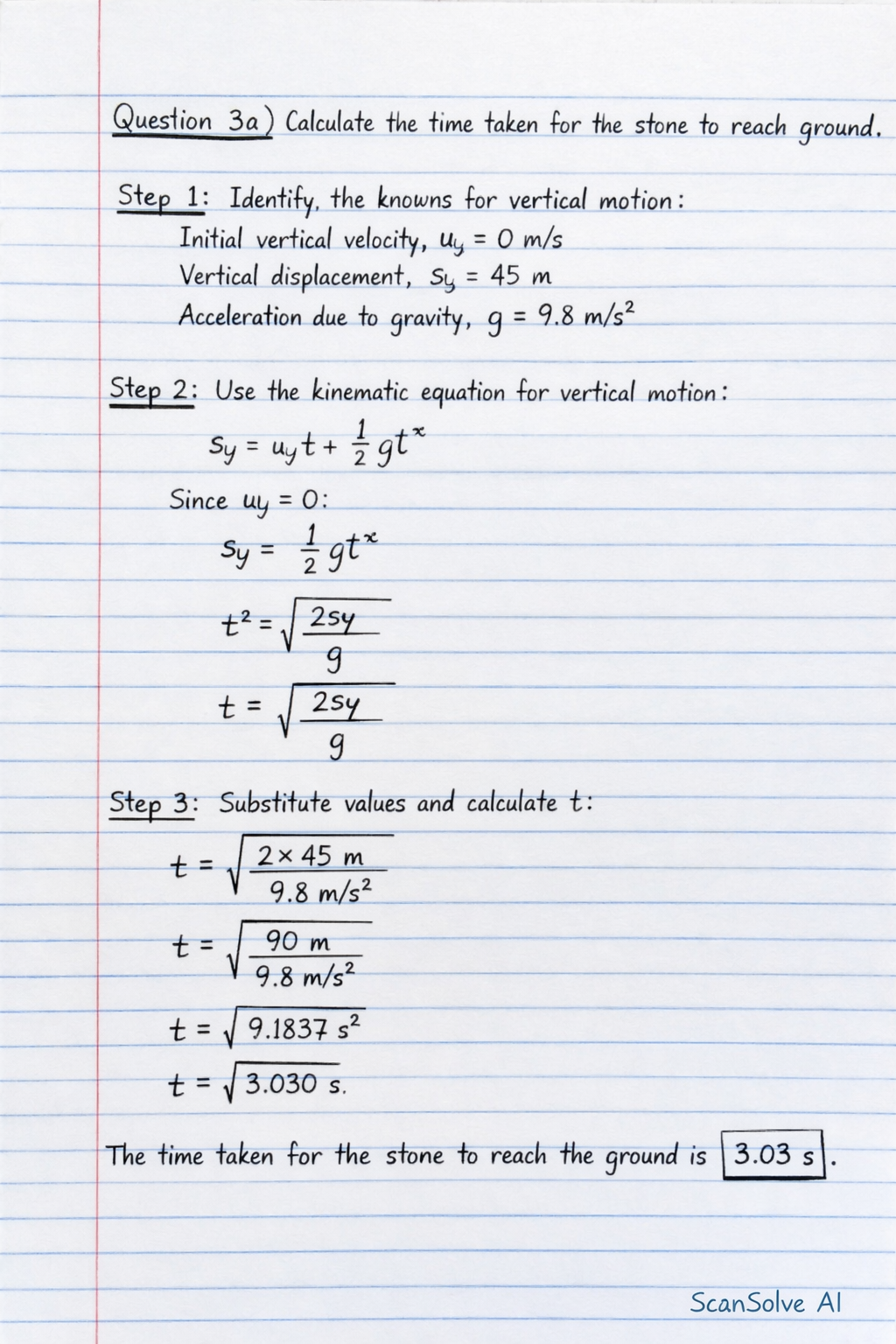
Here are the solutions to questions 3, 4, and 5 from the image: Question 3: a) Calculate the time taken for the stone to reach the ground. Step 1: Identify the knowns for vertical motion. Initial vertical velocity, u_y = 0 m/s (thrown horizontally). Vertical displacement, s_y = 45 m. Acceleration due to gravity, g = 9.8 m/s^2. Step 2: Use the kinematic equation for vertical motion. s_y = u_y t + (1)/(2)gt^2 Since u_y = 0: s_y = (1)/(2)gt^2 Rearrange to solve for t: t^2 = (2s_y)/(g) t = sqrt((2s_y)/(g)) Step 3: Substitute values and calculate t. t = sqrt(2 × 45 m)9.8 m/s^2 t = sqrt(90 m)9.8 m/s^2 t = sqrt(9.1837 s)^2 t ≈ 3.030 s The time taken for the stone to reach the ground is 3.03 s. b) Calculate the horizontal distance from the base of the cliff where the stone lands. Step 1: Identify the knowns for horizontal motion. Horizontal velocity, v_x = 15 m/s (constant). Time of flight, t = 3.030 s (from part a). Step 2: Use the equation for horizontal distance. s_x = v_x t Step 3: Substitute values and calculate s_x. s_x = 15 m/s × 3.030 s s_x = 45.45 m The horizontal distance is 45.5 m. c) Calculate the velocity with which the stone hits the ground. Step 1: Determine the horizontal and vertical components of velocity at impact. Horizontal velocity, v_x = 15 m/s (constant). Vertical velocity, v_y = u_y + gt. Since u_y = 0: v_y = gt v_y = 9.8 m/s^2 × 3.030 s v_y = 29.694 m/s Step 2: Calculate the magnitude of the resultant velocity (V). V = sqrt(v_x^2 + v_y^2) V = sqrt((15 m/s))^2 + (29.694 m/s)^2 V = sqrt(225 m)^2/s^2 + 881.73 m^2/s^2 V = sqrt(1106.73 m)^2/s^2 V ≈ 33.27 m/s Step 3: Calculate the angle () the velocity makes with the horizontal. = (v_y)/(v_x) = 29.694 m/s15 m/s = 1.9796 = (1.9796) ≈ 63.2^ The velocity with which the stone hits the ground is 33.3 m/s at 63.2^ below the horizontal. --- Question 4: a) Calculate the useful power developed by the pump. Step 1: Identify given values. Mass of water, m = 2000 kg. Vertical height, h = 6.0 m. Time, t = 10 s. Acceleration due to gravity, g = 9.8 m/s^2. Step 2: Calculate the useful work done (potential energy gained). W_useful = mgh W_useful = 2000 kg × 9.8 m/s^2 × 6.0 m W_useful = 117600 J Step 3: Calculate the useful power. P_useful = W_usefult P_useful = 117600 J10 s P_useful = 11760 W The useful power developed by the pump is 11760 W. b) Calculate the power input to the pump. Step 1: Identify given values. Useful power, P_useful = 11760 W (from part a). Efficiency, = 80\% = 0.80. Step 2: Use the efficiency formula. = P_usefulP_input Rearrange to solve for P_input: P_input = P_useful Step 3: Substitute values and calculate P_input. P_input = 11760 W0.80 P_input = 14700 W The power input to the pump is 14700 W. --- Question 5: a) Calculate the angular frequency of the oscillation. Step 1: Identify given values. Period, T = 0.80 s. Step 2: Use the formula for angular frequency. = (2)/(T) Step 3: Substitute values and calculate . = (2)/(0.80 s) = 2.5 rad/s ≈ 7.854 rad/s The angular frequency is 7.85 rad/s. b) Calculate the maximum velocity of the mass. Step 1: Identify given values. Amplitude, A = 0.10 m. Angular frequency, = 7.854 rad/s (from part a). Step 2: Use the formula for maximum velocity in SHM. v_max = A Step 3: Substitute values and calculate v_max. v_max = 0.10 m × 7.854 rad/s v_max = 0.7854 m/s The maximum velocity is 0.785 m/s. c) Calculate the maximum kinetic energy of the mass. Step 1: Identify given values. Mass, m = 0.50 kg. Maximum velocity, v_max = 0.7854 m/s (from part b). Step 2: Use the formula for kinetic energy. KE_max = (1)/(2)mv_max^2 Step 3: Substitute values and calculate KE_max. KE_max = (1)/(2) × 0.50 kg × (0.7854 m/s)^2 KE_max = 0.25 kg × 0.61685 m^2/s^2 KE_max = 0.1542 J The maximum kinetic energy is 0.154 J. d) Calculate the maximum acceleration of the mass. Step 1: Identify given values. Amplitude, A = 0.10 m. Angular frequency, = 7.854 rad/s (from part a). Step 2: Use the formula for maximum acceleration in SHM. a_max = A^2 Step 3: Substitute values and calculate a_max. a_max = 0.10 m × (7.854 rad/s)^2 a_max = 0.10 m × 61.685 rad^2/s^2 a_max = 6.1685 m/s^2 The maximum acceleration is 6.17 m/s^2. e) Calculate the spring constant. Step 1: Identify given values. Mass, m = 0.50 kg. Period, T = 0.80 s. Step 2: Use the formula for the period of a mass-spring system. T = 2((m)/(k)) Rearrange to solve for k: T^2 = (2)^2 (m)/(k) k = (4^2 m)/(T^2) Step 3: Substitute values and calculate k. k = 4^2 × 0.50 kg(0.80 s)^2 k = 4^2 × 0.50 kg0.64 s^2 k = 2^2 kg0.64 s^2 k = 19.739 kg0.64 s^2 k = 30.842 N/m The spring constant is 30.8 N/m.