Solve 3 (b) (i) Ammeter reading when key K is open.

English
Solve 3 (b) (i) Ammeter reading when key K is open.

ScanSolve AI Answer

Answer

10 , \Omega

Hey Small, good to see you again.

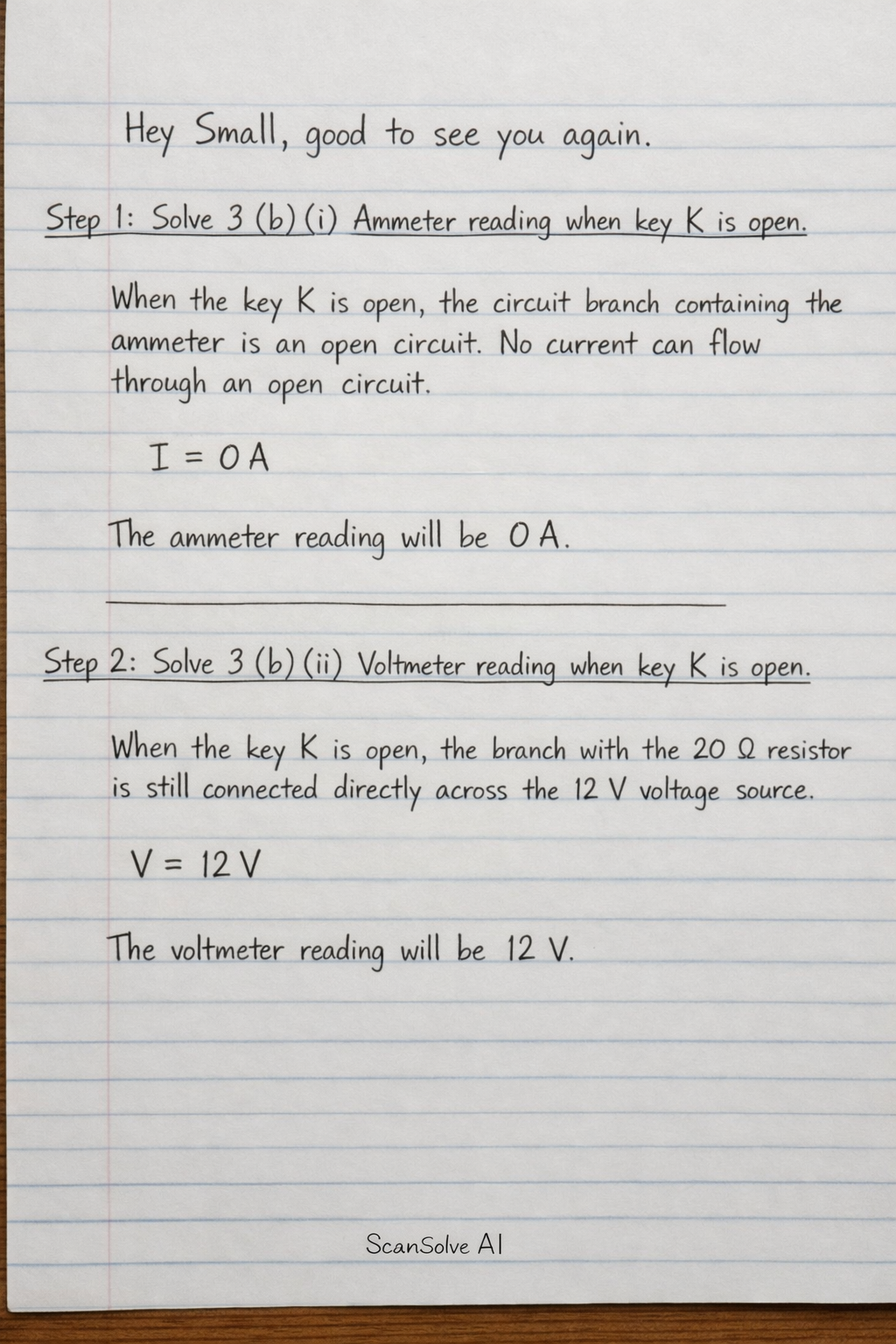
Step 1: Solve 3 (b) (i) Ammeter reading when key K is open. When the key K is open, the circuit branch containing the ammeter is an open circuit. No current can flow through an open circuit. The ammeter reading will be 0A0 \, \text{A}.

Step 2: Solve 3 (b) (ii) Voltmeter reading when key K is open. When the key K is open, the branch with the 20 Ω\Omega resistor is still connected directly across the 12 V voltage source. Therefore, the voltage across the 20 Ω\Omega resistor is the source voltage. The voltmeter reading will be 12V12 \, \text{V}.

Step 3: Solve 3 (c) Combined resistance when key K is closed. The circuit diagram shows two resistors in parallel. One resistor is 20 Ω\Omega. The other resistor (in the branch with the switch and ammeter) has no value indicated. We will assume this unlabeled resistor is also 20Ω20 \, \Omega for the calculation. When the key K is closed, the two 20Ω20 \, \Omega resistors are in parallel. The combined resistance (ReqR_{eq}) for two parallel resistors is given by: Req=R1×R2R1+R2R_{eq} = \frac{R_1 \times R_2}{R_1 + R_2} Substituting the values: Req=20Ω×20Ω20Ω+20Ω=400Ω240Ω=10ΩR_{eq} = \frac{20 \, \Omega \times 20 \, \Omega}{20 \, \Omega + 20 \, \Omega} = \frac{400 \, \Omega^2}{40 \, \Omega} = 10 \, \Omega The combined resistance of the circuit is 10Ω\boxed{*10 \, \Omega*} (assuming the unlabeled resistor is 20Ω20 \, \Omega).

Step 4: Solve 3 (d) Ammeter reading when key K is closed. Assuming the resistor in the ammeter branch is 20Ω20 \, \Omega, and the key K is closed, the voltage across this parallel branch is 12V12 \, \text{V}. The current (II) through this branch is given by Ohm's Law: I=VRI = \frac{V}{R} Substituting the values: I=12V20Ω=0.6AI = \frac{12 \, V}{20 \, \Omega} = 0.6 \, \text{A} The ammeter reading will be 0.6A\boxed{*0.6 \, A*} (assuming the unlabeled resistor is 20Ω20 \, \Omega).

Step 5: Solve 3 (e) (i) Equivalence of 1 kWh in joules. 1 kilowatt-hour (kWh) is a unit of energy. 1kWh=1kW×1h1 \, kWh = 1 \, kW \times 1 \, \text{h} Convert kilowatts to watts and hours to seconds: 1kW=1000W1 \, kW = 1000 \, \text{W} 1h=3600s1 \, h = 3600 \, \text{s} 1kWh=1000W×3600s=3,600,000J1 \, kWh = 1000 \, W \times 3600 \, s = 3,600,000 \, \text{J} 1 \, kWh = \text{*3.6 \times 10^6 \, J*}

Step 6: Solve 3 (e) (ii) Calculate the cost of electricity. First, calculate the total power consumption: Power of cooker = 1000W=1kW1000 \, W = 1 \, \text{kW} Power of immersion heater = 300W=0.3kW300 \, W = 0.3 \, \text{kW} Total power = 1kW+0.3kW=1.3kW1 \, kW + 0.3 \, kW = 1.3 \, \text{kW} Next, calculate the total energy consumed per day: Energy = Total power ×\times Time Energy = 1.3kW×10h=13kWh1.3 \, kW \times 10 \, h = 13 \, \text{kWh} Finally, calculate the total cost: Cost = Energy consumed ×\times Cost per kWh Cost = 13kWh×75frs/kWh=975frs13 \, kWh \times 75 \, frs/kWh = 975 \, \text{frs} The cost of electricity used is 975frs\boxed{*975 \, frs*}

Step 7: Solve 4 (a) (i) Two properties of plastics useful as engineering materials. Two properties of plastics that make them useful as engineering materials are: • They are lightweight with a high strength-to-weight ratio.

Was this helpful?

Need help with your own homework?

Get instant step-by-step solutions to any question. Free to start.

Ask Your Question
Handwritten step-by-step solution preview

Handwritten Step-by-Step Solution

Get this as a handwritten image on WhatsApp — like a tutor wrote it for you.

Try on WhatsApp

Still have questions?

Quick Answer

Hey Small, good to see you again. Step 1: Solve 3 (b) (i) Ammeter reading when key K is open.

Solve 3 (b) (i) Ammeter reading when key K is open.
English

This English question involves literary analysis, grammar, or writing skills. The detailed response below provides a well-structured answer with supporting evidence and clear explanations.

ScanSolve AI Answer
Hey Small, good to see you again. Step 1: Solve 3 (b) (i) Ammeter reading when key K is open. When the key K is open, the circuit branch containing the ammeter is an open circuit. No current can flow through an open circuit. The ammeter reading will be 0 \, A. Step 2: Solve 3 (b) (ii) Voltmeter reading when key K is open. When the key K is open, the branch with the 20 resistor is still connected directly across the 12 V voltage source. Therefore, the voltage across the 20 resistor is the source voltage. The voltmeter reading will be 12 \, V. Step 3: Solve 3 (c) Combined resistance when key K is closed. The circuit diagram shows two resistors in parallel. One resistor is 20 . The other resistor (in the branch with the switch and ammeter) has no value indicated. We will assume this unlabeled resistor is also 20 \, for the calculation. When the key K is closed, the two 20 \, resistors are in parallel. The combined resistance (R_eq) for two parallel resistors is given by: R_eq = (R_1 × R_2)/(R_1 + R_2) Substituting the values: R_eq = (20 \, × 20 \, )/(20 \, + 20 \, ) = (400 \, ^2)/(40 \, ) = 10 \, The combined resistance of the circuit is 10 \, (assuming the unlabeled resistor is 20 \, ). Step 4: Solve 3 (d) Ammeter reading when key K is closed. Assuming the resistor in the ammeter branch is 20 \, , and the key K is closed, the voltage across this parallel branch is 12 \, V. The current (I) through this branch is given by Ohm's Law: I = (V)/(R) Substituting the values: I = 12 \, V20 \, = 0.6 \, A The ammeter reading will be 0.6 \, A (assuming the unlabeled resistor is 20 \, ). Step 5: Solve 3 (e) (i) Equivalence of 1 kWh in joules. 1 kilowatt-hour (kWh) is a unit of energy. 1 \, kWh = 1 \, kW × 1 \, h Convert kilowatts to watts and hours to seconds: 1 \, kW = 1000 \, W 1 \, h = 3600 \, s 1 \, kWh = 1000 \, W × 3600 \, s = 3,600,000 \, J 1 \, kWh = 3.6 × 10^6 \, J Step 6: Solve 3 (e) (ii) Calculate the cost of electricity. First, calculate the total power consumption: Power of cooker = 1000 \, W = 1 \, kW Power of immersion heater = 300 \, W = 0.3 \, kW Total power = 1 \, kW + 0.3 \, kW = 1.3 \, kW Next, calculate the total energy consumed per day: Energy = Total power × Time Energy = 1.3 \, kW × 10 \, h = 13 \, kWh Finally, calculate the total cost: Cost = Energy consumed × Cost per kWh Cost = 13 \, kWh × 75 \, frs/kWh = 975 \, frs The cost of electricity used is 975 \, frs Step 7: Solve 4 (a) (i) Two properties of plastics useful as engineering materials. Two properties of plastics that make them useful as engineering materials are: • They are lightweight with a high strength-to-weight ratio.