
We read your photo as:
Identify all the stylistic and sound patterns in the poem (10 mks)
English
ScanSolve AI Answer
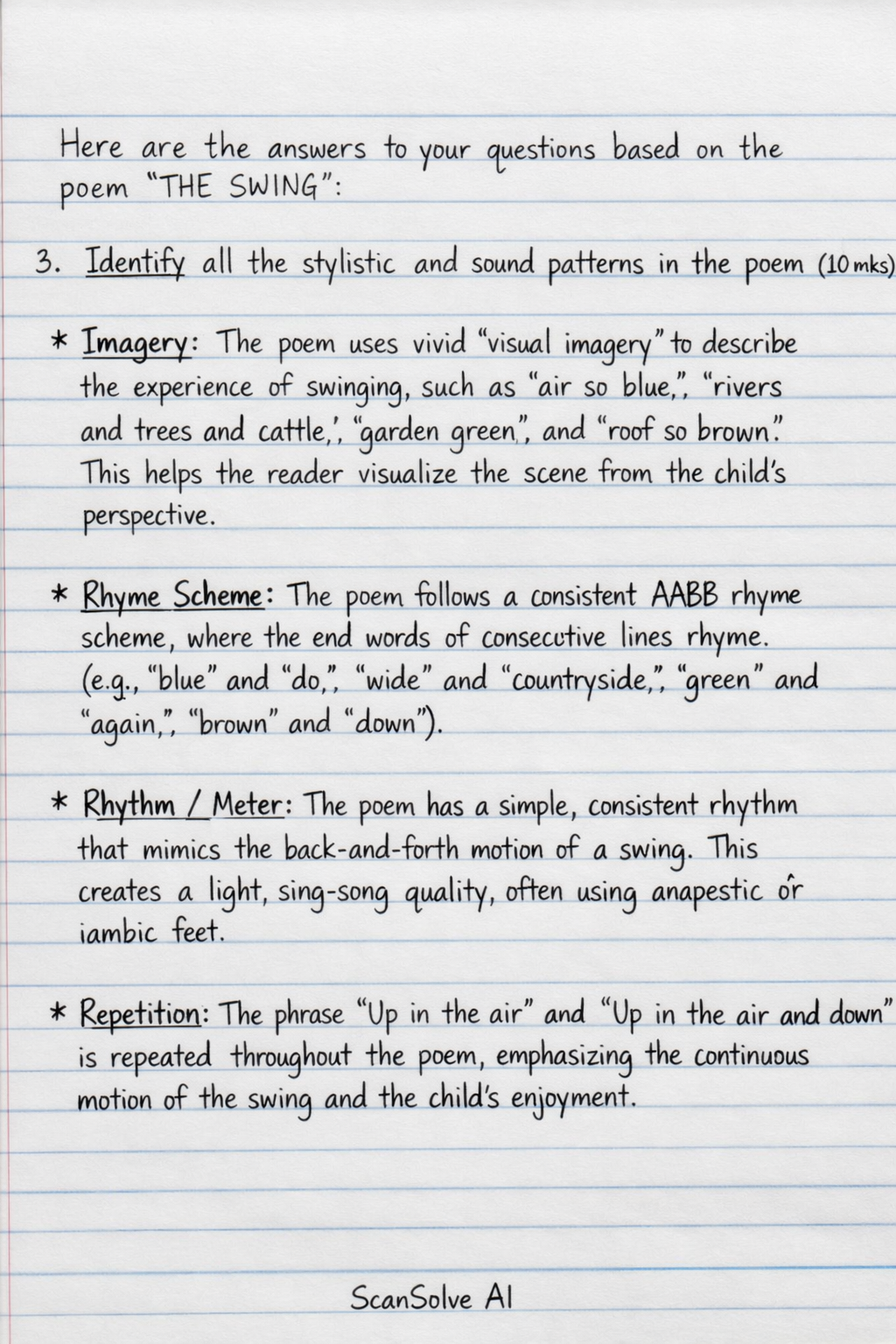
Here are the answers to your questions based on the poem "THE SWING":
-
Identify all the stylistic and sound patterns in the poem (10 mks)
- Imagery: The poem uses vivid visual imagery to describe the experience of swinging, such as "air so blue," "rivers and trees and cattle," "garden green," and "roof so brown." This helps the reader visualize the scene from the child's perspective.
- Rhyme Scheme: The poem follows a consistent AABB rhyme scheme, where the end words of consecutive lines rhyme (e.g., "blue" and "do," "wide" and "countryside," "green" and "again," "brown" and "down").
- Rhythm/Meter: The poem has a simple, consistent rhythm that mimics the back-and-forth motion of a swing. This creates a light, sing-song quality, often using anapestic or iambic feet.
- Repetition: The phrase "Up in the air" and "Up in the air and down" is repeated throughout the poem, emphasizing the continuous motion of the swing and the child's enjoyment.
- Alliteration: There are instances of alliteration, such as "pleasantest thing" and "garden green," where initial consonant sounds are repeated, adding to the musicality of the poem.
- Assonance: The poem also uses assonance, the repetition of vowel sounds within words, like in "blue" and "do," or "wide" and "countryside," contributing to the poem's flow and sound.
- Exaggeration/Hyperbole: The line "Oh, I do think it the pleasantest thing / Ever a child can do!" uses hyperbole to emphasize the immense joy and delight the speaker feels while swinging.
-
What is the overall feeling or mood of the poem? (2 mks) The overall feeling or mood of the poem is one of joy, exhilaration, and childlike wonder. It conveys a sense of freedom and delight experienced by the speaker.
-
Who is speaking in the poem? (1 mks) The speaker in the poem is a .
Was this helpful?
Still stuck on this one?
Ask a follow-up, and the answer starts from this question.
Got a different question?Ask your own question
More English Questions
QAnalyze the poem's setting, stylistic devices, key lines, and themes.QAnalyze the setting, stylistic devices, specific lines, and themes in the provided poem excerpt.QAnalyze the poem for rhyme, sound devices (alliteration, assonance), and homophones. Provide…QAnalyze this poem: a) Give a suitable title. b) Identify the tone. c) Find two figures of speech. d)…QIdentify and analyze the literary devices used in the provided poem excerpt, focusing on repetition…
Browse by topic:Literature
Handwritten Step-by-Step Solution
Get this as a handwritten image on WhatsApp — like a tutor wrote it for you.
Try on WhatsApp