
We read your photo as:
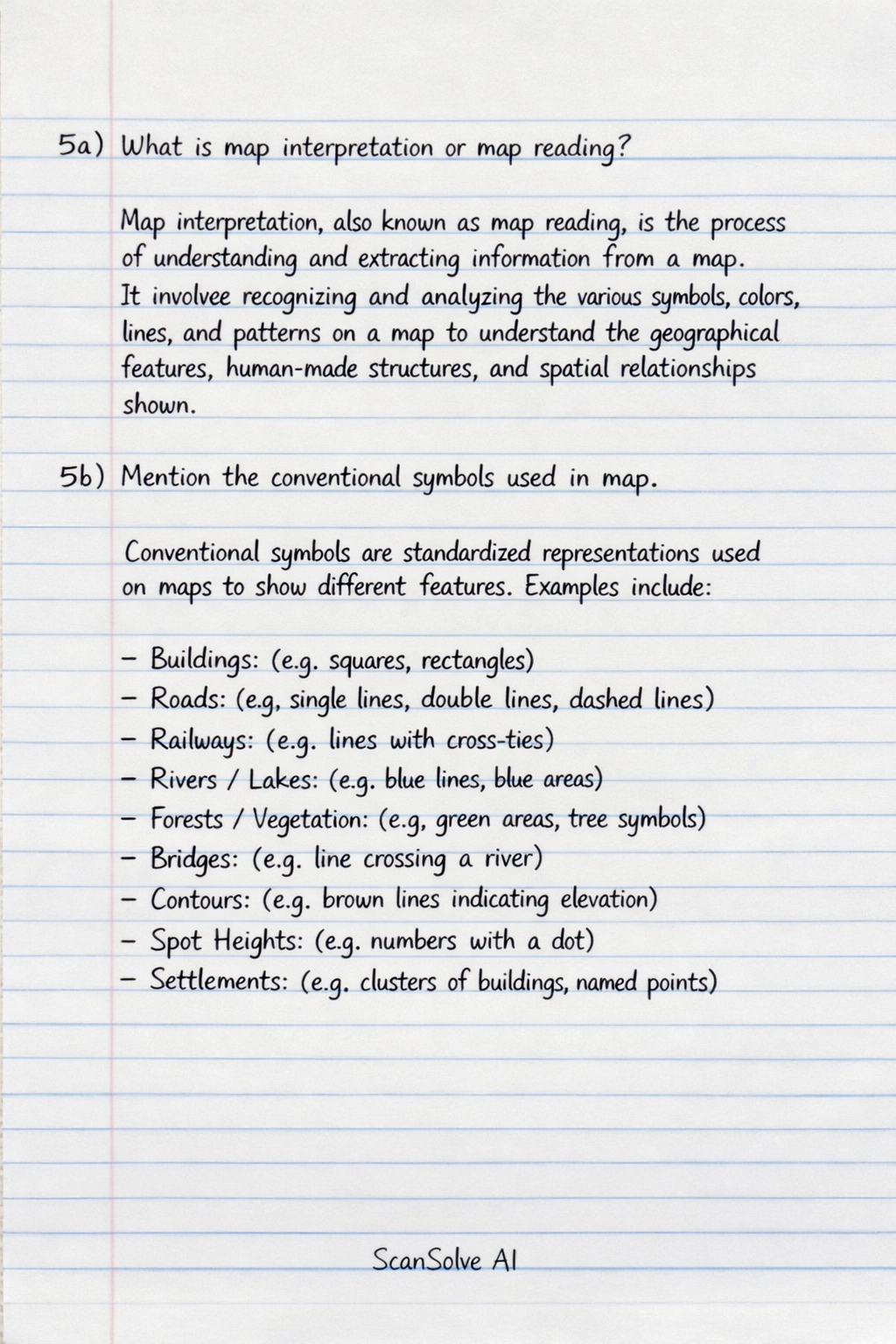
5a) What is map interpretation or map reading?
ScanSolve AI Answer
Here are the answers to your questions:
5a) What is map interpretation or map reading?
Map interpretation, also known as map reading, is the process of understanding and extracting information from a map. It involves recognizing and analyzing the various symbols, colors, lines, and patterns on a map to comprehend the geographical features, human-made structures, and spatial relationships represented.
5b) Mention the conventional symbols used in map.
Conventional symbols are standardized graphical representations used on maps to depict various features. Examples include:
- Buildings (e.g., squares, rectangles)
- Roads (e.g., single lines, double lines, dashed lines)
- Railways (e.g., lines with cross-ties)
- Rivers/Lakes (e.g., blue lines, blue areas)
- Forests/Vegetation (e.g., green areas, tree symbols)
- Bridges (e.g., line crossing a river with a break)
- Contours (e.g., brown lines indicating elevation)
- Spot heights (e.g., numbers with a dot indicating exact elevation)
- Settlements (e.g., clusters of buildings, named points)
- Boundaries (e.g., dashed or dotted lines)
5c) List the types of map you know.
Some common types of maps include:
- Topographic maps: Show detailed surface features, including elevation.
- Political maps: Show governmental boundaries of countries, states, and cities.
- Physical maps: Show natural landscape features like mountains, rivers, and lakes.
- Thematic maps: Focus on a specific theme or topic, such as population density, climate, or economic activity.
- Road maps: Show roads and highways for navigation.
- Cadastral maps: Show property boundaries and ownership.
- Climatic maps: Show weather patterns and climate zones.
- Geological maps: Show the distribution of different rock types and geological structures.
5d) Define scale and mention the different types of scale with exam.
-
Scale is the ratio between a distance on a map and the corresponding distance on the ground. It indicates how much the real world has been reduced to fit on the map.
-
Types of Scale:
- Statement Scale (Verbal Scale): Expressed in words.
- Example: "1 cm to 10 km" means 1 centimeter on the map represents 10 kilometers on the ground.
- Representative Fraction (RF Scale): Expressed as a ratio or fraction.
- Example: "1:50,000" or means one unit of distance on the map represents 50,000 of the same units on the ground (e.g., 1 cm on map = 50,000 cm on ground).
- Graphic Scale (Bar Scale): A line or bar divided into segments, with each segment representing a specific distance on the ground.
- Example: A bar scale might show a segment labeled "0 - 10 km," allowing direct measurement of distances on the map.
- Statement Scale (Verbal Scale): Expressed in words.
6a) What is GPS and list different types of GPS you know.
-
GPS (Global Positioning System) is a satellite-based navigation system that provides location, velocity, and time synchronization information to a GPS receiver anywhere on Earth where there is an unobstructed line of sight to four or more GPS satellites.
-
Types of GPS (referring to components/segments or broader GNSS):
- Space Segment: Consists of the constellation of satellites orbiting Earth.
- Control Segment: Comprises ground stations that monitor and control the satellites.
- User Segment: Includes all GPS receivers used by individuals and organizations.
- Broader Global Navigation Satellite Systems (GNSS) include:
- GLONASS (Russia)
- Galileo (European Union)
- BeiDou (China)
- QZSS (Japan)
- IRNSS/NavIC (India)
6b) Mention ten (10) application area of GPS.
- Navigation (cars, ships, aircraft, personal)
- Surveying and Mapping (creating accurate maps and land surveys)
- Geocaching (outdoor recreational activity)
- Emergency Services (locating 911/112 callers, dispatching aid)
- Agriculture (precision farming, crop monitoring)
- Environmental Monitoring (tracking wildlife, climate research)
- Disaster Relief (coordinating aid, mapping affected areas)
- Logistics and Fleet Management (tracking vehicles, optimizing routes)
- Timing and Synchronization (for telecommunications, power grids)
- Recreation (hiking, cycling, fishing)
6c) List Global Positioning System (GPS) equipment.
- GPS Receiver: The primary device that receives signals from satellites (e.g., handheld GPS units, car navigation systems, smartphones, smartwatches).
- GPS Antenna: Part of the receiver that captures satellite signals.
- GPS Satellites: Orbiting spacecraft that transmit signals.
- Ground Control Stations: Facilities on Earth that monitor and control the satellites.
- Master Control Station (MCS): The central facility for managing the GPS system.
- Atomic Clocks: Highly accurate clocks used in satellites and ground stations for precise timing.
- Differential GPS (DGPS) Base Stations: Ground-based receivers that provide corrections to improve accuracy.
Still stuck on this one?
Ask a follow-up, and the answer starts from this question.
More English Questions
Handwritten Step-by-Step Solution
Get this as a handwritten image on WhatsApp — like a tutor wrote it for you.
Try on WhatsApp