ScanSolve logoScanSolve
Toggle sidebar
  • Homework
  • Tutor
  • Humanizer
  • AI Detector
  • Questions
  • Blog
  • History
  • Mobile App

  • Homework
  • Tutor
  • Humanizer
  • AI Detector

  • Questions
  • Math homework helpMath
    Physics homework helpPhysics
    Chemistry homework helpChemistry
    Biology homework helpBiology
    Computer Science homework helpComputer Science
    History homework helpHistory
    More homework helpMore
  • Blog
  • History

  • Mobile App
ScanSolvePLUS
  • Unlimited answers
  • ScanSolve AI Pro
Start Free Trial →
Try on WhatsApp
Home > English Homework Help > Solution

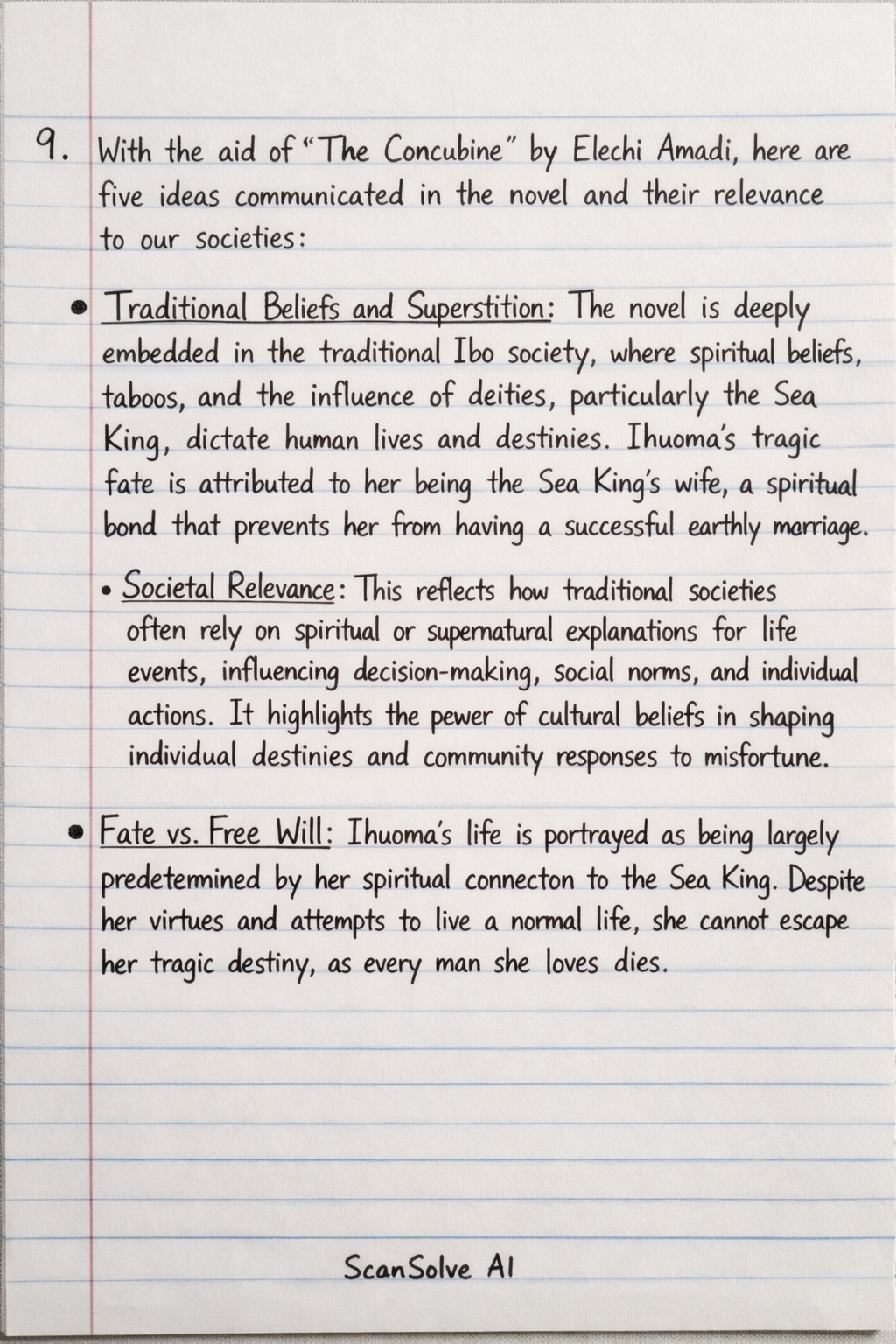
9. With the aid of "The Concubine" by Elechi Amadi, here are five ideas communicated in the novel and their relevance to our societies:

Asked on March 28, 2026|English

This English question involves literary analysis, grammar, or writing skills. The detailed response below provides a well-structured answer with supporting evidence and clear explanations.

ScanSolve AI AnswerAnswered on March 28, 2026
9. With the aid of "The Concubine" by Elechi Amadi, here are five ideas communicated in the novel and their relevance to our societies: Traditional Beliefs and Superstition: The novel is deeply embedded in the traditional Ibo society, where spiritual beliefs, taboos, and the influence of deities, particularly the Sea King, dictate human lives and destinies. Ihuoma's tragic fate is attributed to her being the Sea King's wife, a spiritual bond that prevents her from having a successful earthly marriage. Societal Relevance:* This reflects how traditional societies often rely on spiritual or supernatural explanations for life events, influencing decision-making, social norms, and individual actions. It highlights the power of cultural beliefs in shaping individual destinies and community responses to misfortune. Fate vs. Free Will: Ihuoma's life is portrayed as being largely predetermined by her spiritual connection to the Sea King. Despite her virtues and attempts to live a normal life, she cannot escape her tragic destiny, as every man she loves dies. Societal Relevance:* This explores the universal human question of whether individuals control their own lives or if external forces (divine, societal, or circumstantial) predetermine outcomes. It prompts reflection on personal responsibility versus the influence of forces beyond individual control. Gender Roles and Expectations: The novel depicts clear gender roles within the traditional Ibo community. Women like Ihuoma are expected to be virtuous, fertile, and dedicated to their families, while men are seen as providers and protectors. Societal Relevance:* This highlights historical and ongoing societal expectations placed on men and women, and how these roles can limit individual freedom, shape social structures, and influence personal choices regarding marriage, family, and social standing. Community and Social Cohesion: The village of Omokachi is presented as a close-knit community where collective well-being and adherence to communal norms are paramount. The community's response to Ihuoma's misfortunes and the various rituals underscore the importance of social harmony. Societal Relevance:* This illustrates the importance of community bonds, mutual support, and shared values in traditional societies. It shows how deviations from these norms, or events perceived as supernatural, can affect the entire community and its efforts to maintain order and stability. Love, Marriage, and Family: The novel explores the complexities of love and marriage within a traditional context, where family approval, fertility, and adherence to customs are crucial. Ihuoma's inability to sustain a marriage due to her spiritual bond causes immense suffering for her and her potential partners. Societal Relevance:* This reflects the enduring human themes of love and family, but within a framework where societal expectations, spiritual beliefs, and communal pressures often override individual desires, profoundly shaping marital choices and family dynamics. 11. As a literature taker, literature differs from other works of art in the following six ways: Medium: Literature primarily uses language* (written or spoken words) as its fundamental medium, allowing for the direct expression of thoughts and ideas. Other arts use visual forms (painting, sculpture), sound (music), or movement (dance). Linearity and Narrative: Literature often unfolds in a linear, sequential narrative* over time, guiding the reader through a story, argument, or emotional progression. Many other art forms, such as painting or sculpture, are often experienced spatially and simultaneously. Abstract vs. Concrete: While literature can be highly abstract, its primary tools (words) are inherently tied to specific meanings and concepts*. Visual arts, music, or dance can often convey emotions or ideas more abstractly, without explicit verbal definition. Reader's Imagination: Literature heavily relies on the reader's imagination* to visualize settings, characters, and actions based on textual descriptions. This active engagement is distinct from visual arts which directly present these elements. Direct Communication of Ideas: Literature is uniquely suited for the direct and explicit communication of complex ideas, philosophies, and arguments* through prose, poetry, and dialogue. While other arts can convey ideas, they often do so more implicitly or symbolically. Portability and Accessibility: Historically, literature (especially written texts) has been highly portable and reproducible*, allowing for widespread dissemination and individual engagement without requiring a specific performance or physical location like a gallery or stage.

Related English Questions

  • Your poem must only have 3 stanzas**.
  • A noun is a word that names a person, place, thing, or idea. For example, teacher, city, book, and happiness are all nou...
  • 1. (a) Seven literary forms used in the writing of the Bible are:
  • I snaped and send a reading passage with multiple Choice questions and you didn't solve it . Why ?
  • The question is incomplete. Please provide the full question or the rest of the sentence for "Bhola Grandpa was returnin...
  • How do I scan English Questions and send
See all English questions

This step-by-step solution was generated by ScanSolve AI. Need help with more english problems? Browse English solutions or ask your own question.

Home›English Homework Help›9. With the aid of "The Concubine" by Elechi Amadi, here are…
Q

9. With the aid of "The Concubine" by Elechi Amadi, here are five ideas communicated in the novel and their relevance to our societies:

March 28, 2026|English
9. With the aid of "The Concubine" by Elechi Amadi, here are five ideas communicated in the novel and their relevance to our societies:

9. With the aid of "The Concubine" by Elechi Amadi, here are five ideas communicated in the novel and their relevance to our societies:

ScanSolve AI

ScanSolve AI Answer

Answered on March 28, 2026
  1. With the aid of "The Concubine" by Elechi Amadi, here are five ideas communicated in the novel and their relevance to our societies:
  • Traditional Beliefs and Superstition: The novel is deeply embedded in the traditional Ibo society, where spiritual beliefs, taboos, and the influence of deities, particularly the Sea King, dictate human lives and destinies. Ihuoma's tragic fate is attributed to her being the Sea King's wife, a spiritual bond that prevents her from having a successful earthly marriage.
    • Societal Relevance: This reflects how traditional societies often rely on spiritual or supernatural explanations for life events, influencing decision-making, social norms, and individual actions. It highlights the power of cultural beliefs in shaping individual destinies and community responses to misfortune.
  • Fate vs. Free Will: Ihuoma's life is portrayed as being largely predetermined by her spiritual connection to the Sea King. Despite her virtues and attempts to live a normal life, she cannot escape her tragic destiny, as every man she loves dies.
    • Societal Relevance: This explores the universal human question of whether individuals control their own lives or if external forces (divine, societal, or circumstantial) predetermine outcomes. It prompts reflection on personal responsibility versus the influence of forces beyond individual control.
  • Gender Roles and Expectations: The novel depicts clear gender roles within the traditional Ibo community. Women like Ihuoma are expected to be virtuous, fertile, and dedicated to their families, while men are seen as providers and protectors.
    • Societal Relevance: This highlights historical and ongoing societal expectations placed on men and women, and how these roles can limit individual freedom, shape social structures, and influence personal choices regarding marriage, family, and social standing.
  • Community and Social Cohesion: The village of Omokachi is presented as a close-knit community where collective well-being and adherence to communal norms are paramount. The community's response to Ihuoma's misfortunes and the various rituals underscore the importance of social harmony.
    • Societal Relevance: This illustrates the importance of community bonds, mutual support, and shared values in traditional societies. It shows how deviations from these norms, or events perceived as supernatural, can affect the entire community and its efforts to maintain order and stability.
  • Love, Marriage, and Family: The novel explores the complexities of love and marriage within a traditional context, where family approval, fertility, and adherence to customs are crucial. Ihuoma's inability to sustain a marriage due to her spiritual bond causes immense suffering for her and her potential partners.
    • Societal Relevance: This reflects the enduring human themes of love and family, but within a framework where societal expectations, spiritual beliefs, and communal pressures often override individual desires, profoundly shaping marital choices and family dynamics.
  1. As a literature taker, literature differs from other works of art in the following six ways:
  • Medium: Literature primarily uses language (written or spoken words) as its fundamental medium, allowing for the direct expression of thoughts and ideas. Other arts use visual forms (painting, sculpture), sound (music), or movement (dance).
  • Linearity and Narrative: Literature often unfolds in a linear, sequential narrative over time, guiding the reader through a story, argument, or emotional progression. Many other art forms, such as painting or sculpture, are often experienced spatially and simultaneously.
  • Abstract vs. Concrete: While literature can be highly abstract, its primary tools (words) are inherently tied to specific meanings and concepts. Visual arts, music, or dance can often convey emotions or ideas more abstractly, without explicit verbal definition.
  • Reader's Imagination: Literature heavily relies on the reader's imagination to visualize settings, characters, and actions based on textual descriptions. This active engagement is distinct from visual arts which directly present these elements.
  • Direct Communication of Ideas: Literature is uniquely suited for the direct and explicit communication of complex ideas, philosophies, and arguments through prose, poetry, and dialogue. While other arts can convey ideas, they often do so more implicitly or symbolically.
  • Portability and Accessibility: Historically, literature (especially written texts) has been highly portable and reproducible, allowing for widespread dissemination and individual engagement without requiring a specific performance or physical location like a gallery or stage.

Need help with your own homework?

Get instant step-by-step solutions to any question. Free to start.

Ask Your Question
Handwritten step-by-step solution

Handwritten Step-by-Step Solution

Get this solution as a handwritten image on WhatsApp — just like a tutor wrote it for you.

Try on WhatsApp

More English Questions

Your poem must only have 3 stanzas**.A noun is a word that names a person, place, thing, or idea. For example, teacher, city, book, and h…1. (a) Seven literary forms used in the writing of the Bible are:I snaped and send a reading passage with multiple Choice questions and you didn't solve it . Why ?The question is incomplete. Please provide the full question or the rest of the sentence for "Bhola…How do I scan English Questions and send
See all Englishquestions →