
We read your photo as:
A. Complete the following statements with the correct question tags.
ScanSolve AI Answer
Here are the completed statements with the correct question tags:
-
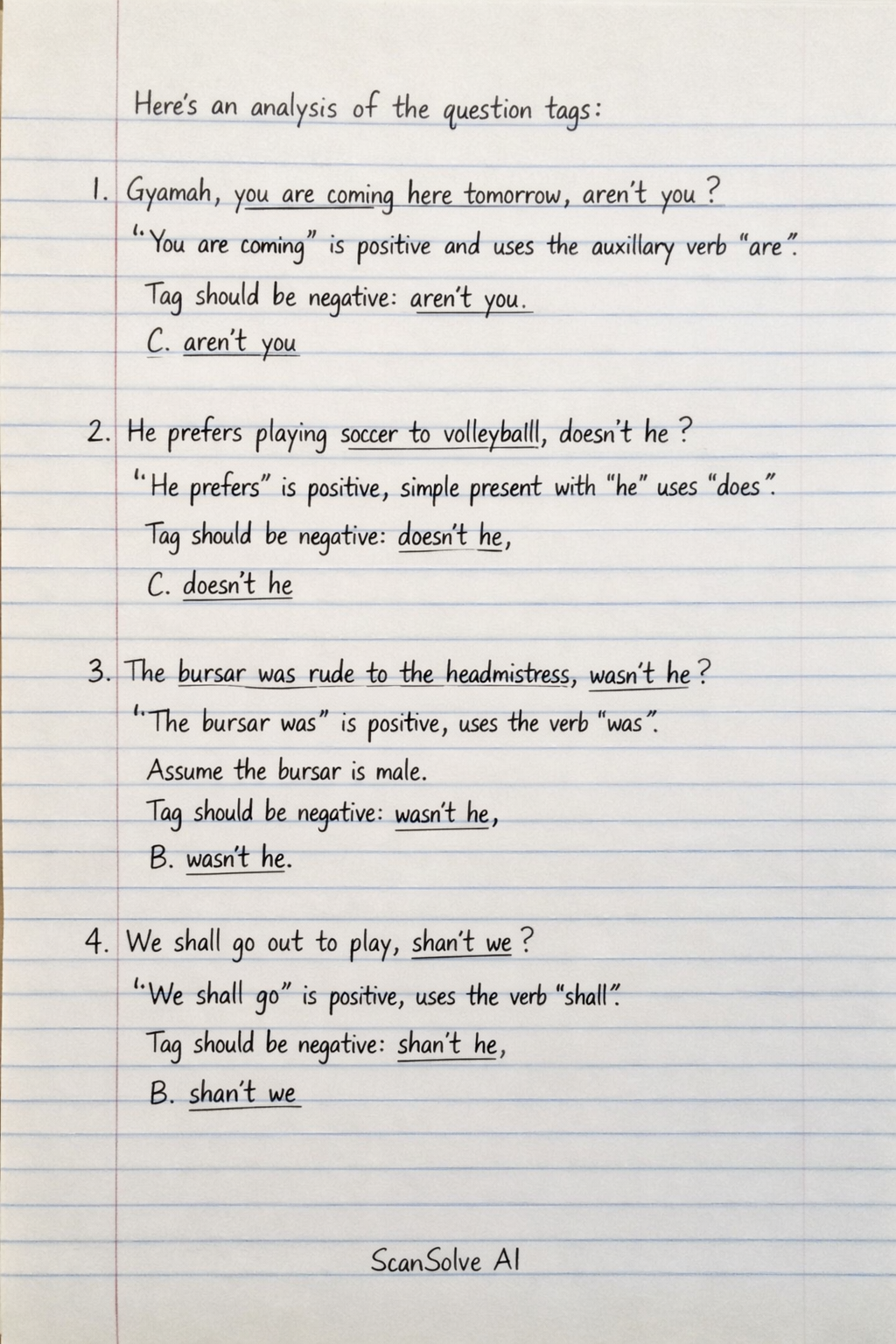
Gyamah, you are coming here tomorrow, aren't you? The statement "you are coming" is positive and uses the auxiliary verb "are". The question tag should be negative, "aren't you".
- C. aren't you
-
He prefers playing soccer to volleyball, doesn't he? The statement "He prefers" is positive and in the simple present tense. The auxiliary verb for the simple present with "he" is "does". The question tag should be negative, "doesn't he".
- C. doesn't he
-
The bursar was rude to the headmistress, wasn't he? The statement "The bursar was" is positive and uses the auxiliary verb "was". Assuming "the bursar" is male, the question tag should be negative, "wasn't he".
- B. wasn't he
-
We shall go out to play, shan't we? The statement "We shall go" is positive and uses the auxiliary verb "shall". The question tag should be negative, "shan't we".
- B. shan't we
-
You are hungry, aren't you? Yes, I am. This question asks for a response to the given question tag "aren't you?". A common affirmative response is "Yes, I am".
- B. Yes, I am
-
She can't eat all the cake, can she? The statement "She can't eat" is negative and uses the modal verb "can't". The question tag should be positive, "can she".
- B. can she
Still stuck on this one?
Ask a follow-up, and the answer starts from this question.
More English Questions
Handwritten Step-by-Step Solution
Get this as a handwritten image on WhatsApp — like a tutor wrote it for you.
Try on WhatsApp