ScanSolve logoScanSolve
Toggle sidebar
  • Homework
  • Tutor
  • Humanizer
  • AI Detector
  • Questions
  • Blog
  • History
  • Mobile App

  • Homework
  • Tutor
  • Humanizer
  • AI Detector

  • Questions
  • Math homework helpMath
    Physics homework helpPhysics
    Chemistry homework helpChemistry
    Biology homework helpBiology
    Computer Science homework helpComputer Science
    History homework helpHistory
    More homework helpMore
  • Blog
  • History

  • Mobile App
ScanSolvePLUS
  • Unlimited answers
  • ScanSolve AI Pro
Start Free Trial →
Try on WhatsApp
Home > English Homework Help > Solution

A. Comprehension exercises

Asked on March 27, 2026|English

This English question involves literary analysis, grammar, or writing skills. The detailed response below provides a well-structured answer with supporting evidence and clear explanations.

ScanSolve AI AnswerAnswered on March 27, 2026
A. Comprehension exercises 1. The central theme of the passage is the overwhelming power and destructive force of natural disasters, specifically tsunamis, and the resilience, vulnerability, and varied responses of humans in the face of such catastrophic events. It is conveyed through individual accounts that highlight personal experiences of survival, loss, and the immediate aftermath. 2. The different narratives (e.g., the stories of Ignatious, Sanjeev, and Tilly Smith) work together to express the overall message by providing multiple perspectives on the same disaster. Each account offers a unique insight into the tsunami's impact, demonstrating different survival strategies, emotional tolls, and the diverse ways people react to extreme danger, collectively painting a comprehensive picture of the event's human dimension. 3. A key lesson or message about human response to natural disasters that can be inferred from the text is the critical importance of quick thinking, awareness of natural warning signs, and preparedness. It also highlights the psychological impact of such events and the instinctual drive for survival that emerges in crises. B. Rearrange them in the correct chronological order by numbering the sentences in the correct order: 1. a. The family hears the rumble of the earthquake. 2. c. Family members rush out of the house as the tsunami approaches. 3. d. Some family members are swept away by the waves. 4. b. The sea starts rising, and relief helicopters appear overhead. 5. e. Survivors are later rescued or find refuge. C. Vocabulary and Inference a. In the context of the little girl who doesn't want to talk about the tsunami, "traumatised" means she has experienced severe emotional and psychological shock or injury due to the terrifying event. This distress makes it too painful or difficult for her to discuss her experiences. b. The description of animal behavior during the disaster helps reinforce the narrative's overall theme by illustrating that animals often possess an innate ability to sense impending natural disasters before humans do. This highlights nature's subtle warnings and underscores the immense power of the tsunami, which even animals instinctively recognize and react to, thereby emphasizing the severity and natural origins of the catastrophe.

Related English Questions

  • 9. With the aid of "The Concubine" by Elechi Amadi, here are five ideas communicated in the novel and their relevance to...
  • Your poem must only have 3 stanzas**.
  • A noun is a word that names a person, place, thing, or idea. For example, teacher, city, book, and happiness are all nou...
  • 1. (a) Seven literary forms used in the writing of the Bible are:
  • I snaped and send a reading passage with multiple Choice questions and you didn't solve it . Why ?
  • The question is incomplete. Please provide the full question or the rest of the sentence for "Bhola Grandpa was returnin...
See all English questions

This step-by-step solution was generated by ScanSolve AI. Need help with more english problems? Browse English solutions or ask your own question.

Home›English Homework Help›A. Comprehension exercises
Q

A. Comprehension exercises

March 27, 2026|English
A. Comprehension exercises

A. Comprehension exercises

ScanSolve AI

ScanSolve AI Answer

Answered on March 27, 2026

A. Comprehension exercises

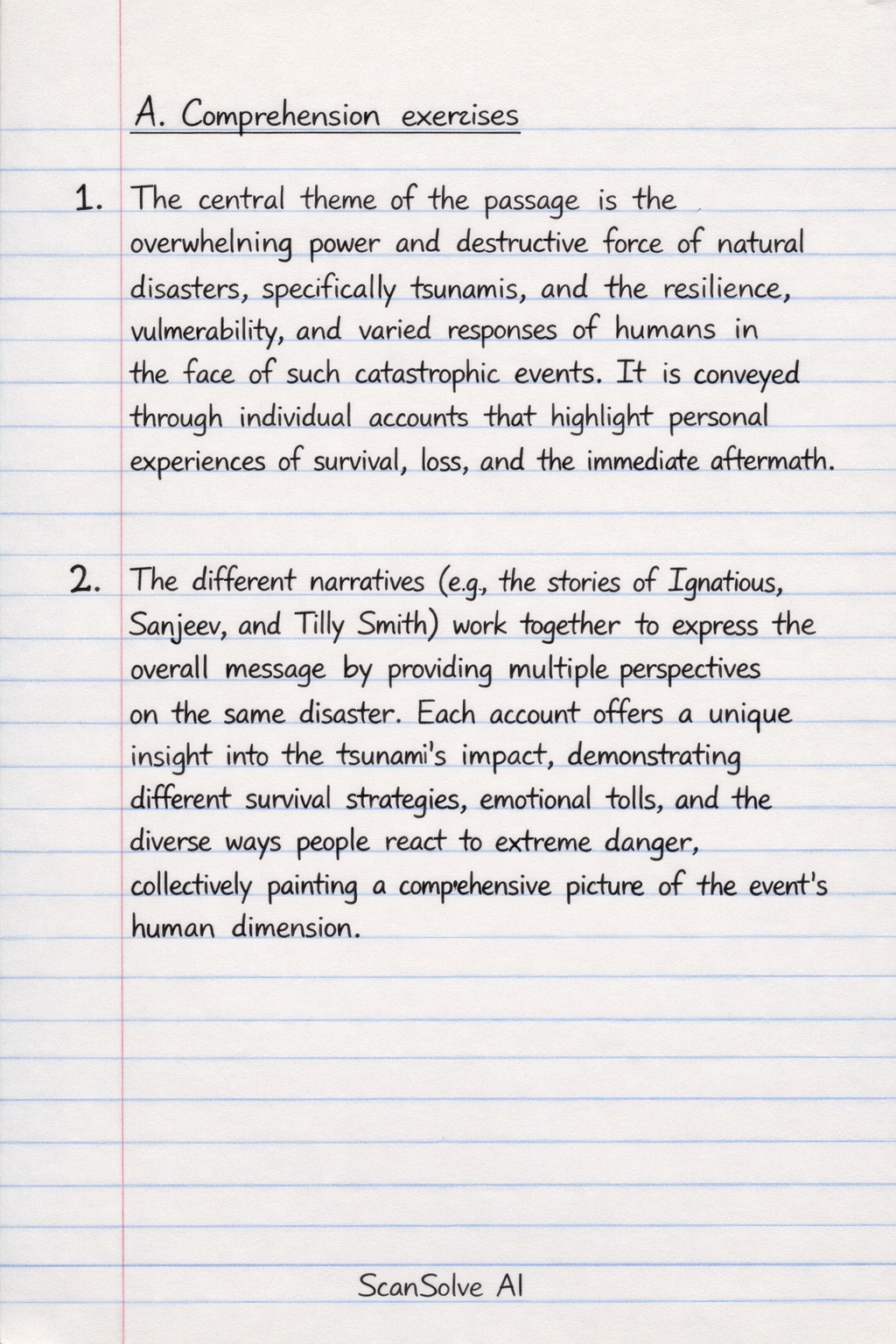
  1. The central theme of the passage is the overwhelming power and destructive force of natural disasters, specifically tsunamis, and the resilience, vulnerability, and varied responses of humans in the face of such catastrophic events. It is conveyed through individual accounts that highlight personal experiences of survival, loss, and the immediate aftermath.

  2. The different narratives (e.g., the stories of Ignatious, Sanjeev, and Tilly Smith) work together to express the overall message by providing multiple perspectives on the same disaster. Each account offers a unique insight into the tsunami's impact, demonstrating different survival strategies, emotional tolls, and the diverse ways people react to extreme danger, collectively painting a comprehensive picture of the event's human dimension.

  3. A key lesson or message about human response to natural disasters that can be inferred from the text is the critical importance of quick thinking, awareness of natural warning signs, and preparedness. It also highlights the psychological impact of such events and the instinctual drive for survival that emerges in crises.

B. Rearrange them in the correct chronological order by numbering the sentences in the correct order:

  1. a. The family hears the rumble of the earthquake.
  2. c. Family members rush out of the house as the tsunami approaches.
  3. d. Some family members are swept away by the waves.
  4. b. The sea starts rising, and relief helicopters appear overhead.
  5. e. Survivors are later rescued or find refuge.

C. Vocabulary and Inference

a. In the context of the little girl who doesn't want to talk about the tsunami, "traumatised" means she has experienced severe emotional and psychological shock or injury due to the terrifying event. This distress makes it too painful or difficult for her to discuss her experiences.

b. The description of animal behavior during the disaster helps reinforce the narrative's overall theme by illustrating that animals often possess an innate ability to sense impending natural disasters before humans do. This highlights nature's subtle warnings and underscores the immense power of the tsunami, which even animals instinctively recognize and react to, thereby emphasizing the severity and natural origins of the catastrophe.

Need help with your own homework?

Get instant step-by-step solutions to any question. Free to start.

Ask Your Question
Handwritten step-by-step solution

Handwritten Step-by-Step Solution

Get this solution as a handwritten image on WhatsApp — just like a tutor wrote it for you.

Try on WhatsApp

More English Questions

9. With the aid of "The Concubine" by Elechi Amadi, here are five ideas communicated in the novel an…Your poem must only have 3 stanzas**.A noun is a word that names a person, place, thing, or idea. For example, teacher, city, book, and h…1. (a) Seven literary forms used in the writing of the Bible are:I snaped and send a reading passage with multiple Choice questions and you didn't solve it . Why ?The question is incomplete. Please provide the full question or the rest of the sentence for "Bhola…
See all Englishquestions →