
We read your photo as:
A. Look at the picture and answer these questions. a. Who do you think they are?
ScanSolve AI Answer
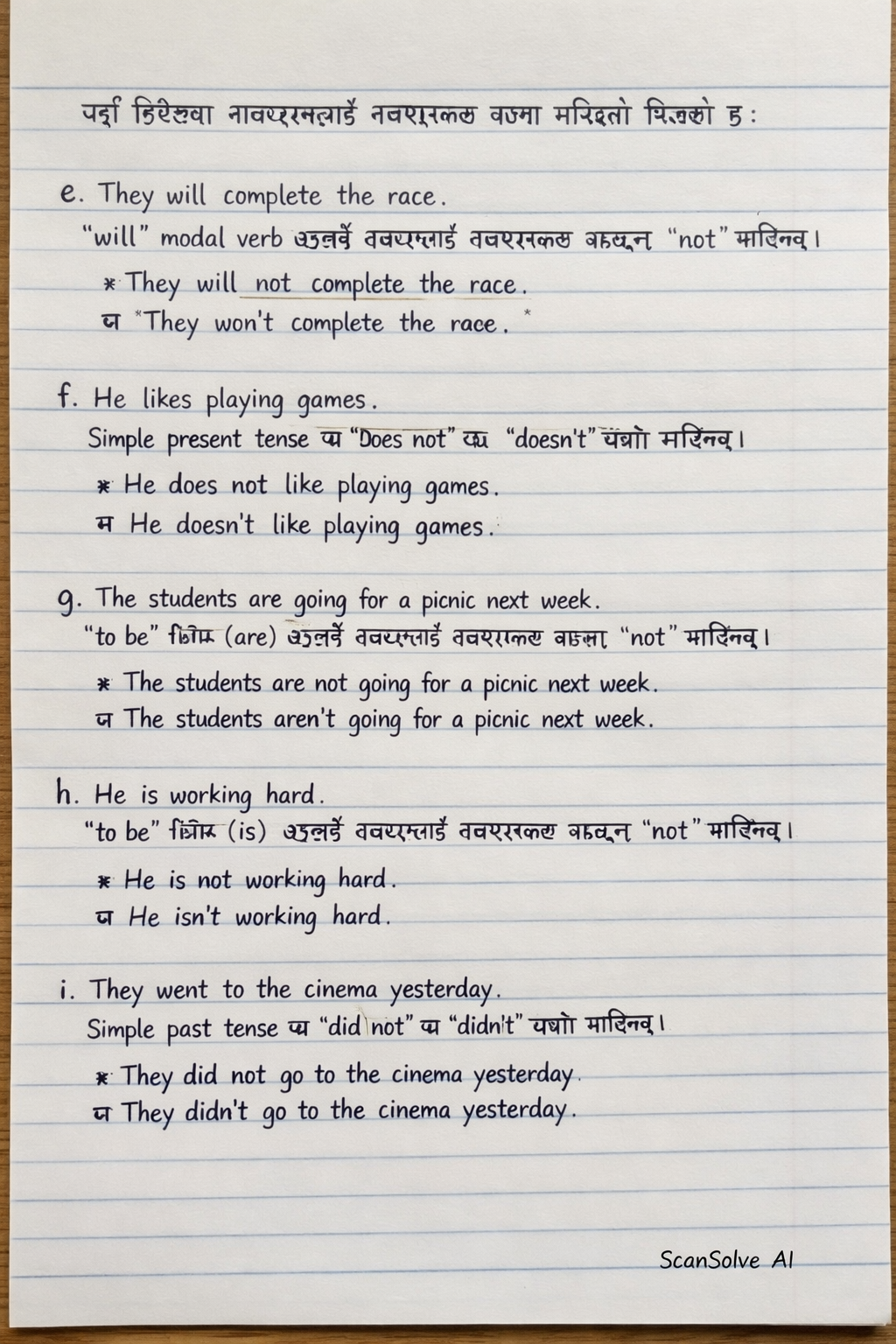
यहाँ दिइएका वाक्यहरूलाई नकारात्मक रूपमा परिवर्तन गरिएको छ:
e. They will complete the race.
'will' modal verb भएको वाक्यलाई नकारात्मक बनाउन 'not' थपिन्छ।
They will not complete the race.
वा
They won't complete the race.
f. He likes playing games.
Simple present tense मा 'does not' वा 'doesn't' प्रयोग गरिन्छ।
He does not like playing games.
वा
He doesn't like playing games.
g. The students are going for a picnic next week.
'to be' क्रिया (are) भएको वाक्यलाई नकारात्मक बनाउन 'not' थपिन्छ।
The students are not going for a picnic next week.
वा
The students aren't going for a picnic next week.
h. He is working hard.
'to be' क्रिया (is) भएको वाक्यलाई नकारात्मक बनाउन 'not' थपिन्छ।
He is not working hard.
वा
He isn't working hard.
i. They went to the cinema yesterday.
Simple past tense मा 'did not' वा 'didn't' प्रयोग गरिन्छ।
They did not go to the cinema yesterday.
वा
They didn't go to the cinema yesterday.
j. The students have got a lot of homework.
'have got' भएको वाक्यलाई नकारात्मक बनाउन 'not' थपिन्छ।
The students have not got a lot of homework.
वा
The students haven't got a lot of homework.
यहाँ प्रत्येक वाक्यको नकारात्मक रूप छ:
e. They will not complete the race.
f. He does not like playing games.
g. The students are not going for a picnic next week.
h. He is not working hard.
i. They did not go to the cinema yesterday.
j. The students have not got a lot of homework.
Still stuck on this one?
Ask a follow-up, and the answer starts from this question.
More English Questions
Handwritten Step-by-Step Solution
Get this as a handwritten image on WhatsApp — like a tutor wrote it for you.
Try on WhatsApp