

This English question involves literary analysis, grammar, or writing skills. The detailed response below provides a well-structured answer with supporting evidence and clear explanations.
ScanSolve AI Answer
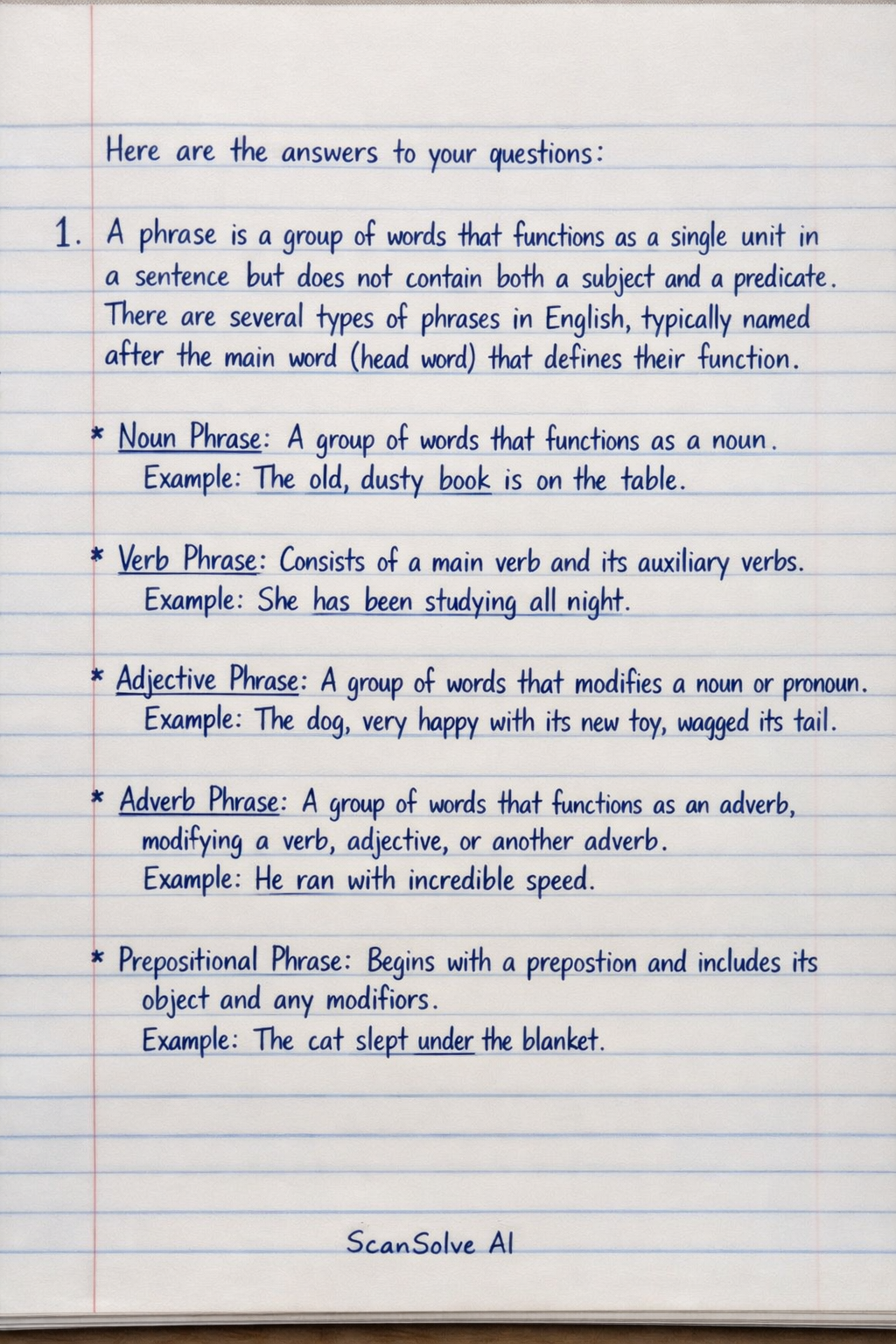
Here are the answers to your questions: 1. A phrase is a group of words that functions as a single unit in a sentence but does not contain both a subject and a predicate. There are several types of phrases in English, typically named after the main word (head word) that defines their function. Noun Phrase: A group of words that functions as a noun. Example: The old, dusty book* is on the table. Verb Phrase: Consists of a main verb and its auxiliary verbs. Example: She has been studying* all night. Adjective Phrase: A group of words that modifies a noun or pronoun. Example: The dog, very happy with its new toy*, wagged its tail. Adverb Phrase: A group of words that functions as an adverb, modifying a verb, adjective, or another adverb. Example: He ran with incredible speed*. Prepositional Phrase: Begins with a preposition and includes its object and any modifiers. Example: The cat slept under the blanket*. 2. A phrase is a group of words without a subject-verb combination that acts as a single part of speech. A clause, on the other hand, is a group of words that contains both a subject and a predicate. Clauses can be independent (can stand alone as a sentence) or dependent/subordinate (cannot stand alone). Types of subordinate clauses: Noun Clause: Functions as a noun in a sentence. It can be the subject, object, or complement. Example: I know that he is honest*. (Object of the verb 'know') Adjective Clause (or Relative Clause): Functions as an adjective, modifying a noun or pronoun. It usually begins with a relative pronoun (who, whom, whose, which, that) or a relative adverb (where, when, why). Example: The book that I borrowed* is excellent. (Modifies 'book') Adverb Clause: Functions as an adverb, modifying a verb, adjective, or another adverb. It tells when, where, why, how, to what extent, or under what condition something happens. Example: Because it was raining*, we stayed indoors. (Modifies 'stayed') 3. Sentences are classified based on the number and types of clauses they contain: Simple Sentence*: Contains one independent clause. It expresses a single complete thought. Example: The bird sang. Compound Sentence*: Contains two or more independent clauses, usually joined by a coordinating conjunction (for, and, nor, but, or, yet, so) or a semicolon. Example: The sun set, and the stars appeared. Complex Sentence*: Contains one independent clause and one or more dependent (subordinate) clauses. Example: Although it was late, we continued working. Compound-Complex Sentence*: Contains two or more independent clauses and one or more dependent clauses. Example: While I was studying, my phone rang, and I answered it. 4. Here are sentences representing each pattern: (i) SVC: Subject-Verb-Complement Sentence: The cake is delicious*. (ii) SVOC: Subject-Verb-Object-Complement Sentence: They made him president*. (iii) SVA: Subject-Verb-Adverbial Sentence: She lives in London*. (iv) SVCA: Subject-Verb-Complement-Adverbial Sentence: He became famous after his discovery*. (v) SVOCA: Subject-Verb-Object-Complement-Adverbial Sentence: We consider him a genius because of his inventions*. 5. Active voice is when the subject of the sentence performs the action. The structure is Subject + Verb + Object. Example: The dog chased the ball. Passive voice* is when the subject of the sentence receives the action. The structure is Object + Verb (to be + past participle) + (by agent). Example: The ball was chased by the dog. The passive voice becomes desirable in situations where: The agent (the one performing the action) is unknown or unimportant. Example: The window was broken* last night. (We don't know who broke it.) The focus is on the action or the receiver of the action, rather than the agent. Example: A new vaccine has been developed*. (The development is more important than who developed it.) To maintain objectivity or formality, often in scientific or academic writing. Example: Experiments were conducted* to test the hypothesis. To avoid assigning blame or to be diplomatic. Example: Mistakes were made*. That's 2 down. 3 left today — send the next one.