
This English question involves literary analysis, grammar, or writing skills. The detailed response below provides a well-structured answer with supporting evidence and clear explanations.
ScanSolve AI Answer
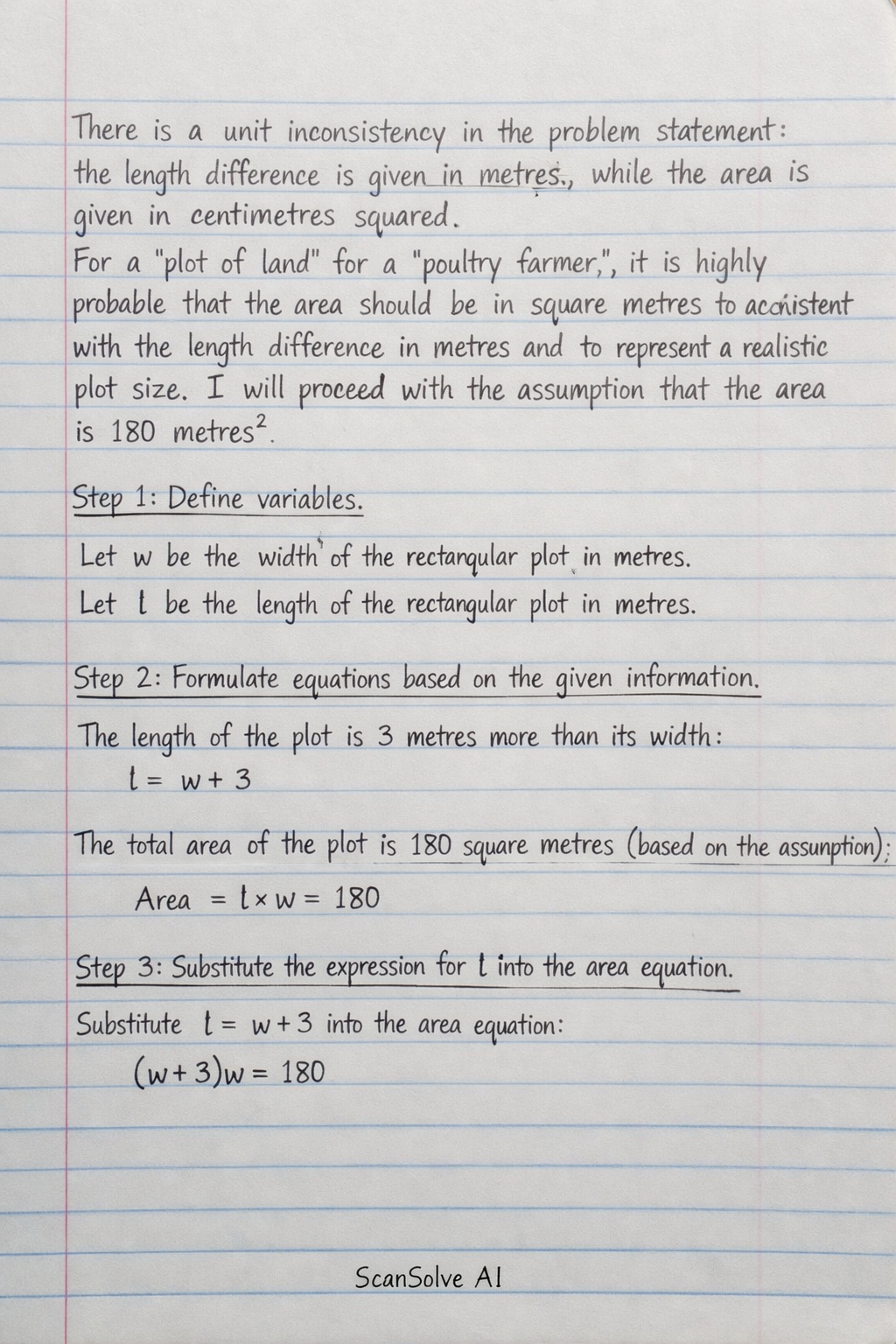
There is a unit inconsistency in the problem statement: the length difference is given in metres, while the area is given in centimetres squared. For a "plot of land" for a "poultry farmer", it is highly probable that the area should be in square metres to be consistent with the length difference in metres and to represent a realistic plot size. I will proceed with the assumption that the area is 180 metres squared. Step 1: Define variables. Let w be the width of the rectangular plot in metres. Let l be the length of the rectangular plot in metres. Step 2: Formulate equations based on the given information. The length of the plot is 3 metres more than its width: l = w + 3 The total area of the plot is 180 square metres (based on the assumption): Area = l × w = 180 Step 3: Substitute the expression for l into the area equation. Substitute l = w + 3 into the area equation: (w + 3)w = 180 Step 4: Expand and rearrange the equation into the standard quadratic form ax^2 + bx + c = 0. w^2 + 3w = 180 Subtract 180 from both sides to set the equation to zero: w^2 + 3w - 180 = 0 The quadratic equation representing this situation is: w^2 + 3w - 180 = 0 That's 3 down. 2 left today — send the next one.