
We read your photo as:
A verb is a king in speech. You cannot express yourself without used of a verb. Discuss. Explain with examples the constituents of verbal group.
ScanSolve AI Answer
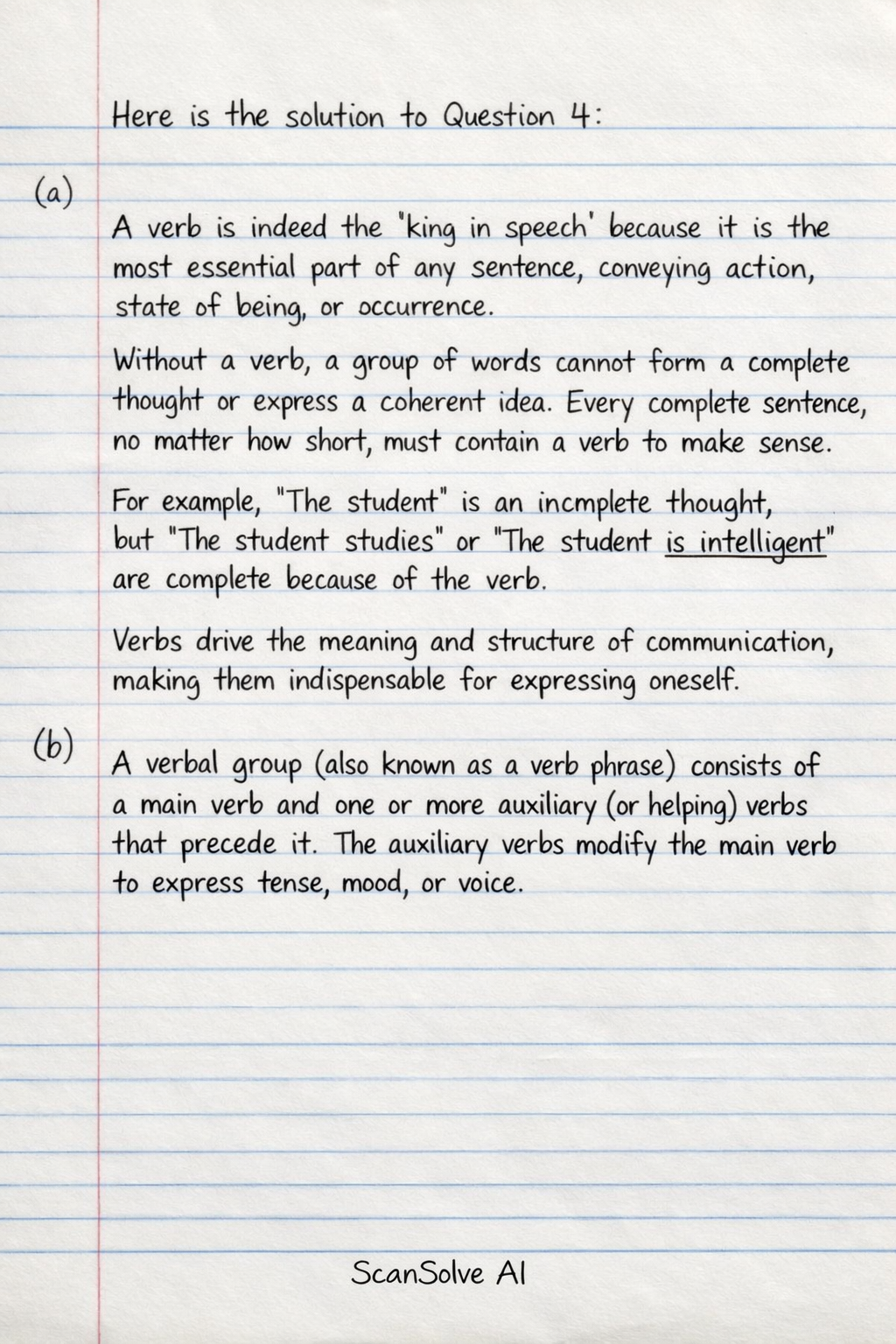
Here is the solution to Question 4:
a) A verb is indeed the "king in speech" because it is the most essential part of any sentence, conveying action, state of being, or occurrence. Without a verb, a group of words cannot form a complete thought or express a coherent idea. Every complete sentence, no matter how short, must contain a verb to make sense. For example, "The student" is an incomplete thought, but "The student studies" or "The student is intelligent" are complete because of the verb. Verbs drive the meaning and structure of communication, making them indispensable for expressing oneself.
b) A verbal group (also known as a verb phrase) consists of a main verb and one or more auxiliary (or helping) verbs that precede it. The auxiliary verbs modify the main verb to express tense, mood, or voice.
The constituents of a verbal group are:
- Main Verb: This is the primary verb that carries the core meaning of the action or state.
- Auxiliary Verbs: These verbs assist the main verb. They are categorized into:
- Primary Auxiliaries: be (e.g., is, am, are, was, were), do (e.g., do, does, did), and have (e.g., has, have, had).
- Example: She is reading a book. (is = auxiliary, reading = main verb)
- Example: They did not understand the lesson. (did = auxiliary, understand = main verb)
- Example: I have completed my assignment. (have = auxiliary, completed = main verb)
- Modal Auxiliaries: These express possibility, necessity, permission, or ability (e.g., can, could, will, would, shall, should, may, might, must).
- Example: He can speak three languages. (can = auxiliary, speak = main verb)
- Example: We should arrive early. (should = auxiliary, arrive = main verb)
- Example: You must submit the report by Friday. (must = auxiliary, submit = main verb)
- Primary Auxiliaries: be (e.g., is, am, are, was, were), do (e.g., do, does, did), and have (e.g., has, have, had).
Still stuck on this one?
Ask a follow-up, and the answer starts from this question.
More English Questions
Handwritten Step-by-Step Solution
Get this as a handwritten image on WhatsApp — like a tutor wrote it for you.
Try on WhatsApp