
We read your photo as:
Describe the role of hormones in the human menstrual cycle.
ScanSolve AI Answer
Step-by-step solution
17 stepsPart a· 2 steps
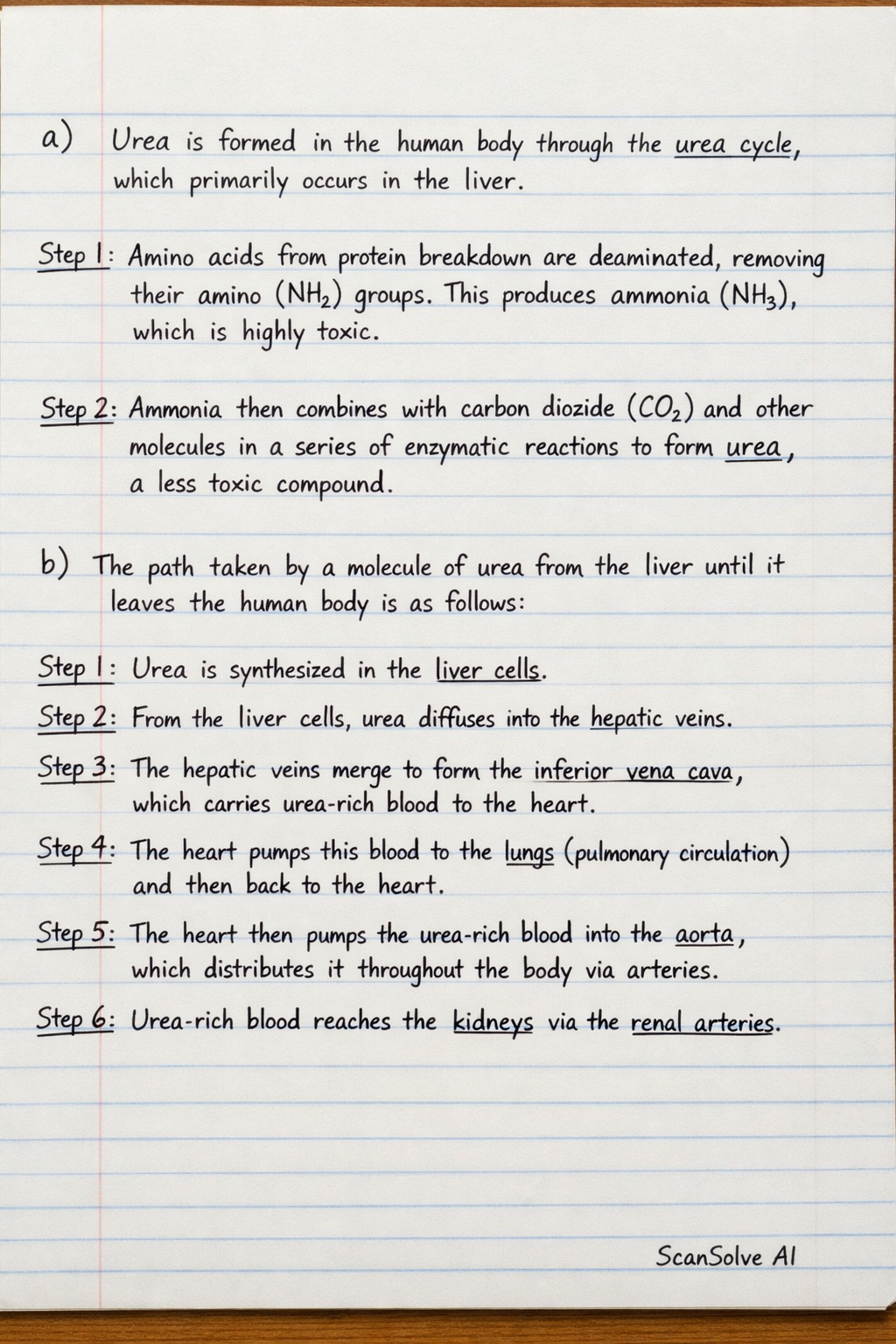
Urea is formed in the human body through the urea cycle, which primarily occurs in the *liver
Amino acids from protein breakdown are deaminated, removing their amino () groups.
This produces ammonia (), which is highly toxic.
Ammonia then combines with carbon dioxide () and other molecules in a series of enzymatic reactions to form urea, a less toxic compound.
Part b· 15 steps
The path taken by a molecule of urea from the liver until it leaves the human body is as follows
Urea is synthesized in the liver cells.
From the liver cells, urea diffuses into the hepatic veins.
The hepatic veins merge to form the inferior vena cava, which carries urea-rich blood to the heart.
The heart pumps this blood to the lungs (pulmonary circulation) and then back to the heart.
The heart then pumps the urea-rich blood into the aorta, which distributes it throughout the body via arteries.
Urea-rich blood reaches the kidneys via the renal arteries.
Inside the kidneys, blood enters the glomeruli (part of the nephrons), where ultrafiltration occurs.
Water, urea, salts, and other small molecules are filtered out of the blood, forming the glomerular filtrate.
The filtrate passes through the renal tubules (proximal convoluted tubule, loop of Henle, distal convoluted tubule).
During this passage, most water, essential salts, and nutrients are reabsorbed back into the blood. Urea, however, is largely retained in the filtrate.
The remaining fluid, now concentrated with urea and other waste products, is called urine.
Urine collects in the collecting ducts within the kidneys.
From the collecting ducts, urine flows into the renal pelvis.
The renal pelvis funnels urine into the ureters.
The ureters transport urine from the kidneys to the urinary bladder.
Urine is stored in the urinary bladder until it is full.
When the bladder is full, urine is expelled from the body through the urethra during urination (micturition).
Still stuck on this one?
Ask a follow-up, and the answer starts from this question.
More Biology Questions
Handwritten Step-by-Step Solution
Get this as a handwritten image on WhatsApp — like a tutor wrote it for you.
Try on WhatsApp