
We read your photo as:
Analyze how Mapheza's journey in "Inkawu Idliw'ilila" exemplifies the proverb "ubomi obububo yimigudu nemizamo, impumelelo isentabeni", focusing on his successful commission of a crime.
ScanSolve AI Answer
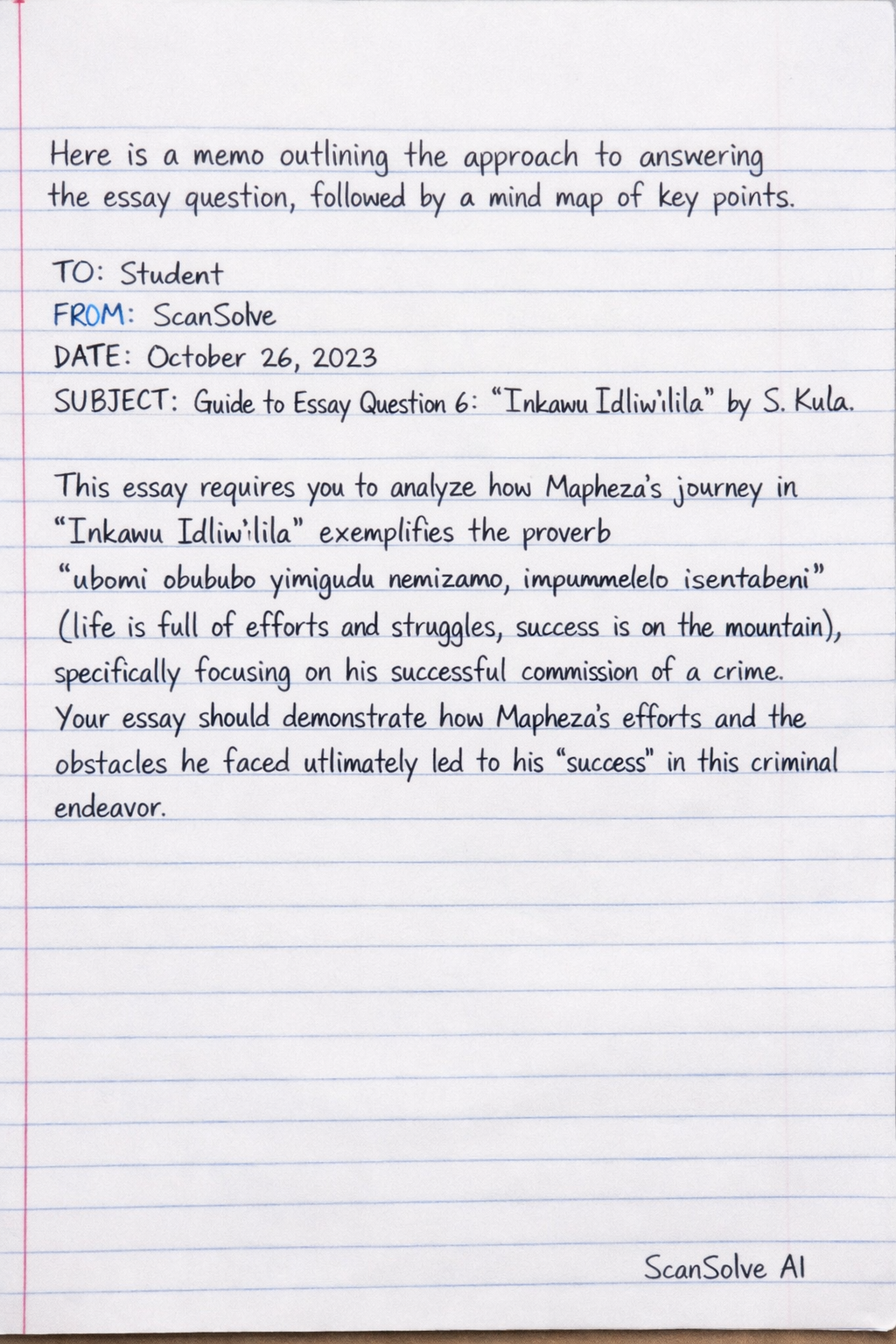
Here is a memo outlining the approach to answering the essay question, followed by a mind map of key points.
MEMO
TO: Student
FROM: ScanSolve
DATE: October 26, 2023
SUBJECT: Guide to Essay Question 6: "Inkawu Idliw'ilila" by S. Kula
This essay requires you to analyze how Mapheza's journey in "Inkawu Idliw'ilila" exemplifies the proverb "ubomi obububo yimigudu nemizamo, impumelelo isentabeni" (life is full of efforts and struggles, success is on the mountain), specifically focusing on his successful commission of a crime. Your essay should demonstrate how Mapheza's efforts and the obstacles he faced ultimately led to his "success" in this criminal endeavor.
Key aspects to cover:
- Introduction: Briefly introduce the proverb and the novel, stating your thesis that Mapheza's criminal success is a testament to this proverb through his persistent efforts and overcoming of obstacles.
- Body Paragraphs:
- Discuss Mapheza's initial motivations and the "mountain" he aims to conquer (the crime itself).
- Detail the imigudu (efforts/struggles) he undertakes, such as planning, gathering resources, and psychological preparation.
- Elaborate on the imiqobo (obstacles) he encounters, which could be internal (fear, moral conflict) or external (other characters, unforeseen circumstances, risks of detection).
- Show how he navigates and overcomes these challenges.
- Conclude each point by linking it back to the proverb and Mapheza's eventual "impumelelo" (success) in committing the crime.
- Conclusion: Summarize how Mapheza's criminal journey, despite its moral implications, perfectly illustrates the proverb's message about effort, struggle, and achieving a desired outcome.
MIND MAP: "Inkawu Idliw'ilila" - Mapheza's Criminal Journey
-
Central Theme: Ubomi obububo yimigudu nemizamo, impumelelo isentabeni (Life is full of efforts and struggles, success is on the mountain).
- Focus: Mapheza's successful commission of a crime.
-
I. Mapheza's "Mountain" (Goal):
- Specific crime Mapheza plans to commit.
- Underlying motivations (e.g., desperation, revenge, greed, survival).
- The perceived "success" he seeks through this crime.
-
II. Imigudu (Efforts/Struggles):
- A. Planning & Preparation:
- Careful strategizing of the crime.
- Gathering necessary tools/information.
- Recruiting accomplices (if any) and managing relationships.
- Mental and emotional preparation for the act.
- B. Execution of the Crime:
- The actual steps taken during the crime.
- Maintaining composure under pressure.
- Adapting to unexpected situations.
- A. Planning & Preparation:
-
III. Imiqobo (Obstacles):
- A. Internal Obstacles:
- Fear of failure or consequences.
- Moral dilemmas or guilt (if any).
- Self-doubt.
- B. External Obstacles:
- Interference from other characters (e.g., victims, witnesses, rivals).
- Threat of law enforcement/detection.
- Logistical challenges or unforeseen complications.
- Lack of resources or support.
- A. Internal Obstacles:
-
IV. Impumelelo (Success in Crime):
- How Mapheza ultimately achieves his criminal objective.
- The immediate outcome of the crime.
- The sense of accomplishment (from Mapheza's perspective) despite the nature of the act.
- How this "success" validates the proverb, showing that even in crime, effort and overcoming obstacles lead to a desired end.
-
V. Conclusion:
- Reiterate how Mapheza's journey, filled with deliberate efforts and the navigation of significant obstacles, culminates in the successful execution of his criminal plan, thus embodying the proverb.
Still stuck on this one?
Ask a follow-up, and the answer starts from this question.
More English Questions
Handwritten Step-by-Step Solution
Get this as a handwritten image on WhatsApp — like a tutor wrote it for you.
Try on WhatsApp