
We read your photo as:
Analyze Shakespeare's Sonnet 73, addressing its structure, figurative language, and themes of aging and mortality.
ScanSolve AI Answer
Step-by-step solution
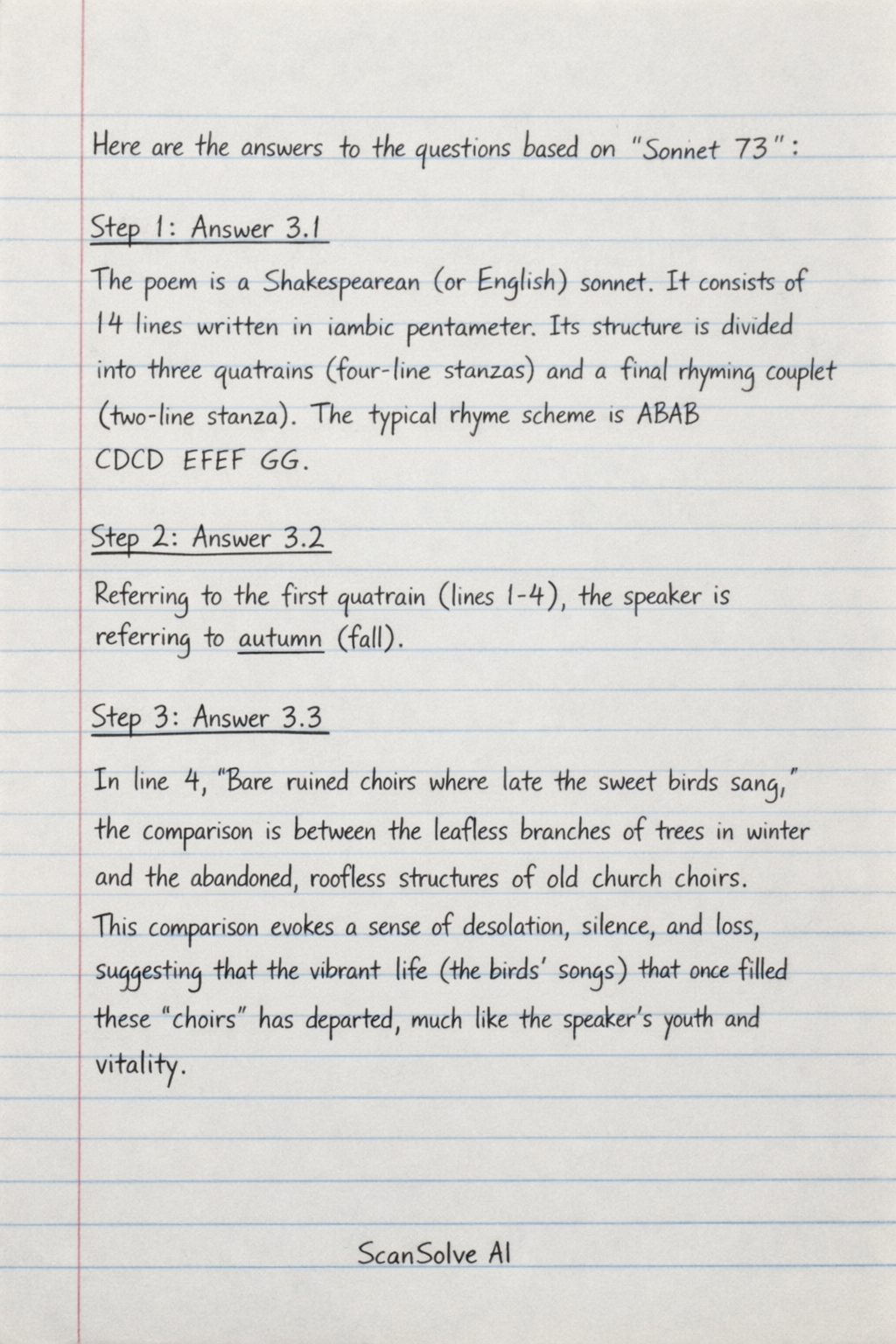
9 stepsHere are the answers to the questions based on "Sonnet 73":
Answer 3.1
The poem is a Shakespearean (or English) sonnet. It consists of 14 lines written in iambic pentameter. Its structure is divided into three quatrains (four-line stanzas) and a final rhyming couplet (two-line stanza). The typical rhyme scheme is ABAB CDCD EFEF GG.
Answer 3.2
Referring to the first quatrain (lines 1-4), the speaker is referring to autumn (fall).
Answer 3.3
In line 4, "Bare ruined choirs where late the sweet birds sang," the comparison is between the leafless branches of trees in winter and the abandoned, roofless structures of old church choirs. This comparison evokes a sense of desolation, silence, and loss, suggesting that the vibrant life (the birds' songs) that once filled these "choirs" has departed, much like the speaker's youth and vitality.
Answer 3.4
Referring to lines 5-6 ("In me thou seest the twilight of such day / As after sunset fadeth in the west"), the imagery is that of twilight or sunset. This imagery represents the end of a day, symbolizing the speaker's approaching old age or the decline of his life, moving towards its inevitable end, just as day fades into night.
Answer 3.5
a) The literal device used in line 7 ("Which by and by black night doth take away") is personification.
b) This literary device enhances the message by giving "black night" (symbolizing death) an active, almost predatory role. It suggests that death is not a passive event but an active force that "takes away" life, making the transition from life to death seem inevitable, forceful, and complete.
Answer 3.6
Referring to lines 8-12, the word that best describes the speaker's state of mind is resigned.
The speaker describes his life as a dying fire, consumed by the very fuel that once sustained it. This imagery suggests an acceptance of the natural process of decay and the inevitability of death, rather than fear or struggle.Answer 3.7
In the third quatrain (lines 9-12), the speaker's tone is melancholy and reflective.
Answer 3.8
The theme of death is central to this poem, presented not as a sudden, terrifying event but as a gradual, natural process of decline and fading. The speaker uses three distinct metaphors—autumn, twilight, and a dying fire—to illustrate different stages of life's end. Death is portrayed as an inevitable conclusion, a "second self" (sleep/night) that seals all in rest, and the ultimate expiration of life's "fire," emphasizing its universality and the quiet, natural progression towards the end.
Answer 3.9
Yes, the couplet is a fitting conclusion to this sonnet. It shifts the focus from the speaker's contemplation of his own mortality to the impact of this realization on the beloved. The lines "This thou perceiv'st, which makes thy love more strong, / To love that well which thou must leave ere long" provide a powerful resolution. They suggest that the awareness of life's brevity and the inevitability of loss does not diminish love but rather intensifies it, urging the beloved to cherish the speaker more deeply precisely because their time together is finite. This provides a poignant and universal message about the nature of love and loss.
Still stuck on this one?
Ask a follow-up, and the answer starts from this question.
More English Questions
Handwritten Step-by-Step Solution
Get this as a handwritten image on WhatsApp — like a tutor wrote it for you.
Try on WhatsApp