
We read your photo as:
Analyze the context and potential use of three songs: 'Ngolingo', 'This road', and 'Up up', detailing the activities they'd accompany and the reasons for their suitability.
English
ScanSolve AI Answer
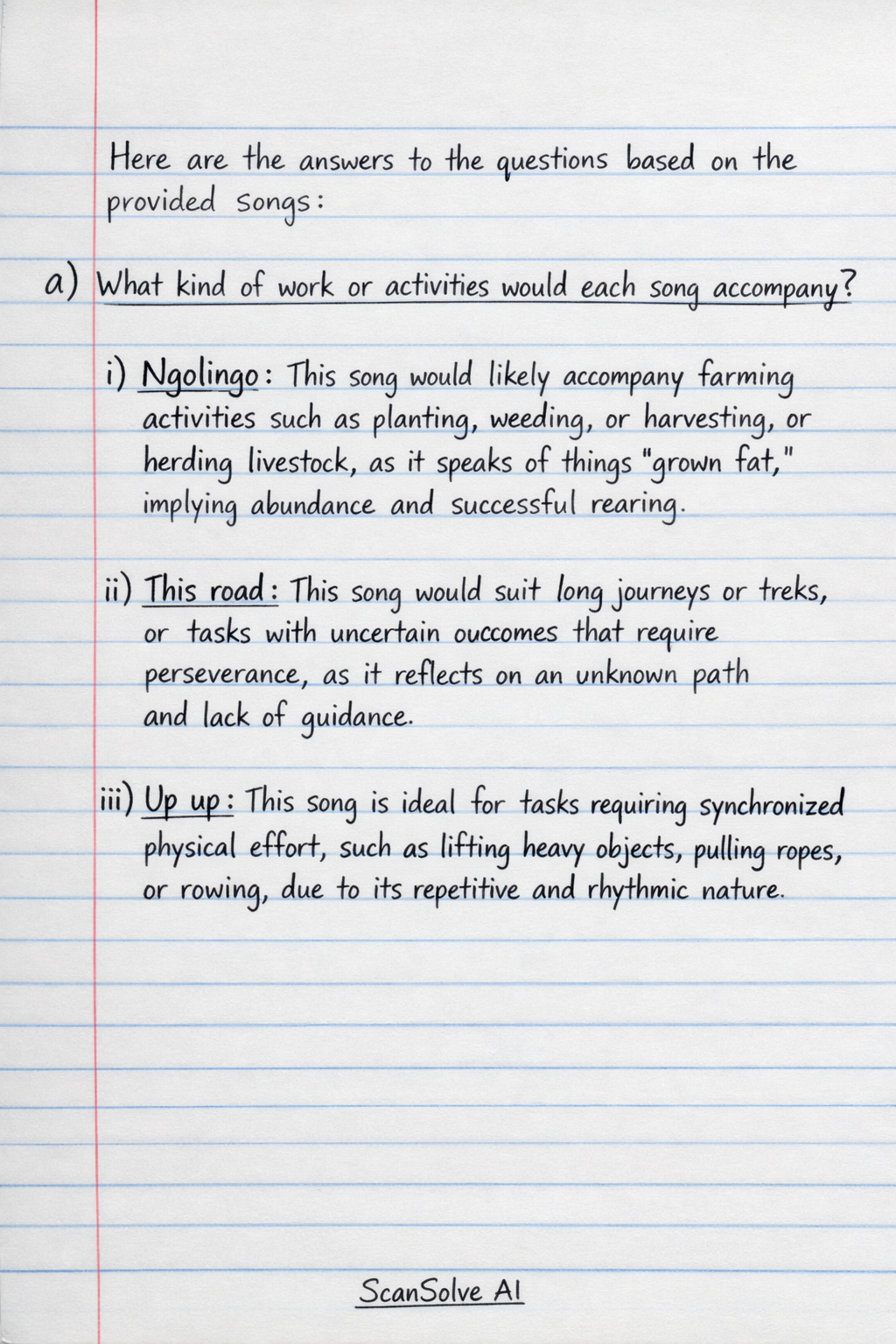
Here are the answers to the questions based on the provided songs:
a) What kind of work or activities would each song accompany?
- i) Ngolingo: This song would likely accompany farming activities such as planting, weeding, or harvesting, or herding livestock, as it speaks of things "grown fat," implying abundance and successful rearing.
- ii) This road: This song would suit long journeys or treks, or tasks with uncertain outcomes that require perseverance, as it reflects on an unknown path and lack of guidance.
- iii) Up up: This song is ideal for tasks requiring synchronized physical effort, such as lifting heavy objects, pulling ropes, or rowing, due to its repetitive and rhythmic nature.
b) Why is each song suitable for the activity you have named in (a)?
- i) Ngolingo: It is suitable because its focus on "what has grown fat" can serve as motivation and a celebration of productivity in agricultural or pastoral work. The repetition helps establish a work rhythm.
- ii) This road: It is suitable for uncertain journeys or tasks because its reflective lyrics acknowledge the challenges and unknown aspects, allowing individuals to express their feelings or find solace in shared experience during difficult endeavors.
- iii) Up up: It is highly suitable because its strong, repetitive rhythm and simple phrases ("Up up," "Up uu ah") are perfect for coordinating group effort and providing a clear signal for synchronized action, making strenuous tasks easier to manage.
c) How do you think each song would be performed (for example: solo, group, call-and-response)?
- i) Ngolingo: This song would most likely be performed by a group, possibly with a call-and-response structure where a leader asks "What has grown fat?" and the group responds with "Ngo" or "Ngolingo."
- ii) This road: Given its reflective nature, it could be performed solo or by a group in unison, perhaps as a way to pass time or express shared sentiment during a long, arduous activity.
- iii) Up up: This song is clearly designed for group performance with a strong call-and-response element, where a leader calls out "Up up" and the group responds "Up uu ah" in coordination with physical exertion.
d) In groups, list five songs you have heard people sing while working.
- "Shosholoza" (a traditional South African work song)
- "Jambo Bwana" (a popular Kenyan song often sung in groups)
- "Heigh-Ho" (from Snow White, a classic example of a mining work song)
- "We Shall Overcome" (often sung during collective action or protest, which can be a form of work)
- Local folk songs used during farming or fishing.
Was this helpful?
Still stuck on this one?
Ask a follow-up, and the answer starts from this question.
Got a different question?Ask your own question
More English Questions
QAnalyze this song as a "wimbo" (song). Explain its characteristics, social/economic functions…QDescribe the scenes in the pictures and suggest suitable songs or oral poems for each. Explain why…QAnalyze the poem's use of literary devices, themes, and specific lines, focusing on "Ndingumntwana…QAnalyze "The Game" by Duma Ndlovu, focusing on Thembi's monologue, the political context of 1986…QAnalyze the provided Swahili excerpts. For each excerpt, explain its context, its main content, and…
Handwritten Step-by-Step Solution
Get this as a handwritten image on WhatsApp — like a tutor wrote it for you.
Try on WhatsApp