
We read your photo as:
Analyze the mood, tone, and themes in the provided texts, focusing on elements of loss, grief, and potential performance interpretations.
ScanSolve AI Answer
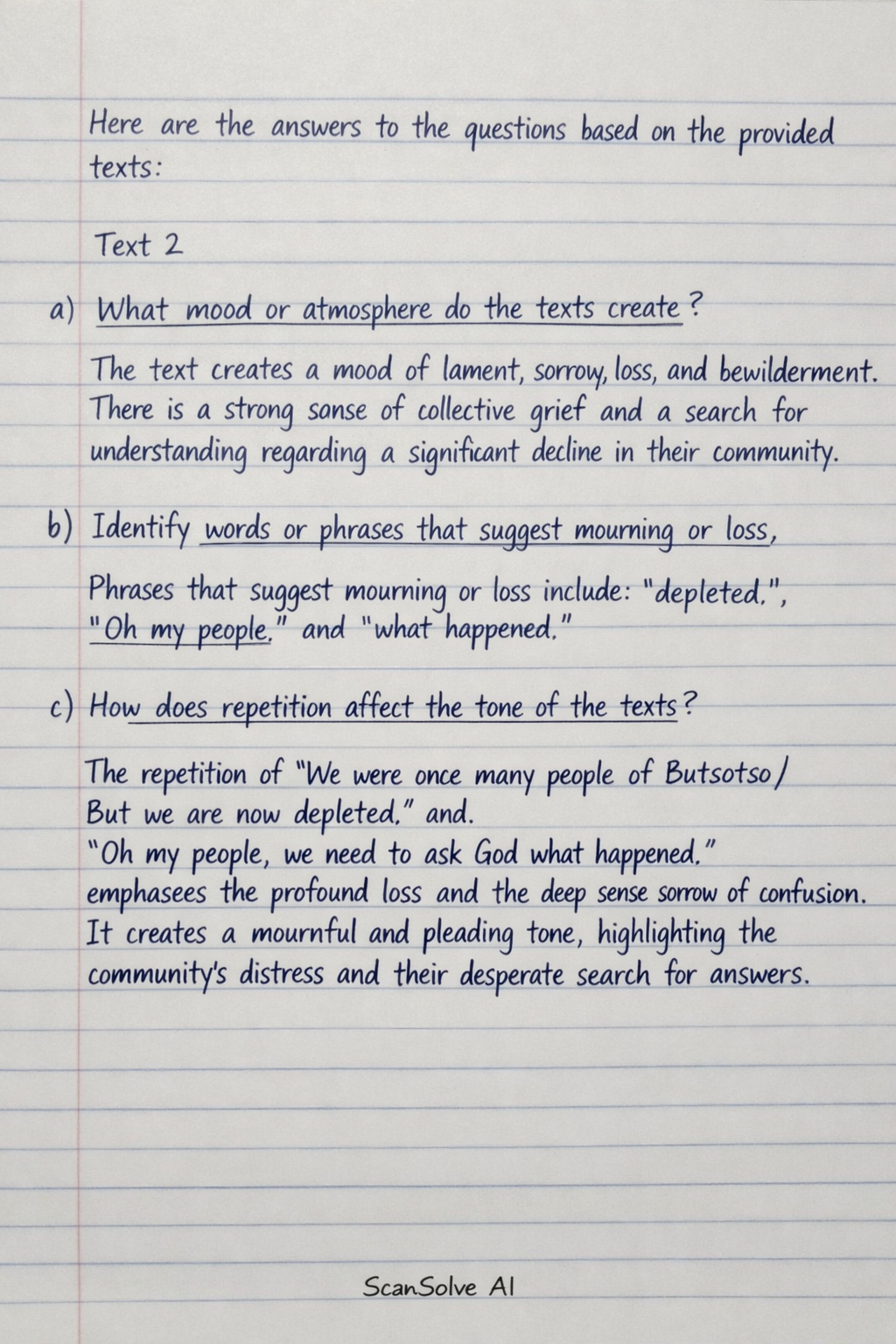
Here are the answers to the questions based on the provided texts:
Text 2
-
a) What mood or atmosphere do the texts create? The text creates a mood of lament, sorrow, loss, and bewilderment. There is a strong sense of collective grief and a search for understanding regarding a significant decline in their community.
-
b) Identify words or phrases that suggest mourning or loss. Phrases that suggest mourning or loss include: "depleted", "Oh my people", and "what happened".
-
c) How does repetition affect the tone of the texts? The repetition of "We were once many people of Butsotso / But we are now depleted" and "Oh my people, we need to ask God what happened" emphasizes the profound loss and the deep sense of sorrow and confusion. It creates a mournful and pleading tone, highlighting the community's distress and their desperate search for answers.
-
d) What beliefs or practices are suggested in the texts? The phrase "we need to ask God what happened" suggests a belief in a higher power (God) and a practice of seeking divine intervention or understanding in times of great misfortune or loss.
-
e) Suggest two ways the texts can be performed for deeper impact.
- Choral recitation: Having a group of voices recite the text, perhaps with a slow, somber pace, would emphasize the collective grief of the "people of Butsotso."
- Mournful chanting or singing: Performing the text with a slow, melodic chant or song, incorporating pauses, would heighten the emotional impact and convey the depth of the lament.
A Mother's Cry (Dirge)
-
a) What emotions are expressed in the dirge? The dirge expresses profound grief, sorrow, heartbreak, and a deep sense of loss. There is also a tender, loving emotion towards the deceased child.
-
b) What images does the speaker use to describe the loss? The speaker uses images such as:
- "My child, my light, you have left so soon, The dawn had barely touched your brow" (emphasizing the child's youth and sudden death).
- "The winds have hushed, the drums are still, The dance halted mid-step in mourning" (depicting a community silenced and paused in grief).
- "The rains speak your name in soft whispers, The fire knows the warmth you held" (personifying nature as mourning and remembering the child).
- "The elders lean on their staffs, eyes dim, Their silence speaks of hearts torn" (showing the deep, silent sorrow of the community's wise figures).
-
c) How do tone, pauses and rhythm influence the performance? The tone is mournful and somber. Pauses would create moments for reflection, emphasizing the weight of the loss and allowing the audience to absorb the speaker's grief. A slow, deliberate rhythm would contribute to the solemn atmosphere, mimicking the heavy heart of the speaker and the slow pace of mourning, thereby deepening the emotional impact.
-
d) What cultural practices can you infer from the dirge? From the dirge, we can infer:
- Communal mourning: The mention of "drums are still" and "dance halted" suggests that mourning is a shared community event.
- Oral tradition: Dirges are oral poems or songs, indicating a culture that uses spoken word and music to express grief.
- Respect for elders: The presence of "elders" visibly affected suggests their significant role in the community and mourning rituals.
- Symbolism in nature: The personification of "rains" and "fire" suggests a connection to nature or spiritual beliefs where natural elements are seen as acknowledging life and death.
-
e) How does oral performance affect the impact of the dirge? Oral performance significantly enhances the impact by allowing the speaker to convey raw emotion through voice modulation, tempo, pauses, and facial expressions. The intonation can emphasize specific words, making the grief palpable. The rhythm and pauses can draw the audience into the solemnity of the moment, creating a shared experience of mourning and making the words more immediate and deeply moving.
Still stuck on this one?
Ask a follow-up, and the answer starts from this question.
More English Questions
Handwritten Step-by-Step Solution
Get this as a handwritten image on WhatsApp — like a tutor wrote it for you.
Try on WhatsApp