
We read your photo as:
Analyze the poem "The Grasshopper and the Cricket" by John Keats, focusing on its structure, figures of speech, and themes.
ScanSolve AI Answer
Step-by-step solution
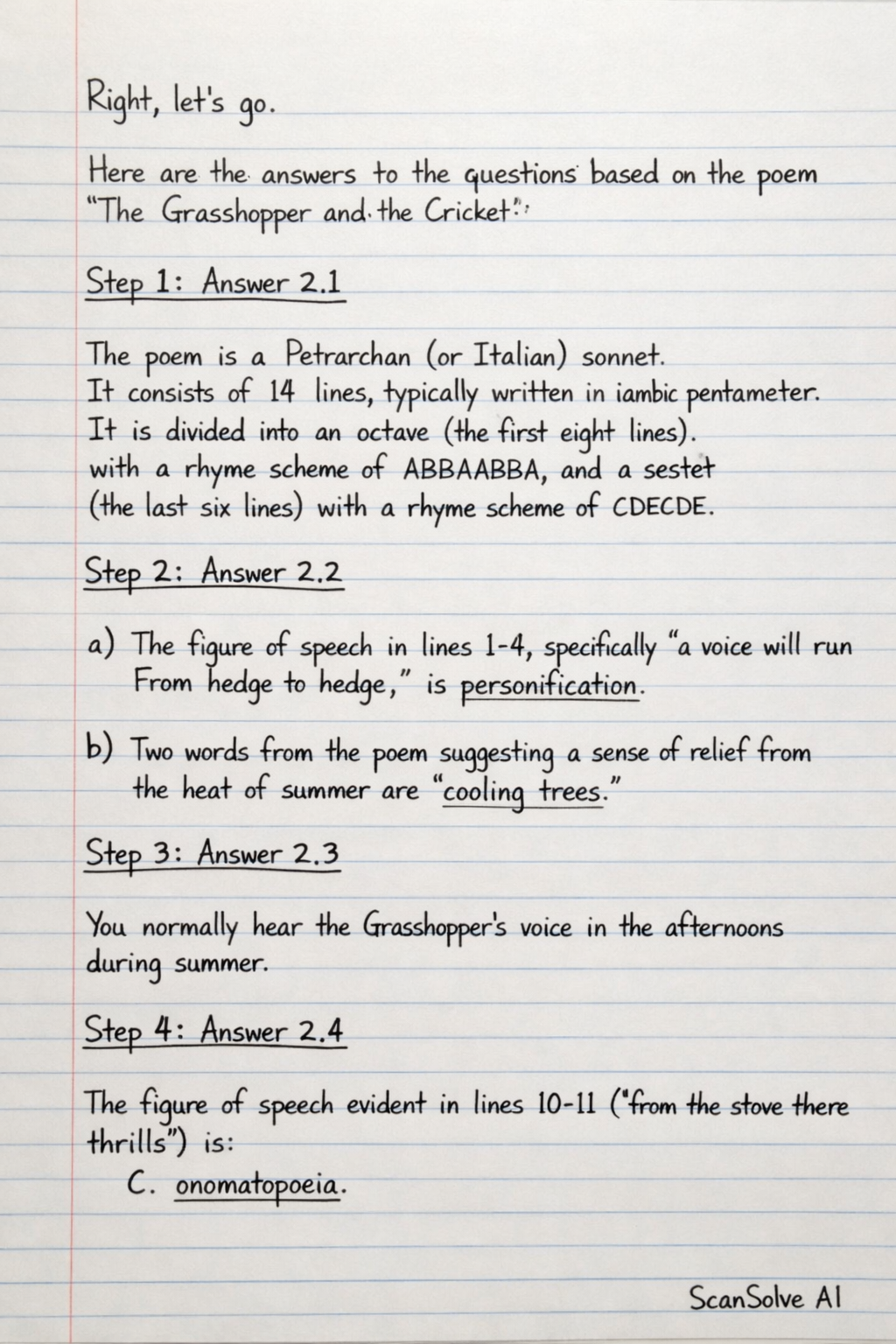
9 stepsHere are the answers to the questions based on the poem "The Grasshopper and the Cricket":
Step 1: Answer 2.1
The poem is a Petrarchan (or Italian) sonnet. It consists of 14 lines, typically written in iambic pentameter. It is divided into an octave (the first eight lines) with a rhyme scheme of ABBAABBA, and a sestet (the last six lines) with a rhyme scheme of CDECDE.
Step 2: Answer 2.2
Part a
The figure of speech in lines 1-4, specifically "a voice will run / From hedge to hedge," is *personification
Part b· 9 steps
Two words from the poem suggesting a sense of relief from the heat of summer are "cooling trees".
Answer 2.3
You normally hear the Grasshopper's voice in the afternoons during summer.
Answer 2.4
The figure of speech evident in lines 10-11 ("from the stove there thrills") is:
C. onomatopoeia.Answer 2.5
The poet believes the poetry of the earth is not dead because nature's music is continuous. When one voice (like the birds in extreme heat) fades, another (like the grasshopper) takes over, and when the grasshopper's song is gone in winter, the cricket's song continues the melody, ensuring the "poetry of earth" never ceases.
Answer 2.6
The Cricket takes over from the grasshopper in winter.
Answer 2.7
The cricket's song sounds like the grasshopper's in the poem because it maintains the continuous, vibrant spirit of nature's music. To a listener "in drowsiness half lost," the cricket's song in winter evokes the same sense of enduring life and warmth as the grasshopper's song in summer, creating a feeling of continuity.
Answer 2.8
The cricket's song brings warmth to people by providing a cheerful, lively sound in the otherwise silent and cold winter evening. It offers a sense of comfort and life from the warmth of the stove, contrasting with the harsh frost outside.
Answer 2.9
The main theme of this sonnet is the perpetuity and continuity of nature's music or "poetry" through all seasons, demonstrating that the life force of the earth never truly dies.
Answer 2.10
The poetry of earth is made of the continuous sounds of nature, specifically the songs of insects like the grasshopper and the cricket, which represent the vibrant, enduring life and music of the natural world through both summer and winter.
Answer 2.11
Yes, the poet succeeds in illustrating the commonality between the grasshopper and the cricket. The commonality lies in their shared role as the carriers of the "poetry of earth." The grasshopper sings in the intense heat of summer when other birds are silent, while the cricket sings in the deep cold of winter when nature is otherwise hushed. The poem explicitly links their songs by suggesting that the cricket's song, heard in a drowsy state, can be mistaken for the grasshopper's, thereby emphasizing that both creatures serve to keep the spirit of nature's music alive and continuous, regardless of the season.
Still stuck on this one?
Ask a follow-up, and the answer starts from this question.
More English Questions
Handwritten Step-by-Step Solution
Get this as a handwritten image on WhatsApp — like a tutor wrote it for you.
Try on WhatsApp