

This English question involves literary analysis, grammar, or writing skills. The detailed response below provides a well-structured answer with supporting evidence and clear explanations.
ScanSolve AI Answer
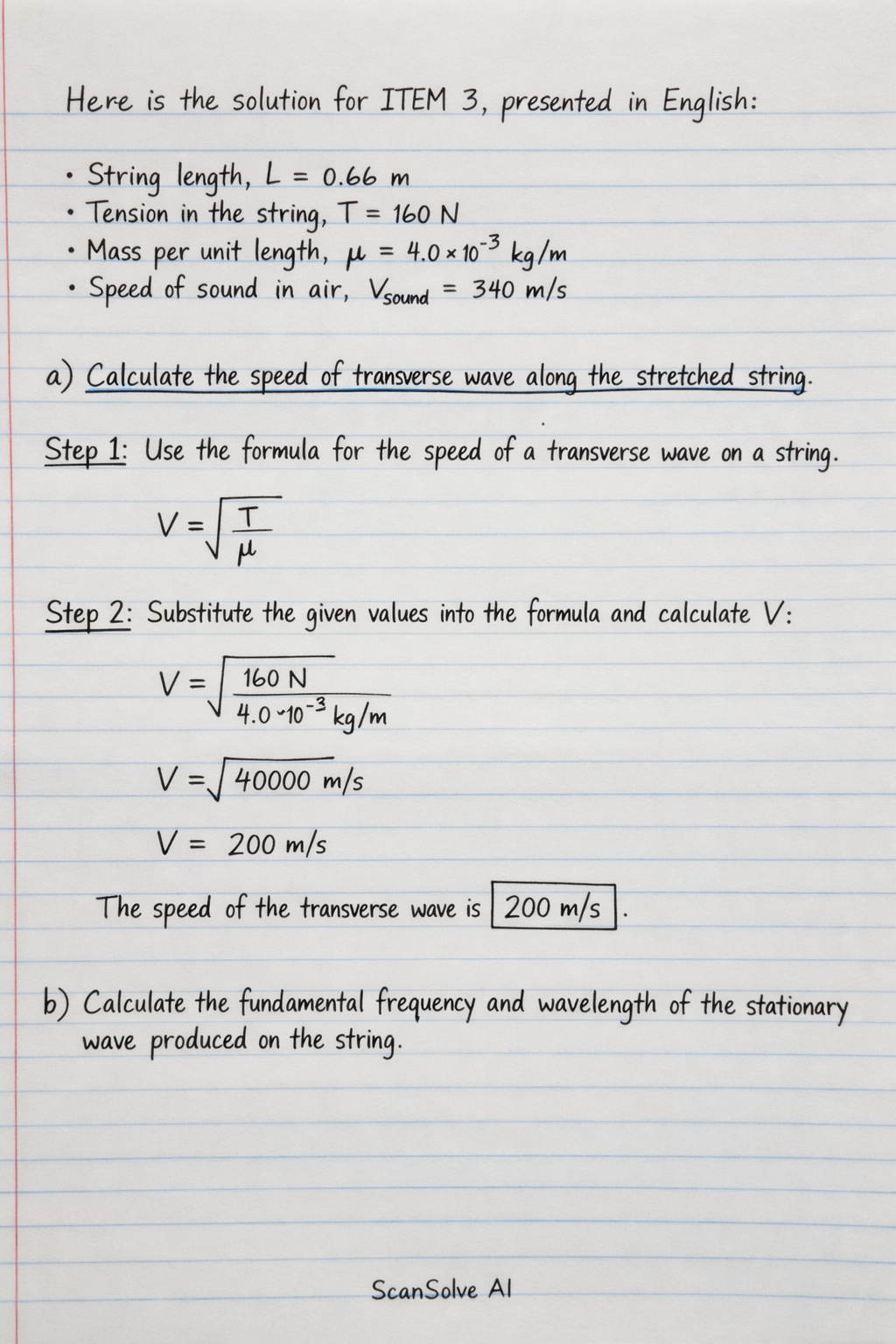
Here is the solution for ITEM 3, presented in English: This problem involves calculating the speed, fundamental frequency, and wavelength of a transverse wave on a stretched string, along with concepts of sound intensity. Given values: • String length, L = 0.66 m • Tension in the string, T = 160 N • Mass per unit length, = 4.0 × 10^-3 kg/m • Speed of sound in air, V_sound = 340 m/s a) Calculate the speed of transverse wave along the stretched string. Step 1: Use the formula for the speed of a transverse wave on a string. The speed V of a transverse wave on a stretched string is given by: V = sqrt((T)/()) Step 2: Substitute the given values into the formula and calculate V. V = sqrt(160 N)4.0 × 10^-3 kg/m V = sqrt(40000) m/s V = 200 m/s The speed of the transverse wave is 200 m/s. b) Calculate the fundamental frequency and wavelength of the stationary wave produced on the string. Step 3: Calculate the wavelength for the fundamental mode (first harmonic). For a string fixed at both ends, the fundamental wavelength (_1) is twice the length of the string: _1 = 2L _1 = 2 × 0.66 m _1 = 1.32 m The fundamental wavelength is 1.32 m. Step 4: Calculate the fundamental frequency. The fundamental frequency (f_1) is related to the wave speed V and fundamental wavelength _1 by the formula f_1 = (V)/(_1): f_1 = 200 m/s1.32 m f_1 ≈ 151.52 Hz The fundamental frequency is 151.52 Hz. c) Determine by what percentage the tension T must be increased to raise the fundamental pitch of the string by 10%. Step 1: Write the relationship between fundamental frequency and tension. The fundamental frequency (f_1) of a wave on a string is given by the formula: f_1 = (1)/(2L)sqrt((T)/()) From this, we see that f_1 is directly proportional to the square root of the tension: f_1 sqrt(T). Step 2: Find the relationship for the new tension. If the fundamental frequency is increased by 10%, the new frequency f_1' will be 1.10 f_1. Thus, we can write: (f_1')/(f_1) = (1.10 f_1)/(f_1) = 1.10 Using the proportionality f_1 sqrt(T): (f_1')/(f_1) = sqrt((T')/(T)) Where T' is the new tension. 1.10 = sqrt((T')/(T)) Step 3: Calculate the percentage increase in tension. Square both sides: (1.10)^2 = (T')/(T) 1.21 = (T')/(T) This means T' = 1.21 T. The percentage increase in tension is: Percentage increase = (T' - T)/(T) × 100\% = (1.21T - T)/(T) × 100\% = (0.21T)/(T) × 100\% = 0.21 × 100\% = 21\% The tension must be increased by 21\%. d) Define sound intensity (I) and sound intensity level (B). • Sound intensity (I): This is the amount of sound energy passing per unit time through a unit area that is perpendicular to the direction of sound wave propagation. It is measured in Watts per square meter (W/m^2). • Sound intensity level (B): This is a logarithmic measure of the sound intensity relative to a reference intensity, which is typically the threshold of human hearing. It is measured in decibels (dB). e) Calculate the sound intensity I in W/m² corresponding to the 100 dB measurement. Step 1: Use the formula for sound intensity level. The formula for sound intensity level (B) is: B = 10 _10((I)/(I_0)) Where I is the sound intensity, and I_0 is the reference intensity, which is 10^-12 W/m^2. Step 2: Substitute the given values and solve for I. We are given B = 100 dB. 100 = 10 _10((I)/(10^-12)) Divide both sides by 10: 10 = _10((I)/(10^-12)) To remove the logarithm, raise both sides to the power of 10: 10^10 = (I)/(10^-12) Solve for I: I = 10^10 × 10^-12 I = 10^(10-12) I = 10^-2 W/m^2 The sound intensity is 10^-2 W/m^2. f) Calculate the wavelength of emitted sound wave. Step 1: Identify the given values and the necessary frequency. The speed of sound in air is 340 m/s. We assume the emitted sound wave has the same frequency as the fundamental frequency of the string, which was calculated in part b) as f_1 ≈ 151.52 Hz. Given: Speed of sound in air, V_sound = 340 m/s Frequency of emitted sound, f = 151.52 Hz Step 2: Use the wave speed formula to calculate the wavelength. The relationship between wave speed (V), frequency (f), and wavelength () is V = f. Rearranging for wavelength: = (V)/(f) Step 3: Substitute the values and calculate the wavelength. = 340 m/s151.52 Hz ≈ 2.243 m The wavelength of the emitted sound wave is 2.243 m. g) Calculate the maximum This part of the question is incomplete as the quantity to be maximized is not specified. Therefore, it cannot be solved. Last free one today — make it count tomorrow, or type /upgrade for unlimited.