
We read your photo as:
Answer this in English showing all the steps used
ScanSolve AI Answer
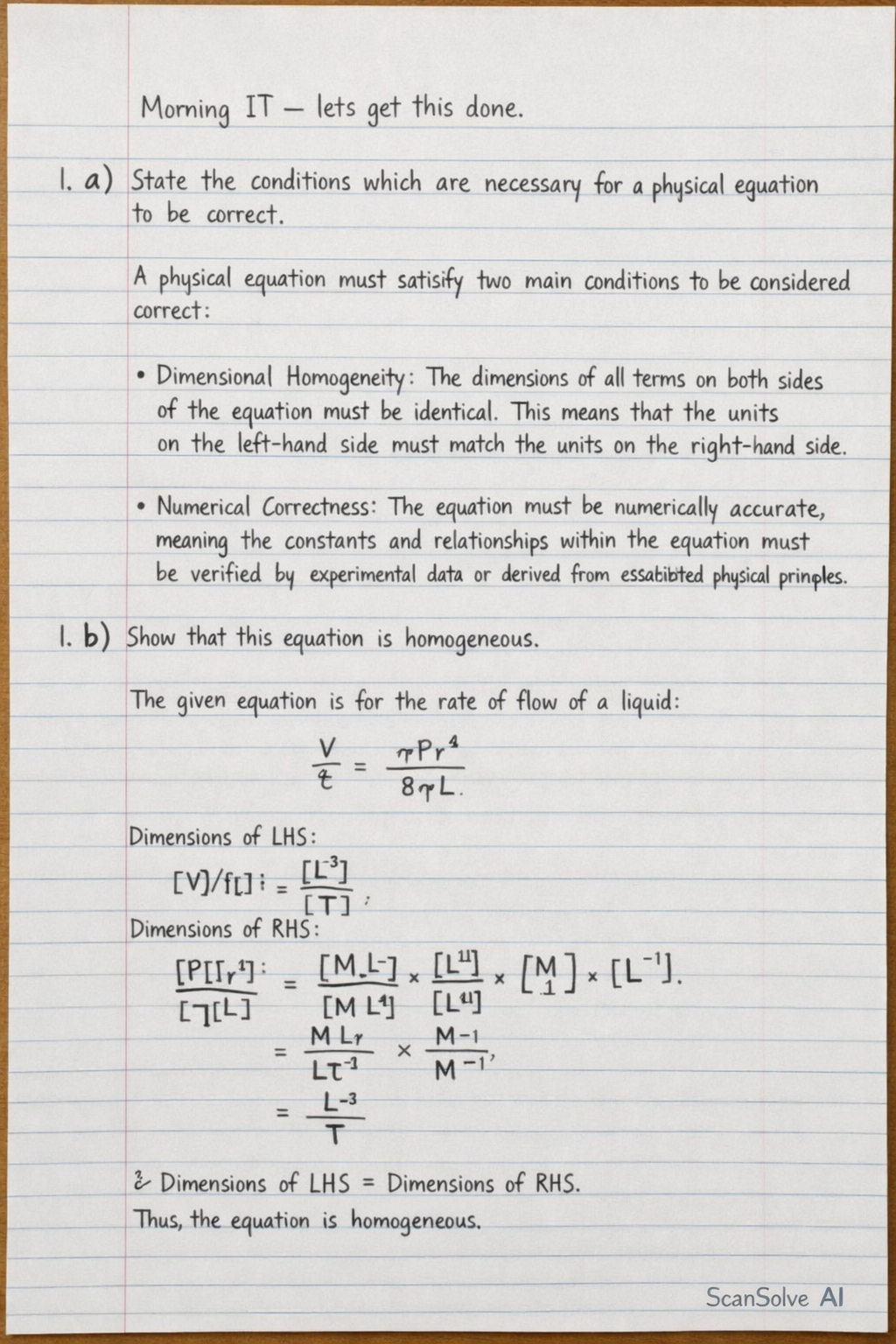
1. a) State the conditions which are necessary for a physical equation to be correct.
A physical equation must satisfy two main conditions to be considered correct:
- Dimensional Homogeneity: The dimensions of all terms on both sides of the equation must be identical. This means that the units on the left-hand side must match the units on the right-hand side.
- Numerical Correctness: The equation must be numerically accurate, meaning the constants and relationships within the equation must be verified by experimental data or derived from established physical principles.
1. b) Show that this equation is homogeneous.
The given equation is for the rate of flow of a liquid:
To show that this equation is homogeneous, we need to verify that the dimensions of the Left Hand Side (LHS) are equal to the dimensions of the Right Hand Side (RHS).
-
Step 1: Identify the dimensions of each variable.
- Volume ():
- Time ():
- Pressure (): Force per unit area. Force has dimensions , and area has dimensions . So,
- Radius ():
- Length ():
- Coefficient of viscosity (): Given in units of . (Newton) is a unit of force, so . (second) is a unit of time, so . (meter squared inverse) is a unit of length squared inverse, so . So,
- and 8 are dimensionless constants.
-
Step 2: Determine the dimensions of the Left Hand Side (LHS). The LHS is .
-
Step 3: Determine the dimensions of the Right Hand Side (RHS). The RHS is . We ignore the dimensionless constants and 8. First, find the dimensions of the numerator :
Next, find the dimensions of the denominator :
Now, combine these to find the dimensions of the RHS:
-
Step 4: Compare the dimensions of the LHS and RHS. Dimensions of LHS = Dimensions of RHS = Since the dimensions of both sides of the equation are identical, the equation is dimensionally homogeneous.
The equation is homogeneous.
Still stuck on this one?
Ask a follow-up, and the answer starts from this question.
More English Questions
Handwritten Step-by-Step Solution
Get this as a handwritten image on WhatsApp — like a tutor wrote it for you.
Try on WhatsApp