

This English question involves literary analysis, grammar, or writing skills. The detailed response below provides a well-structured answer with supporting evidence and clear explanations.
ScanSolve AI Answer
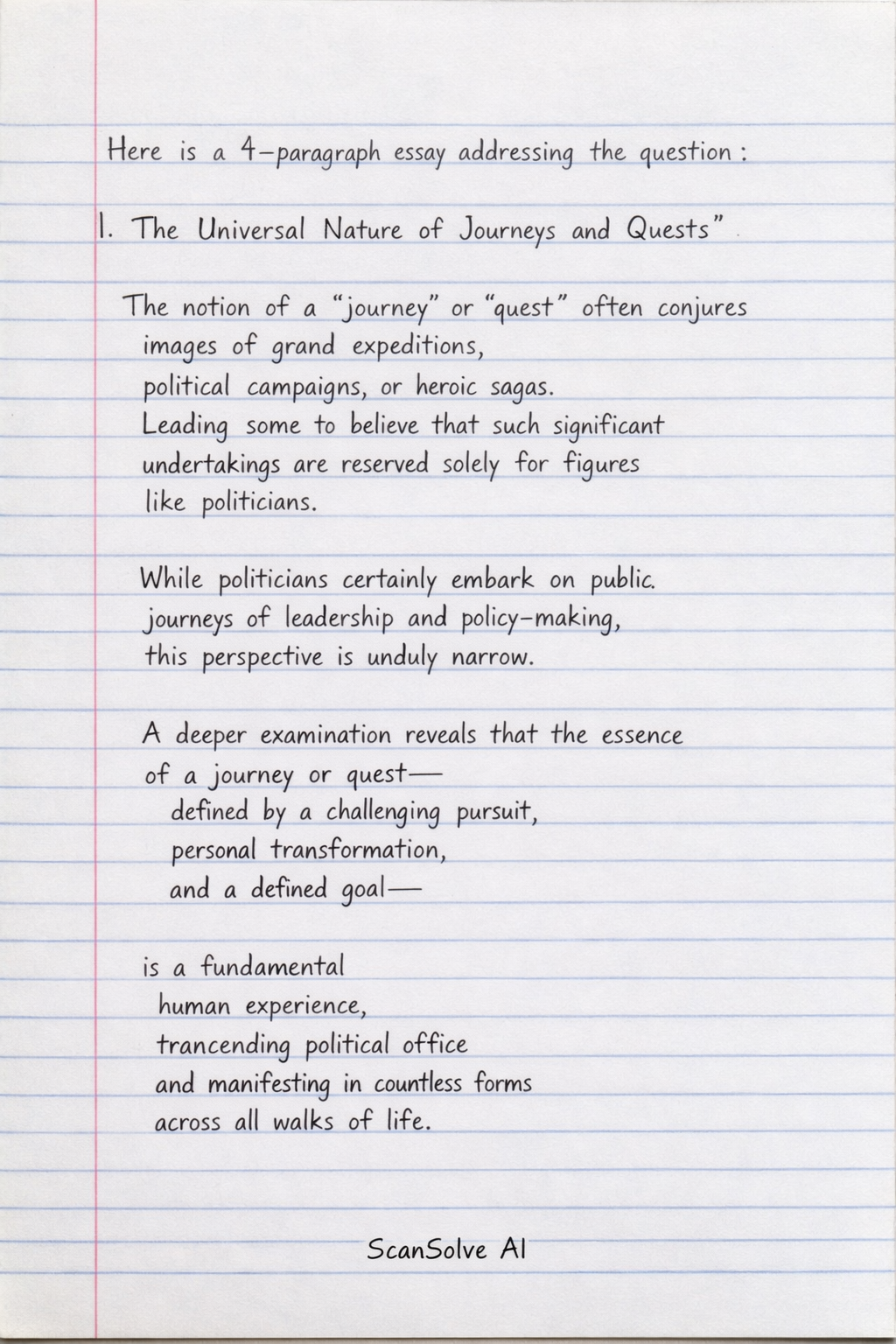
Here is a 4-paragraph essay addressing the question: The Universal Nature of Journeys and Quests The notion of a "journey" or "quest" often conjures images of grand expeditions, political campaigns, or heroic sagas, leading some to believe that such significant undertakings are reserved solely for figures like politicians. While politicians certainly embark on public journeys of leadership and policy-making, this perspective is unduly narrow. A deeper examination reveals that the essence of a journey or quest—defined by a challenging pursuit, personal transformation, and a defined goal—is a fundamental human experience, transcending political office and manifesting in countless forms across all walks of life. Indeed, many individuals undertake profound personal quests for self-discovery, knowledge, or the overcoming of immense adversity. Consider the remarkable journey of Helen Keller, who, despite being deaf and blind from a young age, embarked on a lifelong quest for communication and education. Her struggle to connect with the world, aided by her teacher Anne Sullivan, was a deeply personal and arduous journey that culminated in her becoming a celebrated author, activist, and lecturer. This was not a political journey, but a quest for personal liberation and intellectual growth that inspired millions, demonstrating that the most impactful journeys can be intensely individual and driven by an inner resolve. Furthermore, countless individuals pursue quests that drive innovation, social change, or artistic excellence, leaving indelible marks on society without ever holding political power. Marie Curie, for example, dedicated her life to a scientific quest to understand radioactivity, enduring immense hardship and working in challenging conditions. Her relentless pursuit of knowledge led to the discovery of polonium and radium, and she became the first woman to win a Nobel Prize and the only person to win Nobel Prizes in two different scientific fields. Her journey was a quest for scientific truth, not political power, yet its impact on medicine and physics was revolutionary and global. Similarly, artists, entrepreneurs, and activists frequently embark on quests to create, innovate, or advocate for justice, each a unique journey with far-reaching consequences. In conclusion, while politicians undoubtedly undertake significant public journeys, it is a misconception to view them as the sole proprietors of quests. The human experience is rich with diverse journeys—from personal battles against adversity and the pursuit of knowledge to the relentless drive for innovation and social justice. These quests, often undertaken by ordinary individuals, are equally profound, challenging, and transformative, proving that the spirit of adventure and purpose resides universally, far beyond the confines of political office. Last free one today — make it count tomorrow, or type /upgrade for unlimited.