
We read your photo as:
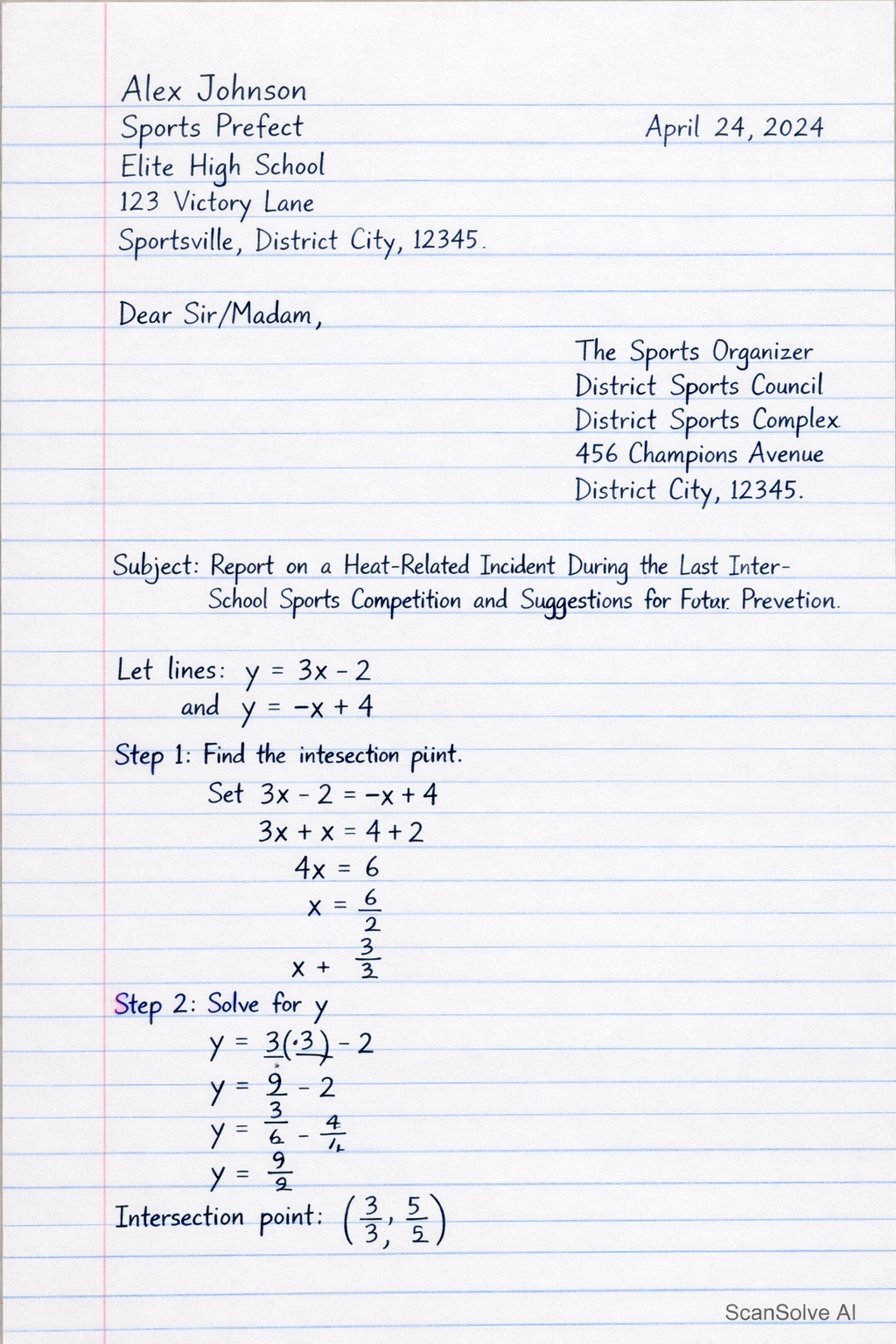
As the sports prefect of your school, write a letter to the sports organizer of your district describing an unfortunate incident during the last inter-school sports competition. Suggest three ways by which such an occurrence could be prevented in future.
ScanSolve AI Answer
[Your Name]
Sports Prefect
Elite High School
123 Victory Lane
Sportsville, District City, 12345
[Current Date]
The Sports Organizer
District Sports Council
District Sports Complex
456 Champions Avenue
District City, 12345
Dear Sir/Madam,
Subject: Report on a Heat-Related Incident During the Last Inter-School Sports Competition and Suggestions for Future Prevention
I am writing to you today in my capacity as the Sports Prefect of Elite High School to formally report a deeply concerning incident that occurred during the recently concluded Inter-School Sports Competition, specifically on [Date of Competition], at the District Stadium. While we acknowledge and appreciate the significant efforts involved in organizing such a large-scale and important event for our district's youth, a particular occurrence during the Boys' Under-17 3000-meter race highlighted critical areas where athlete welfare and environmental safety protocols require substantial enhancement. It is imperative that we address this matter with urgency to prevent similar, or potentially more severe, heat-related incidents from happening in future competitions, thereby safeguarding the health and safety of all participants.
The incident unfolded during the highly anticipated Boys' Under-17 3000-meter race, which commenced in the mid-afternoon under unusually high temperatures and significant humidity. Approximately two-thirds of the way through the race, one of our school's dedicated athletes, [Athlete's Name], began to show visible signs of distress. He was observed staggering slightly, his pace faltering, and his complexion appeared unusually pale. Despite his determination, in the final lap, just meters from the finish line, he collapsed onto the track, clearly suffering from severe heat exhaustion. The sight of an athlete collapsing in such a manner was distressing for everyone present, including fellow competitors, coaches, parents, and spectators.
The immediate aftermath of the collapse was unfortunately characterized by a noticeable delay and a degree of confusion in providing prompt and effective medical assistance. While a few first-aid volunteers were present, their response to a severe heat-related emergency seemed uncoordinated. It took several crucial minutes for them to reach the athlete, and there was a visible lack of immediate cooling measures such as ice packs, cold towels, or a shaded area readily available at the trackside. The athlete had to be carefully moved to a shaded area by his coach and a few concerned officials, rather than being swiftly attended to with specialized equipment. This delay in professional intervention not only exacerbated the athlete's discomfort but also caused significant anxiety among the crowd. The race was temporarily halted, disrupting the flow of the competition and casting a somber mood over the event. Ultimately, [Athlete's Name] required hospitalization for severe heat exhaustion, an outcome that could potentially have been avoided with more robust preventative measures and a swifter, more equipped emergency response. This incident underscored a critical gap in our preparedness for extreme environmental conditions during sporting events.
To prevent such unfortunate occurrences and to ensure the optimal safety and well-being of all participants in future inter-school sports competitions, I respectfully suggest three key areas for immediate improvement:
Firstly, there must be significantly enhanced hydration and cooling protocols implemented across all competition venues, particularly for endurance events. This includes increasing the number and accessibility of water stations along the track and at the finish line, ensuring they are well-stocked with not only water but also electrolyte-rich beverages. Furthermore, designated shaded recovery zones, equipped with misting fans, cool towels, and readily available ice packs, should be strategically placed at various points around the venue, especially near the finish lines of longer races. For events held in high temperatures, mandatory hydration breaks or even shortened race distances should be considered and clearly communicated to all participants and coaches beforehand. This proactive approach to hydration and cooling is fundamental to mitigating the risks associated with heat stress.
Secondly, I recommend improved medical preparedness specifically for heat-related illnesses and robust environmental monitoring. The medical team present at the competition should be expanded to include personnel specifically trained in recognizing, assessing, and treating various stages of heat-related illnesses, from heat cramps to heatstroke. Essential medical equipment for rapid cooling, such as cold water immersion tubs or ice baths, should be readily available at dedicated medical stations. Crucially, throughout the competition day, there should be continuous monitoring of environmental conditions, including ambient temperature, humidity, and the Wet Bulb Globe Temperature (WBGT) index. Pre-determined thresholds for these environmental factors should be established, triggering automatic modifications to the event schedule, such as postponing races, shortening distances, or increasing rest periods, to ensure athlete safety. Clear communication channels between environmental monitoring teams and event organizers are vital for swift decision-making.
Finally, the implementation of comprehensive pre-event athlete and coach education on heat stress management is essential. Before the commencement of any competition, mandatory briefings should be conducted for all participating athletes and their coaches. These sessions should cover critical topics such as proper hydration strategies before, during, and after competition, the importance of acclimatization to hot weather, and how to recognize the early symptoms of heat exhaustion in themselves and their teammates. Coaches should be specifically trained on their responsibility to monitor their athletes closely for signs of distress and to make informed decisions about withdrawing an athlete from competition if their health is at risk. Providing clear guidelines on nutrition, adequate rest, and the importance of reporting any feeling of unwellness will empower both athletes and coaches to prioritize health over performance, fostering a safer competitive environment.
I believe that by implementing these comprehensive suggestions, the District Sports Council can significantly enhance the safety standards and overall experience of future inter-school sports competitions. We are committed to fostering a safe and supportive environment for our athletes, and we trust that these recommendations will be given due consideration.
Yours faithfully,
[Your Name]
Sports Prefect
Elite High School
Still stuck on this one?
Ask a follow-up, and the answer starts from this question.
More English Questions
Handwritten Step-by-Step Solution
Get this as a handwritten image on WhatsApp — like a tutor wrote it for you.
Try on WhatsApp