
Assignment 1 What is irrigation, and why is it important in agriculture? Describe any four methods of irrigation and give one advantage of each.in English language and more explanation
ScanSolve AI Answer
Step-by-step solution
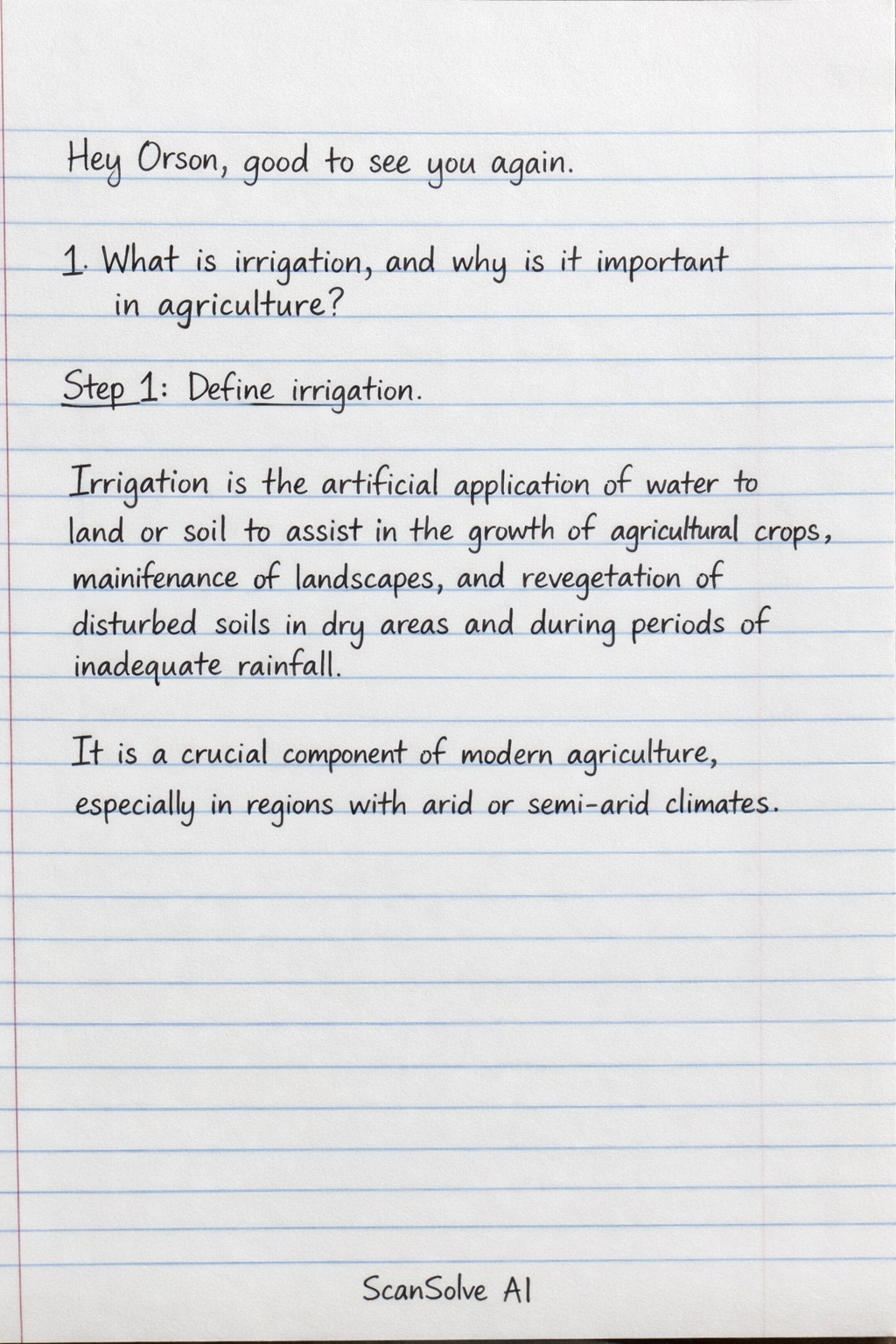
3 steps1. What is irrigation, and why is it important in agriculture?
Define irrigation.
Irrigation is the artificial application of water to land or soil to assist in the growth of agricultural crops, maintenance of landscapes, and revegetation of disturbed soils in dry areas and during periods of inadequate rainfall. It is a crucial component of modern agriculture, especially in regions with arid or semi-arid climates.
Explain the importance of irrigation in agriculture.
Irrigation is important in agriculture for several reasons:
- Ensuring Crop Growth: It provides the necessary water for crops to grow, especially when natural rainfall is insufficient or unreliable, preventing drought stress and crop failure.
- Increasing Yields: Consistent water supply allows farmers to achieve higher crop yields and better quality produce, leading to increased food production and economic benefits.
- Expanding Arable Land: Irrigation makes it possible to cultivate crops in regions that would otherwise be too dry for farming, expanding the amount of productive agricultural land.
- Crop Diversification: It enables farmers to grow a wider variety of crops, including those that require specific moisture levels, thereby diversifying agricultural output.
- Stabilizing Food Supply: By reducing reliance on unpredictable rainfall, irrigation helps stabilize food production, contributing to food security and reducing price volatility.
2. Describe any four methods of irrigation and give one advantage of each.
Describe four irrigation methods and their advantages.
-
Surface Irrigation: This is the oldest and most common method, where water flows over the land surface by gravity to irrigate the soil. It includes methods like furrow irrigation (water flows in small channels between crop rows) and flood irrigation (water covers the entire field).
- Advantage: It is generally low-cost to install and operate, especially in areas with abundant water supply and flat terrain.
-
Sprinkler Irrigation: In this method, water is pumped through a system of pipes and then sprayed into the air through sprinklers, falling onto the crops like natural rainfall. It can be adapted to various terrains and soil types.
- Advantage: It allows for uniform water distribution over the field, which can be adjusted to match the crop's water requirements and soil infiltration rates, reducing water waste compared to some surface methods.
-
Drip (or Trickle) Irrigation: This method delivers water directly to the root zone of plants, drop by drop, through a network of pipes, valves, and emitters. It is highly efficient as it minimizes evaporation and runoff.
- Advantage: It offers high water use efficiency by delivering water precisely where it is needed, significantly reducing water consumption and preventing weed growth between plants.
-
Subsurface Irrigation: This method involves applying water directly to the root zone of plants from below the soil surface. It can be achieved through buried pipes or by controlling the water table level.
- Advantage: It results in minimal water loss due to evaporation from the soil surface and can be highly efficient in delivering water directly to the plant roots.
-
Still stuck on this one?
Ask a follow-up, and the answer starts from this question.
More English Questions
Handwritten Step-by-Step Solution
Get this as a handwritten image on WhatsApp — like a tutor wrote it for you.
Try on WhatsApp