
We read your photo as:
Attempt all questions, choosing a correct answer from options provided and shade the box that corresponds to your chosen answer.
ScanSolve AI Answer
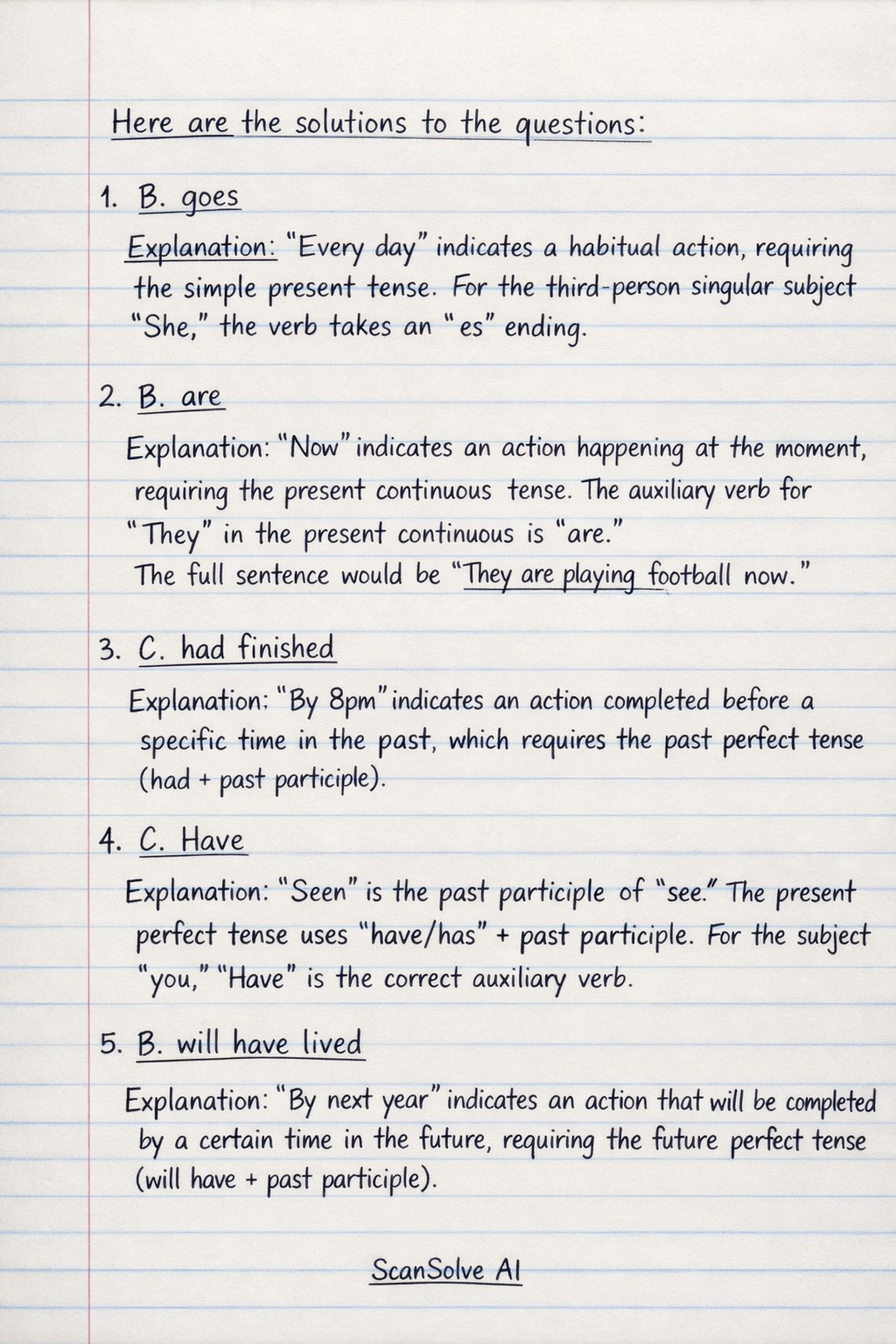
Here are the solutions to the questions:
-
B. goes Explanation: "Every day" indicates a habitual action, requiring the simple present tense. For the third-person singular subject "She," the verb takes an "-es" ending.
-
B. are Explanation: "Now" indicates an action happening at the moment, requiring the present continuous tense. The auxiliary verb for "They" in the present continuous is "are." The full sentence would be "They are playing football now."
-
C. had finished Explanation: "By 8pm" indicates an action completed before a specific time in the past, which requires the past perfect tense (had + past participle).
-
C. Have Explanation: "Seen" is the past participle of "see." The present perfect tense uses "have/has" + past participle. For the subject "you," "Have" is the correct auxiliary verb.
-
B. will have lived Explanation: "By next year" indicates an action that will be completed by a certain time in the future, requiring the future perfect tense (will have + past participle).
-
B. doesn't Explanation: For a simple present negative sentence with the third-person singular subject "He," the correct auxiliary verb is "doesn't."
-
C. are writing Explanation: "Right now" indicates an action happening at the moment of speaking, requiring the present continuous tense. For the subject "we," the form is "are writing."
-
B. She has two brothers Explanation: "Has" is correctly used with singular third-person subjects like "She."
-
B. taught Explanation: "Teach" is an irregular verb, and its simple past tense form is "taught."
-
B. should Explanation: "Should" is the modal auxiliary verb commonly used to give advice or make recommendations.
-
B. Dear Explanation: For a formal letter to a principal, "Dear Sir" or "Dear Madam" is the appropriate and respectful salutation.
-
B. Yours faithfully, John Explanation: "Yours faithfully" is the standard formal closing for a letter when the recipient's name is not known (e.g., "Dear Sir/Madam").
-
C. What's up? Explanation: "What's up?" is a very casual and informal greeting.
-
B. Sender's address top right, receiver's below Explanation: In a formal letter, the sender's address is typically placed at the top right, followed by the receiver's address below it on the left.
-
B. A formal complaint letter Explanation: A subject line is crucial in formal letters, especially complaint letters, to clearly and concisely state the purpose of the communication.
-
C. Informal letter Explanation: Phrases like "LOL" and "bro" are examples of informal language, suitable for an informal letter to a friend.
-
B. Official communication/request Explanation: Formal letters are primarily used for official communication, making requests, lodging complaints, or conveying important information in a professional context.
-
C. Dear Chinedu, Explanation: "Dear [First Name]" is a personal and informal salutation suitable for a letter to a friend.
-
B. Tells a story with events Explanation: Narrative writing is a form of writing that tells a story, recounting a sequence of events.
-
C. Past tense Explanation: Most stories, especially works of fiction, are typically written in the past tense to describe events that have already occurred.
-
B. Sensory details + feelings Explanation: Descriptive writing aims to create a vivid picture in the reader's mind by appealing to the five senses and evoking emotions or feelings.
-
B. Descriptive Explanation: The sentence uses adjectives like "sweet," "golden," and "juicy" to provide sensory details about the mango, which is characteristic of descriptive writing.
-
B. One day, I lost my wallet Explanation: Narratives often begin with phrases that introduce a specific event or setting the stage for a story, such as "One day..."
-
B. To paint a picture Explanation: Adjectives are used in descriptive writing to add detail and create a vivid mental image or "paint a picture" for the reader.
-
B. John kicked the ball Explanation: In the active voice, the subject performs the action. Here, "John" (the subject) performs the action of "kicking."
-
B. Rice is cooked by the chef Explanation: To change an active sentence to passive voice, the object of the active sentence ("rice") becomes the subject, and the verb is changed to "be" + past participle ("is cooked"), often followed by "by" and the original subject ("by the chef").
Still stuck on this one?
Ask a follow-up, and the answer starts from this question.
More English Questions
Handwritten Step-by-Step Solution
Get this as a handwritten image on WhatsApp — like a tutor wrote it for you.
Try on WhatsApp