

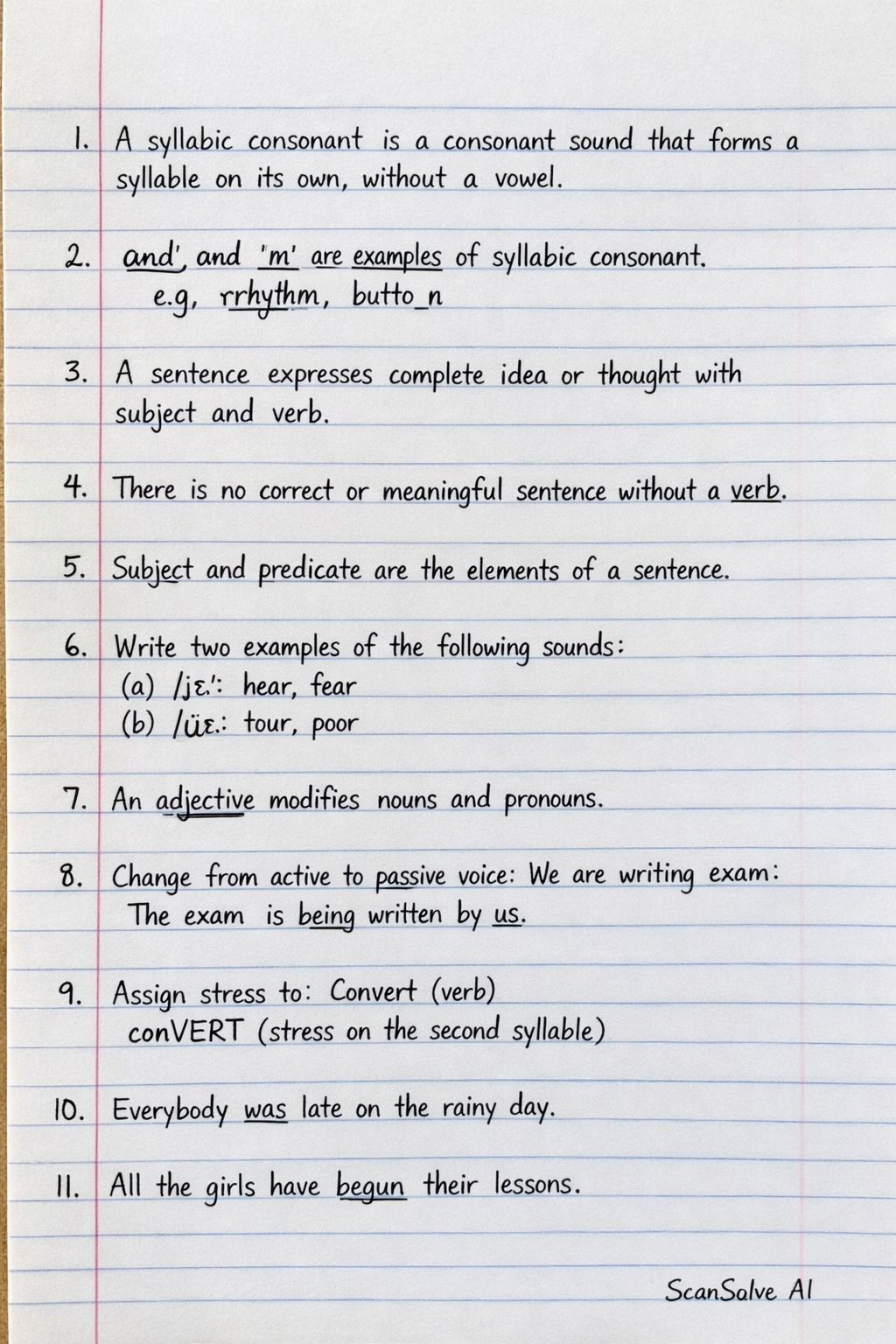
This English question involves literary analysis, grammar, or writing skills. The detailed response below provides a well-structured answer with supporting evidence and clear explanations.
ScanSolve AI Answer
here are the answers to your English Language questions: 1. A syllabic consonant is a consonant sound that forms a syllable on its own, without a vowel. 2. and /m/ are examples of syllabic consonant. Indicate by underlining them. (The image already has "and" filled in. Another common syllabic consonant is /m/ as in "rhythm" or /n/ as in "button".) 3. A sentence expresses complete idea or thought with subject and verb. 4. There is no correct or meaningful sentence without a verb. 5. Subject and predicate are the elements of a sentence. 6. Write two examples of the following sounds. (a) /ɪə/: hear, fear* (b) /ʊə/: tour, poor* 7. An adjective modifies nouns and pronouns. 8. Change from active to passive voice: We are writing exam: The exam is being written by us*. 9. Assign stress to: Convert (verb) conVERT (stress on the second syllable) 10. Everybody was late on the rainy day. (was, were) 11. All the girls have begun their lessons. (begun, began) 12. Mr. Peter is the principal of the college. (principle, principal) Change the following possessive pronouns to possessive adjectives. 13. This car is yours. This is your* car. 14. That house is ours. That is our* house. 15. David has neither a book (b) nor a pen. 16. Jude has no problem (a) hasn't he? Drop the next question.