
We read your photo as:
Choose the option that best completes each of the sentences below.
English
ScanSolve AI Answer
Here are the solutions to the questions:
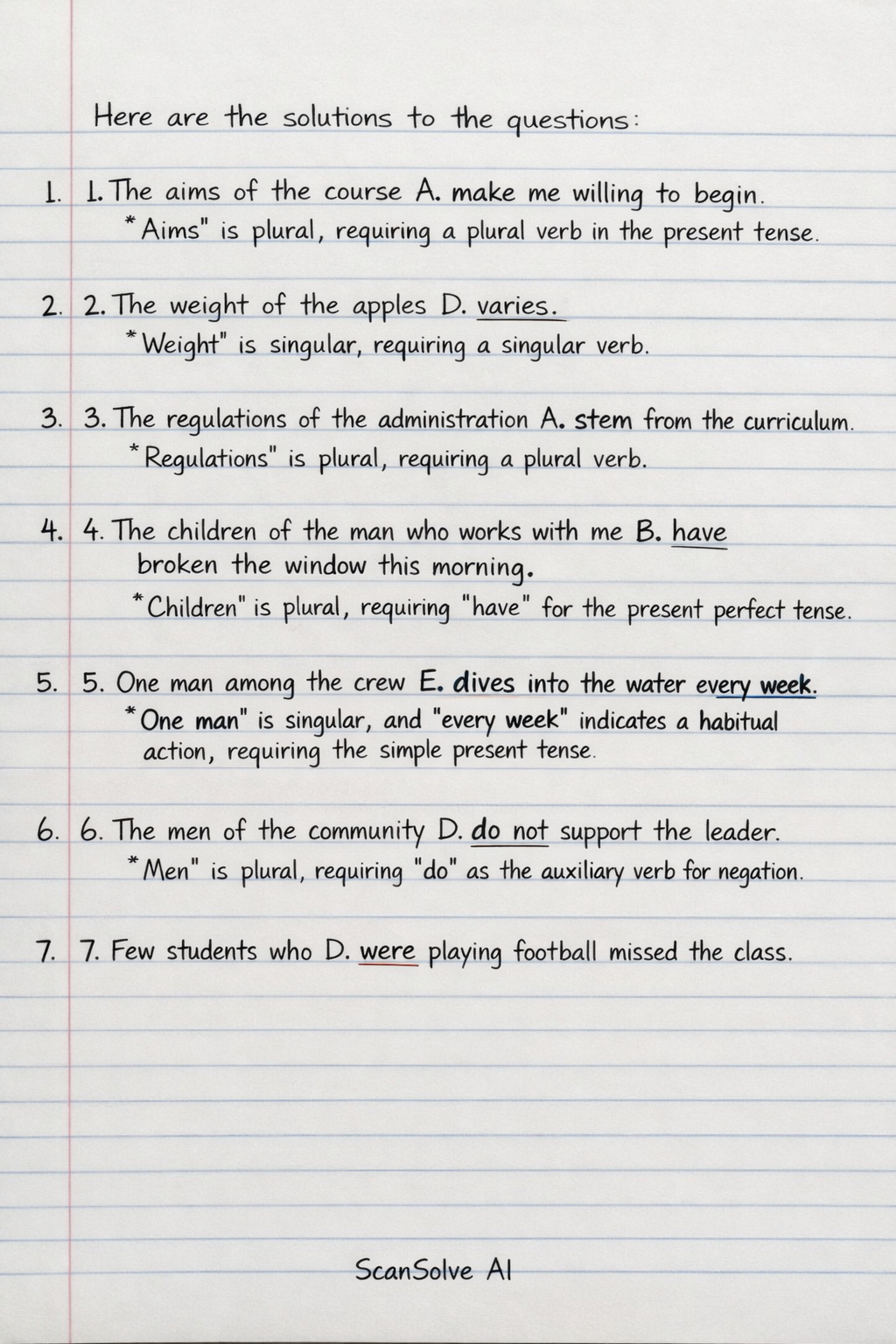
- 1. The aims of the course A. make me willing to begin.
- "Aims" is plural, requiring a plural verb in the present tense.
- 2. The weight of the apples D. varies.
- "Weight" is singular, requiring a singular verb.
- 3. The regulations of the administration A. stem from the curriculum.
- "Regulations" is plural, requiring a plural verb.
- 4. The children of the man who works with me B. have broken the window this morning.
- "Children" is plural, requiring "have" for the present perfect tense.
- 5. One man among the crew E. dives into the water every week.
- "One man" is singular, and "every week" indicates a habitual action, requiring the simple present tense.
- 6. The men of the community D. do not support the leader.
- "Men" is plural, requiring "do" as the auxiliary verb for negation.
- 7. Few students who D. were playing football missed the class.
- "Students" is plural, and the sentence describes a continuous action in the past, requiring "were" for the past continuous tense.
- 8. The police A. were told to be careful since the criminal was dangerous.
- "Police" is treated as a plural noun, and the sentence is in the passive voice, requiring "were told".
- 9. Students' minds B. have been confused about the order of structures.
- "Minds" is plural, and the sentence is in the present perfect passive voice.
- 10. Learning foreign languages B. requires a lot of time.
- "Learning foreign languages" is a gerund phrase acting as a singular subject, requiring a singular verb.
- 11. I'm looking forward to meeting Jane. It's years A. since we last saw each other.
- "Since" is used to indicate a point in time from which an action or state has continued.
- 12. Are you trying to say that I was C. guilty of the accident?
- "Guilty of" is the correct idiom for responsibility in a wrongdoing.
- 13. Let's hurry up, we don't have much time to B. spare.
- "Spare" means to have extra time or to use time economically.
- 14. I advise you to A. take advantage of this unusual opportunity.
- The idiom is "to take advantage of".
- 15. The motorcyclist swerved to the left to D. reach crashing against the lorry.
- This question is ambiguously phrased. The most common phrasing would be "to avoid crashing". Among the given options, "reach" is the least illogical choice, implying "to reach the point of crashing," though this is a very weak fit.
- 16. Sara B. did her best at the exam, but she failed it, anyway.
- The idiom is "to do one's best".
- 17. It's good to D. pay close attention to what your teachers say.
- The idiom is "to pay attention".
- 18. Could I A. draw your attention to one relevant factor?
- The idiom is "to draw attention to".
- 19. Dinner's ready, the table has already been C. laid.
- The past participle of "to lay" (to set a table) is "laid".
- 20. How many points do I need to C. score to qualify in this difficult case?
- To get points in a competition or exam, you "score" points.
- 21. In many ways my parents are very conservative but there are times when they surprise me with their B. liberal ideas on family planning.
- "Liberal" is the most direct antonym for "conservative" in the context of ideas and social views, implying openness to change and new opinions.
- 22. My brother loves dogs but he has a very strong B. dislike for cats.
- The opposite of "loves" is "dislike".
Was this helpful?
Still stuck on this one?
Ask a follow-up, and the answer starts from this question.
Got a different question?Ask your own question
More English Questions
Handwritten Step-by-Step Solution
Get this as a handwritten image on WhatsApp — like a tutor wrote it for you.
Try on WhatsApp