
We read your photo as:
Compose two narrative essays: one about a lost wallet, money, and a good Samaritan; the other illustrating 'once bitten twice shy'. Also, answer a question about Fathers of Nations.
ScanSolve AI Answer
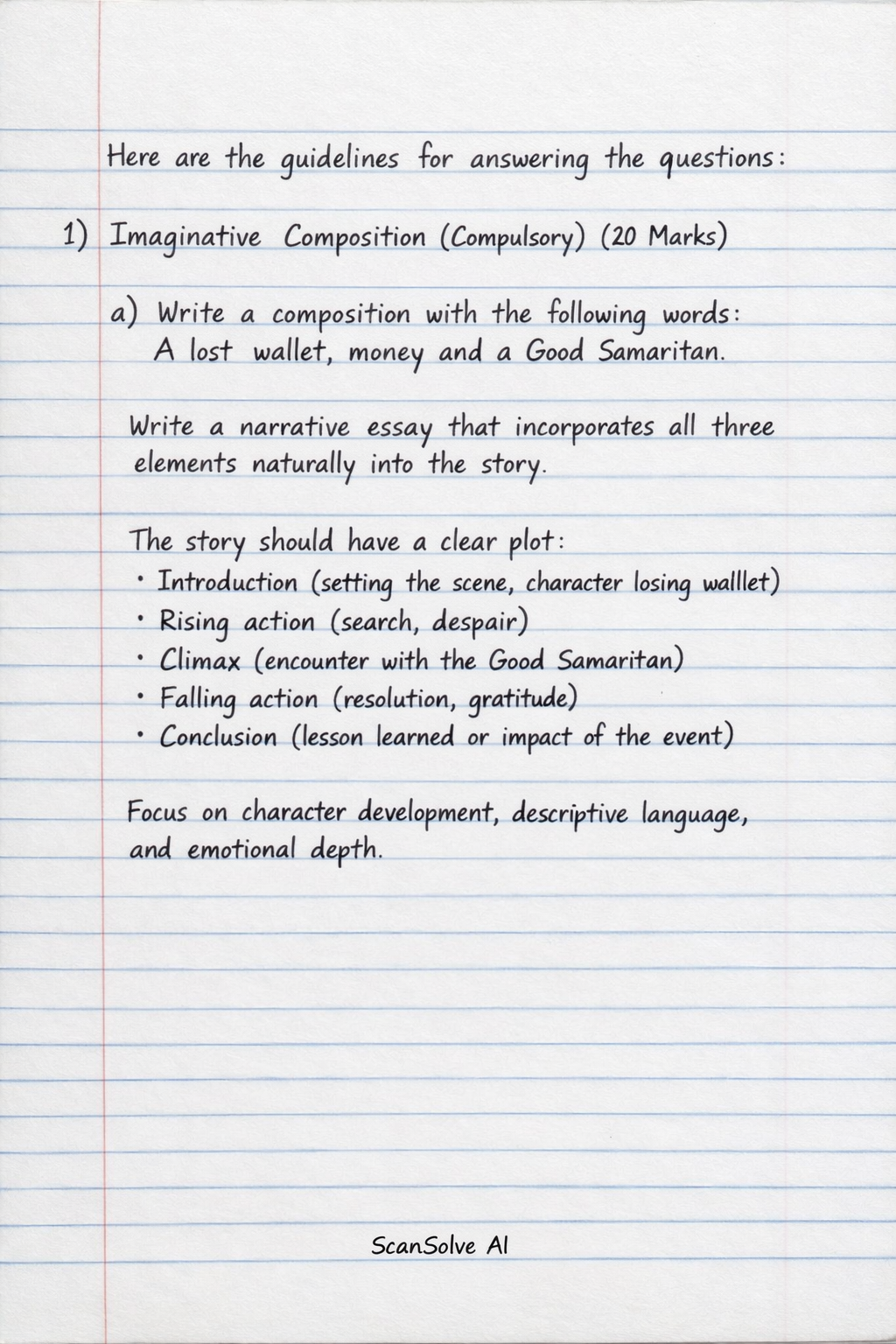
Here are the guidelines for answering the questions:
1) Imaginative Composition (Compulsory) (20 Marks)
-
a) Write a composition with the following words: A lost wallet, money and a Good Samaritan.
- Write a narrative essay that incorporates all three elements naturally into the story.
- The story should have a clear plot: introduction (setting the scene, character losing wallet), rising action (search, despair), climax (encounter with the Good Samaritan), falling action (resolution, gratitude), and conclusion (lesson learned or impact of the event).
- Focus on character development, descriptive language, and emotional depth.
-
b) Write a story to illustrate the saying: once bitten twice shy.
- Write a narrative essay where a character experiences a negative event (is "bitten") and subsequently becomes cautious or hesitant to repeat a similar action or trust a similar situation (is "twice shy").
- The story should clearly show the initial negative experience and then demonstrate how that experience influences the character's future behavior or decisions.
- Ensure the plot effectively illustrates the proverb.
2) The Compulsory Text (Answer both questions) (20 Marks)
Fathers of Nations by Paul B. Vitta.
-
a) "Sometimes going through challenges does not necessarily mean that is the end of the road." Using Prof. Kimani in Paul Vitta's Fathers of Nation, justify this statement.
- Introduce Prof. Kimani and his initial challenges (e.g., loss of family, academic stagnation, disillusionment with the continent's leadership).
- Discuss how he faces these challenges but does not give up. Instead, he channels his frustrations into a desire for change, becoming involved in the Way Omega and Path Alpha initiatives.
- Highlight his resilience and determination to contribute to a better future, even when faced with setbacks and the cynicism of others. Conclude by showing how his continued efforts, despite personal and professional hurdles, exemplify the statement.
-
b) The irresponsible decisions that people make in life have consequences. Drawing illustrations from the novel, Fathers of Nation, show how valid this assertion is.
- Introduce the concept of irresponsible decisions and their consequences as a central theme in the novel.
- Provide specific examples from the novel:
- President Bangoura's decision to cling to power and manipulate the summit, leading to continued suffering for his people and the failure of meaningful reform.
- Minister Zito's corrupt practices and self-serving actions, which perpetuate poverty and underdevelopment.
- The leaders' collective failure to genuinely address the continent's problems, prioritizing personal gain and political maneuvering over the welfare of their citizens, resulting in stagnation and disillusionment.
- Prof. Kimani's past decision to focus solely on academic pursuits, neglecting his family, which led to personal tragedy.
- Conclude by emphasizing how these illustrations from the novel strongly validate the assertion that irresponsible decisions inevitably lead to negative consequences.
3) The Optional Texts. (20 Marks)
Answer any One of the following Three questions.
-
a. The Short Story: A Silent Song and Other Short Stories by Godwin Siundu. "Rosanna has admirable characters that contribute to the success of her as a person and her business." Write an essay in support of this statement.
- Introduce Rosanna and her background, establishing her as a character who achieves success.
- Identify and discuss her admirable character traits, providing specific examples from the story to illustrate each:
- Diligence/Hard work: Her commitment to her craft or business.
- Resilience/Perseverance: Her ability to overcome challenges and setbacks.
- Integrity/Honesty: Her ethical approach to her work and dealings with others.
- Creativity/Innovation: Her ability to think outside the box or adapt.
- Empathy/Compassion: How she interacts with and supports others.
- Explain how each of these traits directly contributes to her personal growth and the prosperity of her business. Conclude by summarizing how her character is central to her achievements.
-
b. Drama: Parliament of Owls by Adipo Sidang' "Wrong doings are expensive especially for leaders." Write an essay in support of this assertion drawing your illustrations on Adipo Sidang's play "Parliament of Owls."
- Introduce the play and its allegorical representation of leadership and governance.
- Discuss how the "wrong doings" of the owl leaders (e.g., corruption, abuse of power, deceit, neglect of their subjects) lead to significant costs.
- Provide specific illustrations from the play:
- Loss of trust and legitimacy: The citizens (other birds) lose faith in their leaders, leading to unrest and rebellion.
- Economic decline/suffering: The resources meant for the community are embezzled, leading to poverty and hardship for the common birds.
- Social instability/conflict: The division and injustice caused by the leaders' actions create tension and conflict within the parliament and the wider community.
- Personal downfall/punishment: The leaders themselves face consequences, such as being overthrown, disgraced, or even facing violence.
- Conclude by emphasizing that the play powerfully demonstrates how the moral and practical costs of leaders' wrongdoings are indeed "expensive," leading to the downfall of both the leaders and the society they govern.
-
c. The Novel
- The question for the novel is not visible in the provided image.
Still stuck on this one?
Ask a follow-up, and the answer starts from this question.
More English Questions
Handwritten Step-by-Step Solution
Get this as a handwritten image on WhatsApp — like a tutor wrote it for you.
Try on WhatsApp