
We read your photo as:
Critically explore the concept of identity with regards to the portrayal of the main character in the novel you are studying i.e. either Tsotsi OR Things Fall Apart.
ScanSolve AI Answer
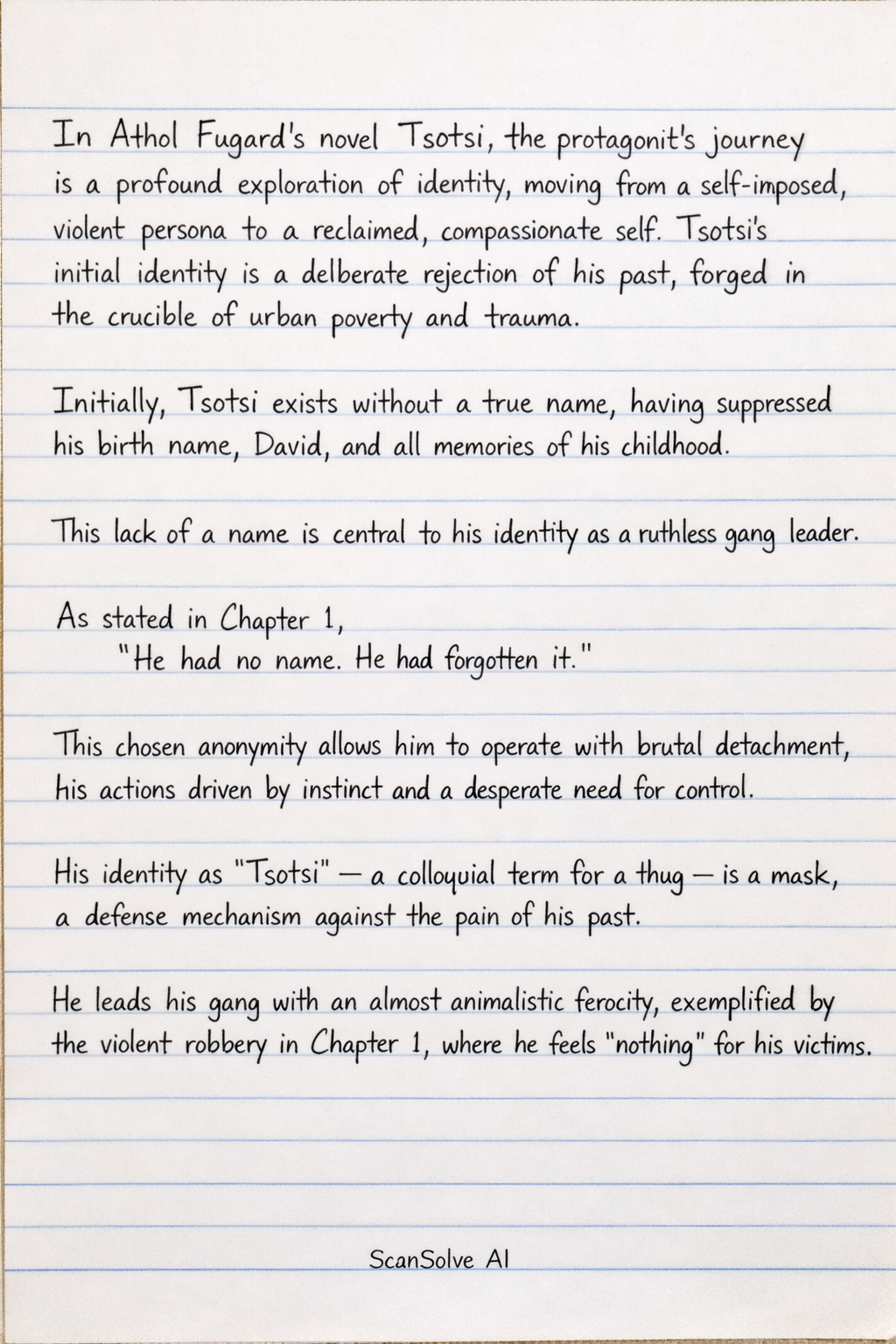
In Athol Fugard's novel Tsotsi, the protagonist's journey is a profound exploration of identity, moving from a self-imposed, violent persona to a reclaimed, compassionate self. Tsotsi's initial identity is a deliberate rejection of his past, forged in the crucible of urban poverty and trauma.
Initially, Tsotsi exists without a true name, having suppressed his birth name, David, and all memories of his childhood. This lack of a name is central to his identity as a ruthless gang leader. As stated in Chapter 1, "He had no name. He had forgotten it." This chosen anonymity allows him to operate with brutal detachment, his actions driven by instinct and a desperate need for control. His identity as "Tsotsi" – a colloquial term for a thug – is a mask, a defense mechanism against the pain of his past. He leads his gang with an almost animalistic ferocity, exemplified by the violent robbery in Chapter 1, where he feels "nothing" for his victims.
A pivotal moment in his transformation occurs in Chapter 3 when he is left with a baby after a botched kidnapping. This unexpected responsibility shatters his carefully constructed identity. The baby, initially an inconvenience, forces him to confront his own humanity. His clumsy attempts to care for the infant, such as trying to feed it condensed milk, mark the beginning of his emotional awakening. The baby's utter dependence chips away at his hardened exterior, compelling him to feel, to nurture, and to connect.
His interactions with other characters further dismantle his "Tsotsi" persona. His encounter with Boston, a former gang member, in Chapter 6, is significant. Boston's persistent questioning, particularly "What is it to be a man?", forces Tsotsi to reflect on his actions and the emptiness of his current existence. Later, his relationship with Miriam, a young mother, provides him with a model of care and empathy. Through her, he learns about tenderness and responsibility, which are alien concepts to his "Tsotsi" identity.
Crucially, Tsotsi's identity crisis culminates in the resurfacing of his traumatic memories. In Chapter 9, he recalls his childhood, his mother's arrest, and his subsequent abandonment, which led him to flee his home and adopt the "Tsotsi" identity. This remembrance of his true name, David, is a powerful act of reclamation. It signifies his acceptance of his past and his willingness to shed the violent persona he had adopted. By the novel's end, Tsotsi has transformed into David, a man capable of love, responsibility, and sacrifice, demonstrating that identity is not fixed but is a fluid construct shaped by experience, choice, and the courage to confront one's true self.
Still stuck on this one?
Ask a follow-up, and the answer starts from this question.
More English Questions
Handwritten Step-by-Step Solution
Get this as a handwritten image on WhatsApp — like a tutor wrote it for you.
Try on WhatsApp