

This English question involves literary analysis, grammar, or writing skills. The detailed response below provides a well-structured answer with supporting evidence and clear explanations.
ScanSolve AI Answer
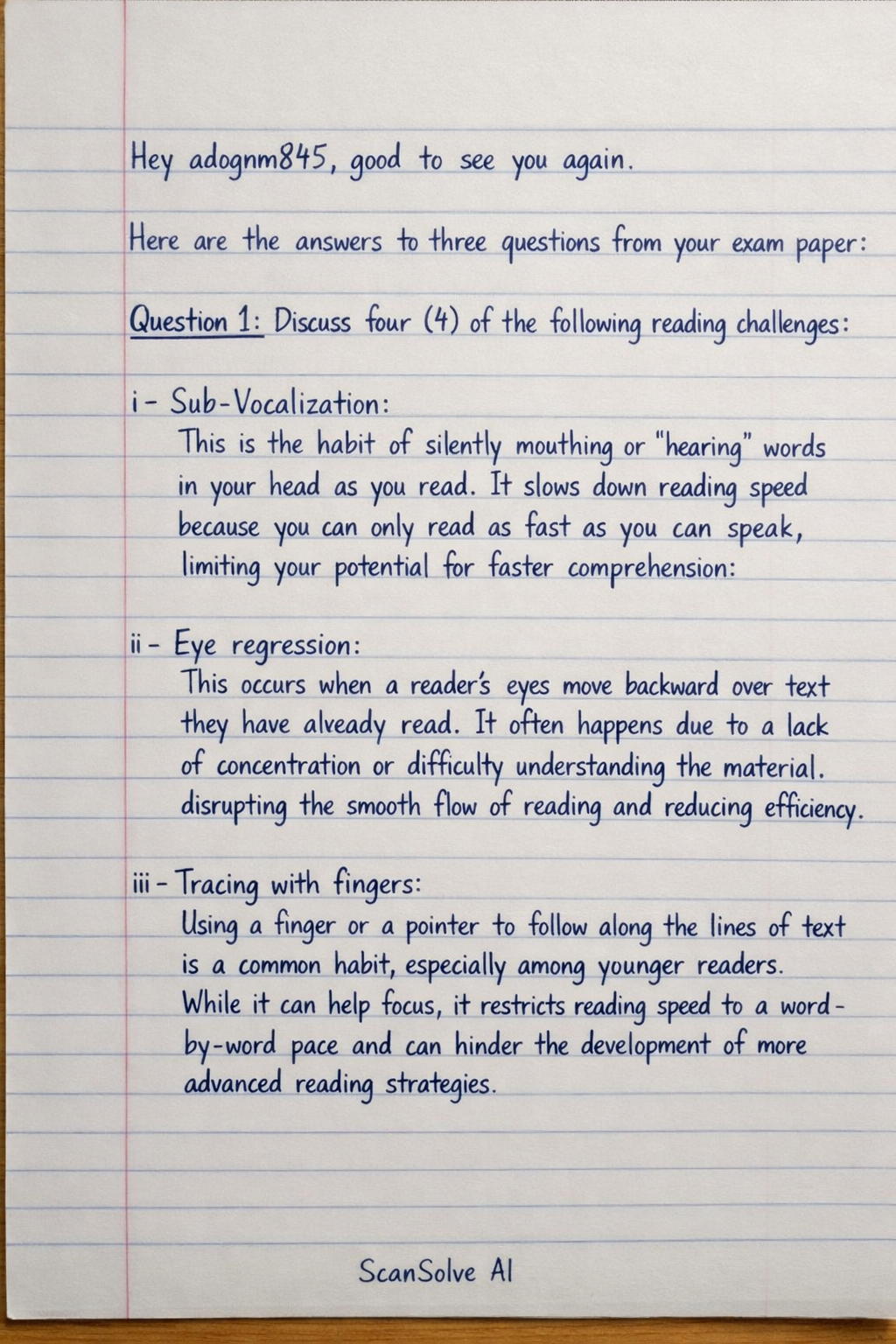
Hey adognm845, good to see you again. Here are the answers to three questions from your exam paper: Question 1: Discuss four (4) of the following reading challenges: i- Sub-Vocalization: This is the habit of silently mouthing or "hearing" words in your head as you read. It slows down reading speed because you can only read as fast as you can speak, limiting your potential for faster comprehension. ii- Eye regression: This occurs when a reader's eyes move backward over text they have already read. It often happens due to a lack of concentration or difficulty understanding the material, disrupting the smooth flow of reading and reducing efficiency. iii- Tracing with fingers: Using a finger or a pointer to follow along the lines of text is a common habit, especially among younger readers. While it can help focus, it restricts reading speed to a word-by-word pace and can hinder the development of more advanced reading strategies. iv- Head movement: Moving your head from side to side while reading is an inefficient physical habit. Effective reading primarily involves eye movements across the page, and unnecessary head motion can cause fatigue and slow down reading speed. Question 2: a- Define the term Reading Reading is the cognitive process of decoding written symbols to construct meaning. It involves recognizing words, understanding their definitions, and interpreting the overall message conveyed by the text. b- List five (5) types of Reading 1. Skimming 2. Scanning 3. Extensive Reading 4. Intensive Reading 5. Critical Reading c- Explain two (2) of the followings in relation to reading skills: i- Decoding: Decoding is the ability to translate written words into spoken language by understanding the relationship between letters and sounds (phonics). It is a fundamental skill that allows readers to pronounce unfamiliar words and access their meaning. ii- Fluency: Reading fluency is the ability to read text accurately, quickly, and with appropriate expression. Fluent readers can focus their cognitive resources on understanding the text rather than struggling with individual words, which significantly aids comprehension. Question 3: a- What is Text Comprehension? Text comprehension is the ability to understand and interpret the meaning of written text. It involves making sense of words, sentences, and paragraphs to grasp the overall message, draw inferences, and connect new information with existing knowledge. b- Explain two (2) techniques for Text Comprehension 1. Summarizing: This technique involves identifying the main ideas and key details of a text and restating them in your own words, in a shorter form. It helps readers distinguish essential information from less important details and consolidate understanding. 2. Questioning: Readers can improve comprehension by asking questions before, during, and after reading. This active engagement encourages critical thinking, helps clarify confusing parts, and prompts the reader to seek answers within the text. c- Discuss four (4) importance of Text Comprehension 1. Knowledge Acquisition: Strong text comprehension allows individuals to effectively learn new information from books, articles, and other written materials, expanding their general knowledge and understanding of various subjects. 2. Critical Thinking: It enables readers to analyze, evaluate, and synthesize information presented in a text, fostering the development of critical thinking and problem-solving skills. 3. Effective Communication: Understanding written communication is crucial for responding appropriately in academic, professional, and social contexts, thereby improving overall communication abilities. 4. Academic and Professional Success: High levels of text comprehension are fundamental for success in education, as well as for understanding instructions, reports, and complex documents required in most professional fields. Send me the next one 📸