
We read your photo as:
Distinguish between posters and banners, simple and complex illustrations, project work and research proposals, and syllables and intonation.
ScanSolve AI Answer
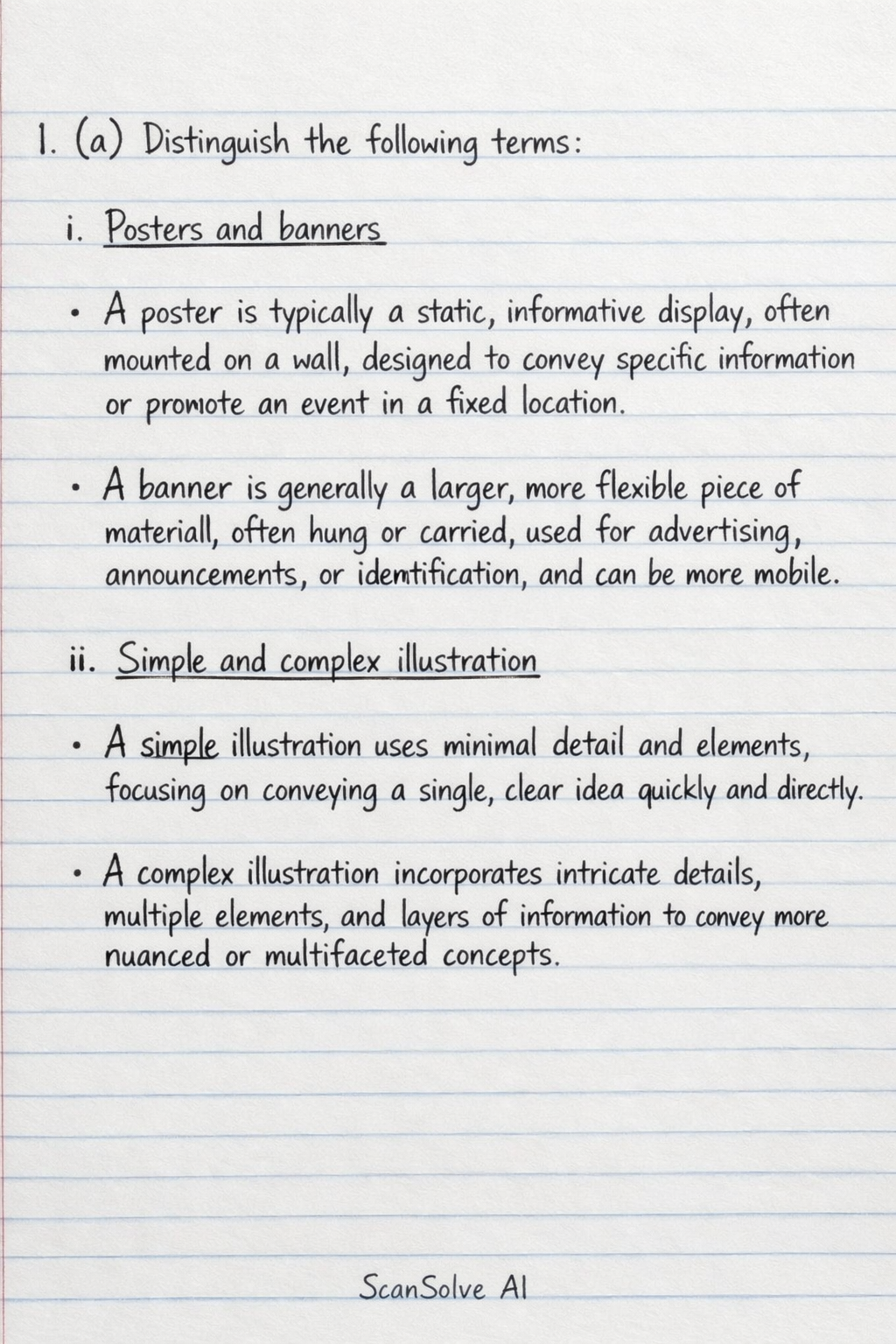
- (a) Distinguish the following terms:
-
i. Posters and banners
- A poster is typically a static, informative display, often mounted on a wall, designed to convey specific information or promote an event in a fixed location.
- A banner is generally a larger, more flexible piece of material, often hung or carried, used for advertising, announcements, or identification, and can be more mobile.
-
ii. Simple and complex illustration
- A simple illustration uses minimal detail and elements, focusing on conveying a single, clear idea quickly and directly.
- A complex illustration incorporates intricate details, multiple elements, and layers of information to convey more nuanced or multifaceted concepts.
-
iii. Project work and research proposal
- Project work refers to the actual execution of a task or study, involving practical application, data collection, analysis, and the production of a final output or report.
- A research proposal is a detailed plan outlining a proposed research study, including its objectives, methodology, literature review, and expected outcomes, submitted for approval before the research begins.
-
iv. Syllable and intonation
- A syllable is a unit of pronunciation consisting of a single vowel sound, with or without surrounding consonants, forming the basic building blocks of words.
- Intonation refers to the rise and fall of the voice in speaking, which conveys meaning, emotion, or grammatical structure beyond the individual words themselves.
-
v. Classroom presentation and debate
- A classroom presentation is a formal or informal delivery of information by one or more students to an audience, primarily for informing or explaining a topic.
- A debate is a structured argument between two opposing sides on a particular topic, where participants present arguments, rebut opposing points, and aim to persuade an audience or judge.
-
(b) Four challenges faced during a classroom presentation and how they were addressed:
- i. Challenge: Stage Fright/Nervousness
- Addressed by: Practicing the presentation multiple times, focusing on breathing exercises, and visualizing a successful delivery to build confidence.
- ii. Challenge: Technical Issues
- Addressed by: Preparing backup materials (e.g., handouts, printed slides), arriving early to test equipment, and having a contingency plan for unexpected failures.
- iii. Challenge: Time Management
- Addressed by: Rehearsing with a timer to ensure the presentation fits within the allotted time, prioritizing key points, and preparing concise content.
- iv. Challenge: Audience Engagement
- Addressed by: Incorporating interactive elements like questions, polls, or short activities, using varied vocal tone and body language, and making eye contact with different audience members.
- i. Challenge: Stage Fright/Nervousness
-
(a) Syllabic structure of the following words:
- i. Abstract: Ab-stract
- ii. December: De-cem-ber
- iii. Eye: Eye
- iv. Starts: Starts
- v. Street: Street
-
(b) Five key tasks in proofreading:
- Checking for spelling errors.
- Correcting grammatical mistakes.
- Ensuring proper punctuation.
- Verifying consistency in formatting and terminology.
- Checking for typographical errors and missing words.
-
(c) Five importance of learning language of instruction:
- Facilitates comprehension of academic content.
- Enables active participation in classroom discussions.
- Improves overall academic performance.
- Develops effective communication skills for academic and professional contexts.
- Enhances critical thinking and analytical abilities through deeper engagement with course material.
-
Confidence is the key in communicating complex ideas with clarity and precision. Justify 6 points:
- i. Enhances Credibility: A confident speaker appears knowledgeable and trustworthy, making the audience more receptive to complex information.
- ii. Reduces Ambiguity: Confidence allows for clear, direct articulation, minimizing hesitation and vague language that can obscure complex ideas.
- iii. Improves Delivery: Confident speakers maintain better eye contact, use appropriate body language, and control their voice, which helps in conveying intricate details effectively.
- iv. Fosters Engagement: Confidence can captivate an audience, making them more attentive and willing to follow along with challenging concepts.
- v. Allows for Clear Articulation: When confident, a speaker can organize thoughts logically and choose precise vocabulary, ensuring complex ideas are presented systematically.
- vi. Manages Nervousness: Confidence helps overcome anxiety, preventing it from disrupting the flow of thought and speech, thus maintaining clarity and precision.
-
Argue against "Classroom presentations are wastage of time while learning" by giving 6 points:
- i. Develops Public Speaking Skills: Presentations provide invaluable practice in speaking clearly, organizing thoughts, and managing nerves, essential skills for future careers.
- ii. Enhances Understanding: Preparing and delivering a presentation forces students to deeply research and synthesize information, leading to a more thorough understanding of the topic than passive learning.
- iii. Promotes Critical Thinking: Students must analyze information, select key points, and structure arguments logically, fostering critical thinking and analytical skills.
- iv. Encourages Research and Information Literacy: Presentations require students to find, evaluate, and cite credible sources, improving their research abilities.
- v. Fosters Collaboration and Teamwork: Group presentations teach students how to work effectively with peers, delegate tasks, and resolve conflicts.
- vi. Provides Immediate Feedback: Presenters receive feedback from instructors and peers, allowing them to identify areas for improvement in their communication and content delivery.
-
Analyze six roles of illustrations in academic communication:
- i. Clarifying Complex Data: Illustrations like graphs, charts, and diagrams can simplify complex numerical data or intricate processes, making them easier for the audience to understand at a glance.
- ii. Enhancing Engagement and Interest: Visuals break up text, making academic documents more appealing and preventing reader fatigue, thereby increasing engagement with the content.
- iii. Summarizing Information: Infographics and flowcharts can condense large amounts of textual information into a concise visual format, allowing for quick comprehension of key points.
- iv. Providing Visual Evidence: Photographs, maps, or technical drawings can serve as direct evidence or examples, supporting arguments and adding credibility to academic claims.
- v. Aiding Memory and Retention: Visual information is often more memorable than text alone. Illustrations help readers recall key concepts and relationships long after reading.
- vi. Simplifying Abstract Concepts: For abstract theories or models, illustrations can provide concrete representations, helping to bridge the gap between theoretical ideas and practical understanding.
Still stuck on this one?
Ask a follow-up, and the answer starts from this question.
More English Questions
Handwritten Step-by-Step Solution
Get this as a handwritten image on WhatsApp — like a tutor wrote it for you.
Try on WhatsApp