
This English question involves literary analysis, grammar, or writing skills. The detailed response below provides a well-structured answer with supporting evidence and clear explanations.
ScanSolve AI Answer
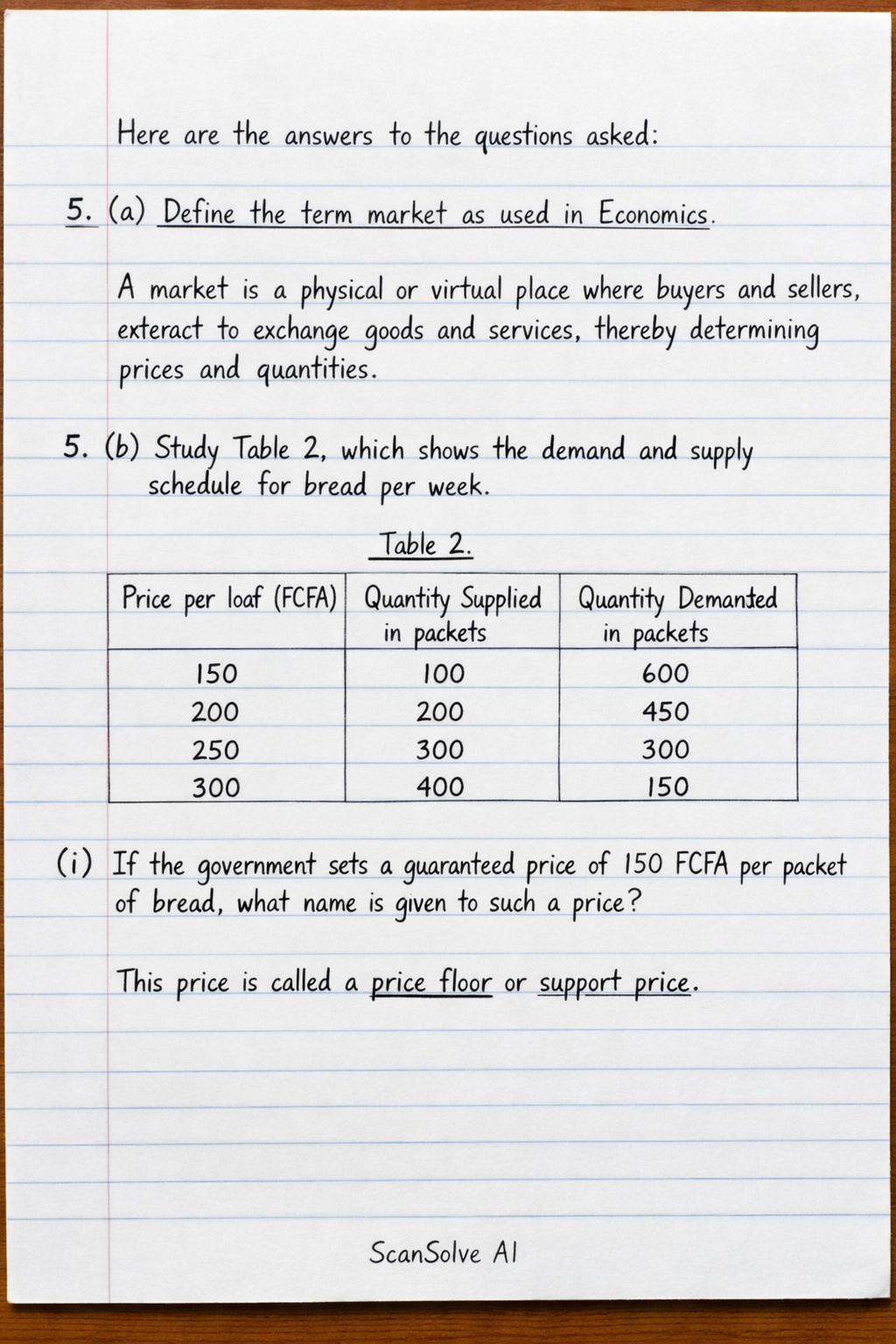
Here are the answers to the questions asked: 5. (a) Define the term market as used in Economics. A market is a physical or virtual place where buyers and sellers interact to exchange goods and services, thereby determining prices and quantities. 5. (b) Study Table 2, which shows the demand and supply schedule for bread per week. Table 2 | Price per loaf (FCFA) | Quantity supplied in packets | Quantity demanded in packets | | :-------------------- | :-------------------------- | :--------------------------- | | 150 | 100 | 600 | | 200 | 200 | 450 | | 250 | 300 | 300 | | 300 | 400 | 150 | (i) If the government sets a guaranteed price of 150 FCFA per packet of bread. What name is given to such a price? This price is called a price floor or support price. (ii) Calculate the costs for the government, if it imposes a price of 300 FCFA per packet of bread and decides to buy the surplus on the market. Step 1: Identify the quantity supplied and quantity demanded at the price of 300 FCFA. At 300 FCFA: Quantity supplied (Q_S) = 400 packets Quantity demanded (Q_D) = 150 packets Step 2: Calculate the surplus. Surplus = Q_S - Q_D Surplus = 400 - 150 = 250 packets Step 3: Calculate the cost to the government. Cost = Surplus × Price Cost = 250 packets × 300 FCFA/packet Cost = 75000 FCFA The costs for the government are 75,000 FCFA. (iii) Calculate the price elasticity of demand if the price of bread changes from 250 FCFA to 200 FCFA per packet and identify whether it is elastic or inelastic. Step 1: Identify the corresponding prices and quantities. Initial Price (P_1) = 250 FCFA, Initial Quantity Demanded (Q_1) = 300 packets Final Price (P_2) = 200 FCFA, Final Quantity Demanded (Q_2) = 450 packets Step 2: Calculate the percentage change in quantity demanded. \% Q_D = (Q_2 - Q_1)/((Q_1 + Q_2)/2) = (450 - 300)/((300 + 450)/2) = (150)/(750/2) = (150)/(375) = 0.4 Step 3: Calculate the percentage change in price. \% P = (P_2 - P_1)/((P_1 + P_2)/2) = (200 - 250)/((250 + 200)/2) = (-50)/(450/2) = (-50)/(225) ≈ -0.2222 Step 4: Calculate the Price Elasticity of Demand (PED). PED = | (\% Q_D)/(\% P) | = | (0.4)/(-0.2222) | ≈ |-1.8| = 1.8 Step 5: Identify whether the demand is elastic or inelastic. Since PED = 1.8 > 1, the demand is elastic. The price elasticity of demand is approximately 1.8, and the demand is elastic. 5. (c) State and explain three (3) factors that affect the elasticity of supply. Time period: In the short run, supply is generally inelastic because firms have little time to adjust their factors of production. In the long run, supply becomes more elastic as firms can change their production capacity. Storage capacity: Goods that can be easily stored have a more elastic supply because producers can hold back inventory when prices are low and release it when prices rise. Availability of inputs: If inputs (raw materials, labor) are readily available and can be quickly mobilized, supply will be more elastic. If inputs are scarce or difficult to obtain, supply will be inelastic. 5. (d) Describe three (3) functions of the retailer in the channel of distribution. Breaking bulk: Retailers purchase goods in large quantities from wholesalers or manufacturers and sell them in smaller quantities to individual consumers. Providing information: They provide product information to consumers and relay customer feedback to manufacturers. Offering after-sales services: Retailers can offer services such as delivery, installation, credit, and customer support, enhancing the overall shopping experience. 6. (a) Define the following: (i) Budget A budget is a financial plan that estimates revenues and expenditures for a given future period, usually a year, used by individuals, businesses, or governments. (ii) Internal debt Internal debt is the portion of a country's public debt owed to creditors residing within the country, such as domestic banks or citizens. (iii) Value Added Tax (VAT) Value Added Tax (VAT) is a consumption tax applied to the value added at each stage of the production and distribution of a good or service, ultimately borne by the final consumer. (iv) Tax burden The tax burden, or tax incidence, represents the proportion of income or wealth that an individual or business pays in taxes, often expressed as a percentage of GDP for a country. 6. (b) Explain three (3) qualities of a good tax system. Equity: A good tax system must be fair, meaning that people with similar abilities to pay should pay similar taxes (horizontal equity) and those with higher abilities to pay should contribute more (vertical equity). Simplicity: The tax system should be easy to understand and administer, both for taxpayers and the tax authority, to reduce compliance costs and avoid confusion. Efficiency: An efficient tax system must generate sufficient revenue to finance public expenditures without creating excessive distortions in the economy or discouraging economic activity. 6. (c) Using diagrams, distinguish between a progressive tax system and a regressive tax system. Progressive tax system: In a progressive tax system, the tax rate increases as the taxpayer's income or ability to pay increases. This means that high-income earners pay a higher percentage of their income in taxes than low-income earners. Diagram (description):* A graph would show an upward-sloping curve where the X-axis represents income and the Y-axis represents the average tax rate. The curve would rise, indicating that the tax rate increases with income. Regressive tax system: In a regressive tax system, the tax rate decreases as the taxpayer's income or ability to pay increases. This means that low-income earners pay a higher percentage of their income in taxes than high-income earners. Diagram (description):* A graph would show a downward-sloping curve where the X-axis represents income and the Y-axis represents the average tax rate. The curve would fall, indicating that the tax rate decreases with income. 7. (a) Distinguish between the following: (i) Optimal population and overpopulation. Optimal population: The optimal population is the level of population that, given available resources and technology, allows for the highest possible standard of living per capita. Overpopulation: Overpopulation occurs when the population size exceeds the carrying capacity of the environment and available resources, leading to a decline in living standards and environmental degradation. (ii) Plantation agriculture and smallholder farming. Plantation agriculture: Plantation agriculture is a large-scale, typically monoculture farming system focused on producing cash crops (such as coffee, tea, rubber) for export, often using significant labor and intensive techniques. Smallholder farming: Smallholder farming refers to an agricultural system where individual farmers or families cultivate small plots of land, primarily for subsistence or to sell surpluses in local markets, with limited resources and technology. (iii) Economic growth and economic development. Economic growth: Economic growth is the increase in the production of goods and services in an economy over a period, usually measured by the increase in real Gross Domestic Product (GDP). Economic development: Economic development is a broader, multidimensional process that encompasses not only economic growth but also improvements in the overall well-being of the population, including advancements in education, health, poverty reduction, and social equality. 7. (b) Explain three (3) limitations of Malthus's theory of population growth. Technological progress: Malthus did not adequately account for the impact of technological progress, particularly in agriculture (Green Revolution), which significantly increased food production, contradicting his prediction of arithmetic resource growth. Birth control: Malthus's theory did not anticipate the widespread adoption of birth control methods and the demographic transition, where birth rates decline with economic development and urbanization. International trade: Malthus overlooked the role of international trade, which allows countries to compensate for local food shortages by importing goods from other regions, thereby reducing pressure on national resources. 7. (c) Describe four (4) causes of economic growth. Capital accumulation: Investment in physical capital (machinery, infrastructure) and human capital (education, training) increases an economy's productive capacity. Technological progress: Innovation and the adoption of new technologies improve production efficiency and allow more to be produced with the same resources. Increase in labor force: An increase in the size of the active population or an improvement in its quality (skills, health) can lead to an increase in total output. Natural resources: The discovery and exploitation of new natural resources or more efficient management of existing resources can stimulate economic growth.