
English mein bata do
English
ScanSolve AI Answer
Answer
We considered because it falls within the given interval and it is the point where the function reaches its maximum value within that interval.
To determine the range of over the interval :
- We evaluate at the endpoints: and .
- We also consider any critical points (where the derivative is zero or undefined) within the interval. For , its derivative is , which is 0 at .
- At , .
Since the interval is open, cannot be exactly or , so will be strictly greater than . However, is included in the interval, so can be equal to 1.
Therefore, the range of for is . Considering was crucial to establish the upper bound of 1 for .
Was this helpful?
Still stuck on this one?
Ask a follow-up, and the answer starts from this question.
Got a different question?Ask your own question
More English Questions
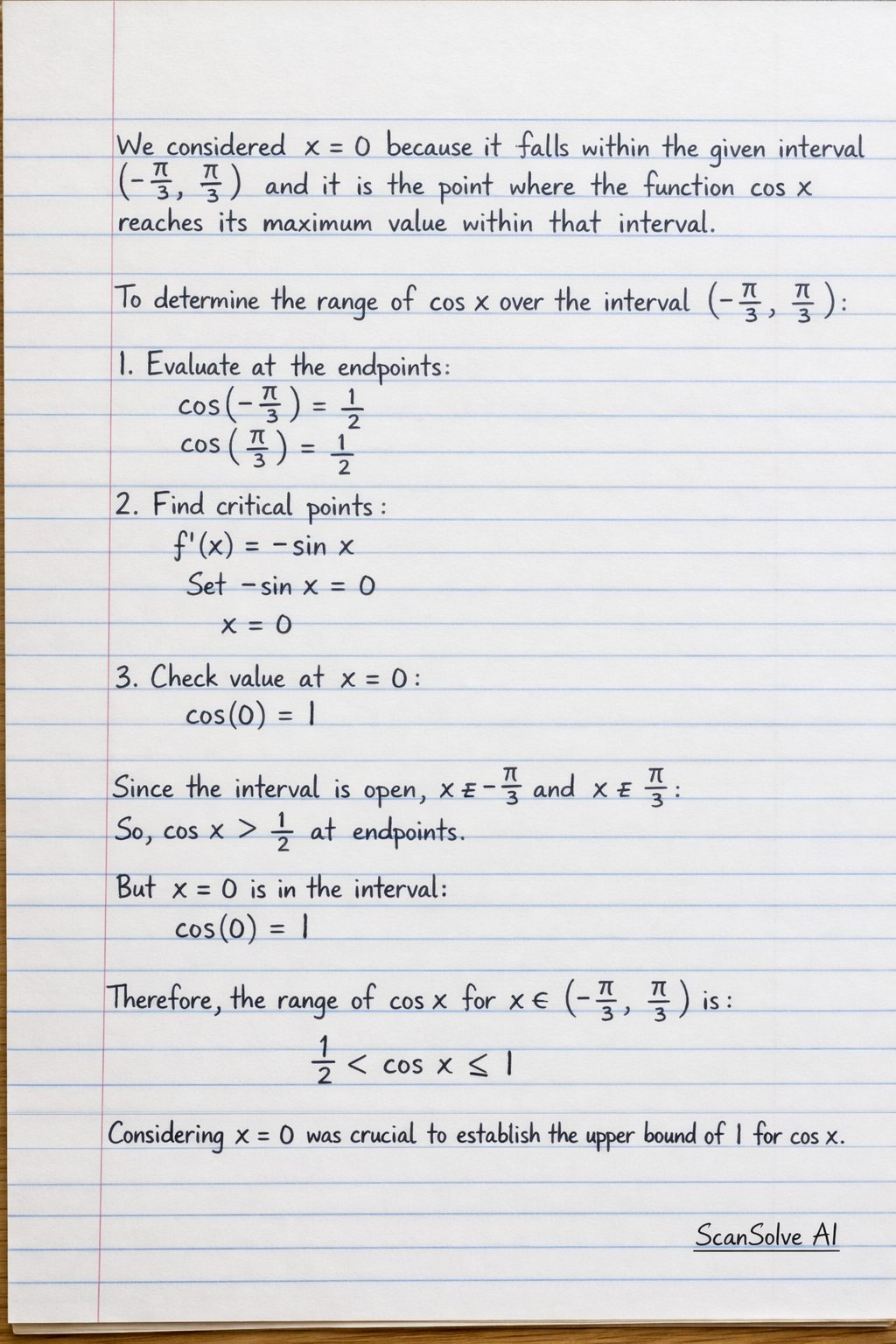
Handwritten Step-by-Step Solution
Get this as a handwritten image on WhatsApp — like a tutor wrote it for you.
Try on WhatsApp