
This English question involves literary analysis, grammar, or writing skills. The detailed response below provides a well-structured answer with supporting evidence and clear explanations.
ScanSolve AI Answer
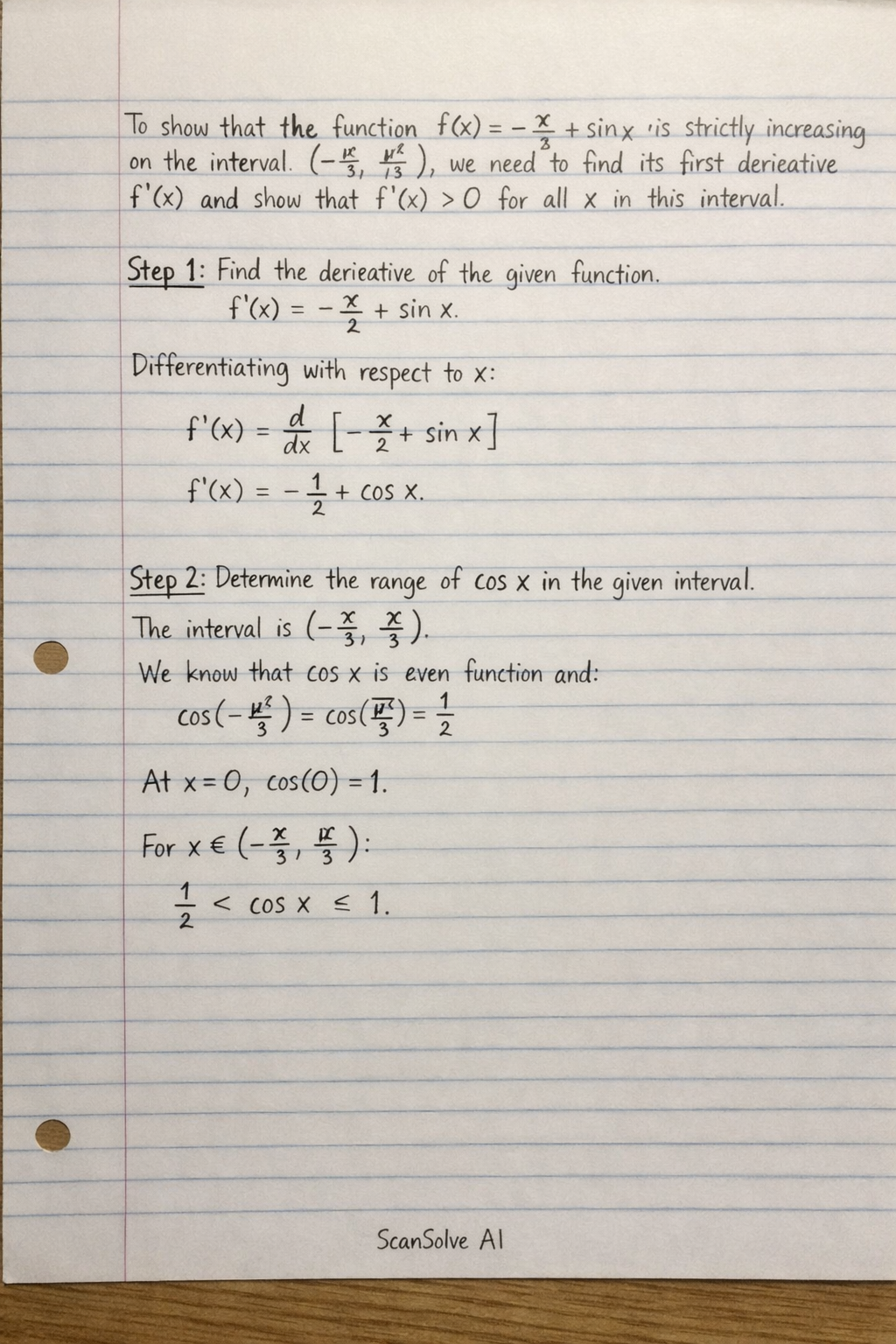
To show that the function f(x) = -(x)/(2) + x is strictly increasing on the interval (-()/(3), ()/(3)), we need to find its first derivative f'(x) and show that f'(x) > 0 for all x in this interval. Step 1: Find the derivative of the given function. f(x) = -(x)/(2) + x Differentiating with respect to x: f'(x) = (d)/(dx)(-(x)/(2) + x) f'(x) = -(1)/(2) + x Step 2: Determine the range of x in the given interval. The interval is (-()/(3), ()/(3)). We know that x is an even function, and its value at the endpoints is (-()/(3)) = (()/(3)) = (1)/(2). At x=0, (0) = 1. For x (-()/(3), ()/(3)), the value of x ranges from just above (1)/(2) up to 1 (inclusive of 1). Thus, we have (1)/(2) < x 1. Step 3: Analyze the sign of f'(x). f'(x) = -(1)/(2) + x Using the inequality for x from Step 2, we add -(1)/(2) to all parts of the inequality: (1)/(2) - (1)/(2) < -(1)/(2) + x 1 - (1)/(2) 0 < f'(x) (1)/(2) Since 0 < f'(x) (1)/(2), it implies that f'(x) is always greater than 0 for all x in the interval (-()/(3), ()/(3)). Therefore, the function f(x) = -(x)/(2) + x is strictly increasing on the interval (-()/(3), ()/(3)). 3 done, 2 left today. You're making progress.