

This English question involves literary analysis, grammar, or writing skills. The detailed response below provides a well-structured answer with supporting evidence and clear explanations.
ScanSolve AI Answer
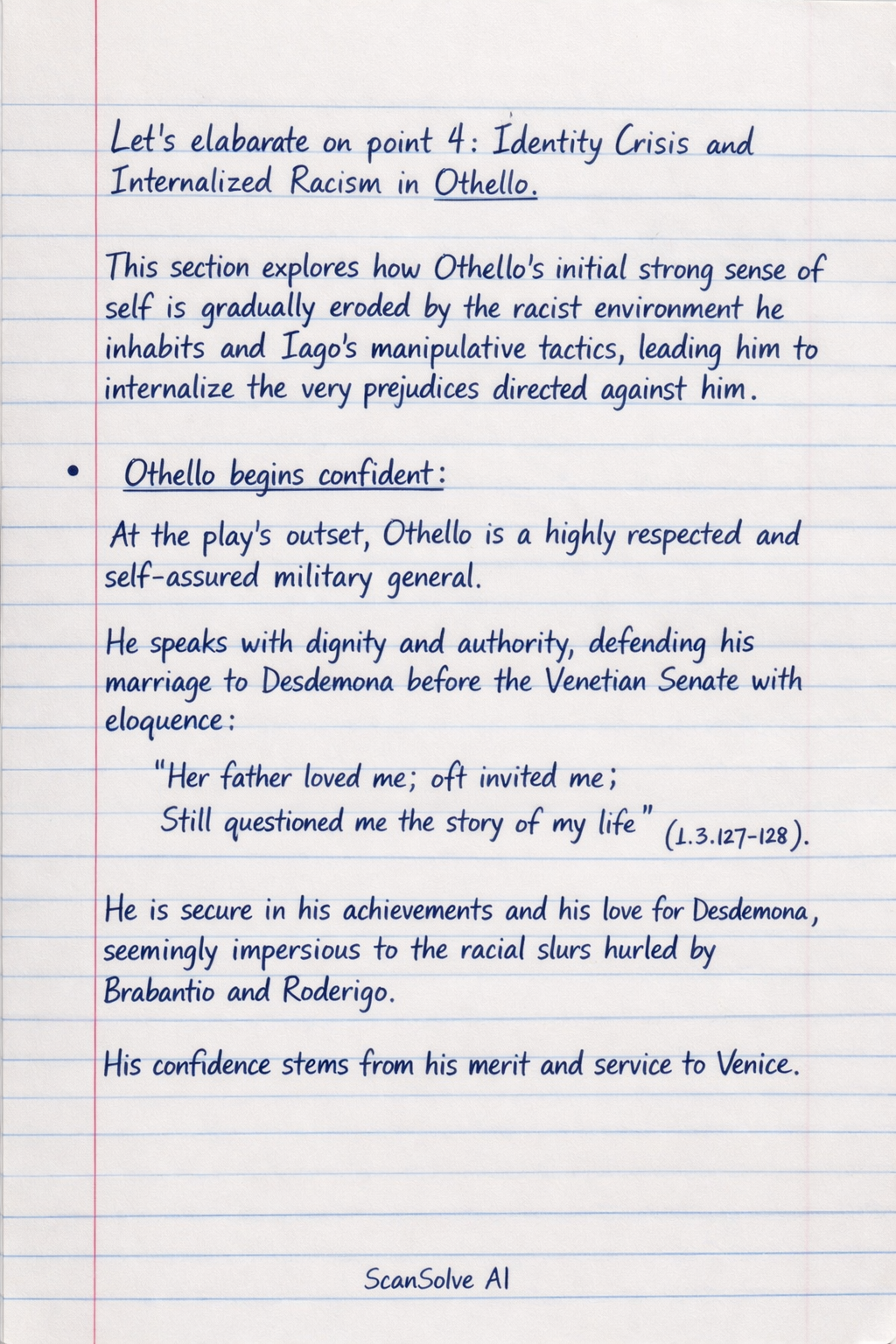
Let's elaborate on point 4: Identity Crisis and Internalized Racism in Othello. This section explores how Othello's initial strong sense of self is gradually eroded by the racist environment he inhabits and Iago's manipulative tactics, leading him to internalize the very prejudices directed against him. Othello begins confident: At the play's outset, Othello is a highly respected and self-assured military general. He speaks with dignity and authority, defending his marriage to Desdemona before the Venetian Senate with eloquence: "Her father loved me; oft invited me; / Still questioned me the story of my life" (1.3.127-128). He is secure in his achievements and his love for Desdemona, seemingly impervious to the racial slurs hurled by Brabantio and Roderigo. His confidence stems from his merit and service to Venice. Starts doubting himself: Iago's insidious manipulation targets Othello's vulnerabilities, which are rooted in his status as an "Other" in Venetian society. Iago subtly suggests that Desdemona's choice of Othello is "unnatural" and that she will eventually regret marrying someone of a different race and background: "Not to affect many proposed matches / Of her own clime, complexion, and degree, / Whereto we see in all things nature tends— / Foh! one may smell in such a will most rank, / Foul disproportion, thoughts unnatural" (3.3.229-233). This plants seeds of doubt about his worthiness and Desdemona's fidelity, exploiting his awareness of his racial and cultural difference. Believes stereotypes about his own race: As Iago's poison takes hold, Othello begins to internalize the racist stereotypes that Venetian society projects onto him. He starts to see himself through the prejudiced lens of the "savage Moor" – prone to jealousy, irrationality, and violence. He laments his "blackness" and his "rude speech" as reasons for Desdemona's supposed infidelity, believing that his racial identity makes him inherently undesirable or incapable of sustaining a pure relationship: "Haply, for I am black / And have not those soft parts of conversation / That chamberers have, or for I am declined / Into the vale of years—yet that's not much— / She's gone" (3.3.263-267). He accepts the narrative that his race makes him inherently flawed or less civilized, leading to his tragic transformation. Show how racism affects psychology: The constant "Othering" and the insidious nature of Iago's racism profoundly affect Othello's psychology. He descends into a state of extreme paranoia, insecurity, and rage. His once calm and rational demeanor gives way to fits of epilepsy, violent threats, and a complete loss of self-control. This psychological breakdown demonstrates how systemic racism, even when subtle, can dismantle an individual's mental stability and self-perception, leading to self-destructive behavior and a distorted view of reality. Theory Link: Internalized oppression (Postcolonial / CRT): Othello's journey is a powerful example of internalized oppression*. This concept, central to Postcolonial Theory and Critical Race Theory (CRT), describes how members of an oppressed group begin to believe and act on the negative stereotypes and prejudices directed at them by the dominant group. Othello, initially resisting these stereotypes, eventually succumbs to them, allowing the racist narratives of Venetian society to define his identity and actions. He becomes an agent of his own destruction by adopting the very prejudices that sought to diminish him, ultimately fulfilling the tragic prophecy of the "savage Moor" that Iago and others had constructed. This analysis highlights how racism is not just external prejudice but can become a deeply damaging internal force, leading to an identity crisis and tragic consequences.