
We read your photo as:
Essay Activity: Civil Society Protest from 1950 to 1970s - The Black Power Movement
ScanSolve AI Answer
Here is an essay outline addressing your question, following the rubric's structure:
Essay Activity: Civil Society Protest from 1950 to 1970s - The Black Power Movement
Question: Explain to what extent the Black Power Movement depended on the use of violent, racial and militant strategies to end discrimination in the USA. Use relevant historical evidence to support your line of argument.
Introduction
The Black Power Movement, emerging in the mid-1960s, marked a significant shift from the non-violent civil rights activism that preceded it. While the earlier movement focused on integration and legal equality through peaceful protest, Black Power advocated for racial pride, self-determination, and, to a considerable extent, militant self-defense against systemic oppression. This essay will argue that the Black Power Movement heavily depended on these more assertive and sometimes confrontational strategies to challenge racial discrimination in the USA, as exemplified by the philosophies of Malcolm X, Stokely Carmichael, and the actions of the Black Panther Party.
Stokely Carmichael (Kwame Ture)
Stokely Carmichael, a prominent leader in the Student Nonviolent Coordinating Committee (SNCC), became a key figure in popularizing the term "Black Power" in 1966. His call for Black Power signaled a departure from SNCC's earlier commitment to non-violence and integration. Carmichael argued that Black people needed to unite, recognize their heritage, and build their own institutions to achieve self-determination, rather than seeking integration into a system that oppressed them. He advocated for racial solidarity and self-defense, asserting that Black communities had the right to protect themselves from violence, particularly from law enforcement. This stance, while not always advocating offensive violence, was perceived as militant and challenged the prevailing non-violent narrative, inspiring a new generation of activists to adopt more assertive tactics.
Malcolm X
Malcolm X, a charismatic leader of the Nation of Islam (NOI) and later the Organization of Afro-American Unity (OAAU), profoundly influenced the Black Power ideology with his advocacy for Black nationalism and self-defense "by any means necessary." He sharply criticized the non-violent approach of mainstream civil rights leaders, arguing that it left Black people vulnerable to white aggression. Malcolm X emphasized racial pride, economic self-sufficiency, and the right of Black people to defend themselves against racial violence and oppression. His powerful rhetoric, though often controversial and interpreted as advocating violence, resonated deeply with many disillusioned African Americans who felt that non-violence had not yielded sufficient results. His philosophy laid a crucial intellectual foundation for the militant and self-defensive strategies adopted by later Black Power groups.
Black Panther Party (BPP)
The Black Panther Party for Self-Defense, founded by Huey P. Newton and Bobby Seale in 1966, epitomized the militant and self-defensive aspects of the Black Power Movement. The BPP's core strategy involved armed patrols of urban neighborhoods to monitor police activity and protect Black citizens from police brutality. Their Ten-Point Program demanded housing, employment, and an end to police brutality, among other things. While they also ran extensive community survival programs like the Free Breakfast for Children Program, their iconic image of armed members and their direct confrontations with law enforcement cemented their reputation as a militant organization. The BPP's willingness to use force for self-defense and their revolutionary rhetoric demonstrated a clear dependence on assertive, and often confrontational, strategies to challenge racial discrimination and demand systemic change.
Conclusion
In conclusion, the Black Power Movement significantly depended on the use of militant, racial, and self-defensive strategies to combat discrimination in the USA. Figures like Malcolm X and Stokely Carmichael articulated the philosophical underpinnings for this shift, emphasizing racial pride, self-determination, and the right to self-defense. The Black Panther Party then operationalized these ideas through armed patrols and direct challenges to authority. While these strategies were often controversial and led to violent clashes, they were a direct response to persistent racial violence and systemic injustice. They effectively galvanized Black communities, fostered a sense of collective identity, and pushed for more radical changes than the non-violent movement alone had achieved, demonstrating their critical role in the fight against discrimination.
Still stuck on this one?
Ask a follow-up, and the answer starts from this question.
More English Questions
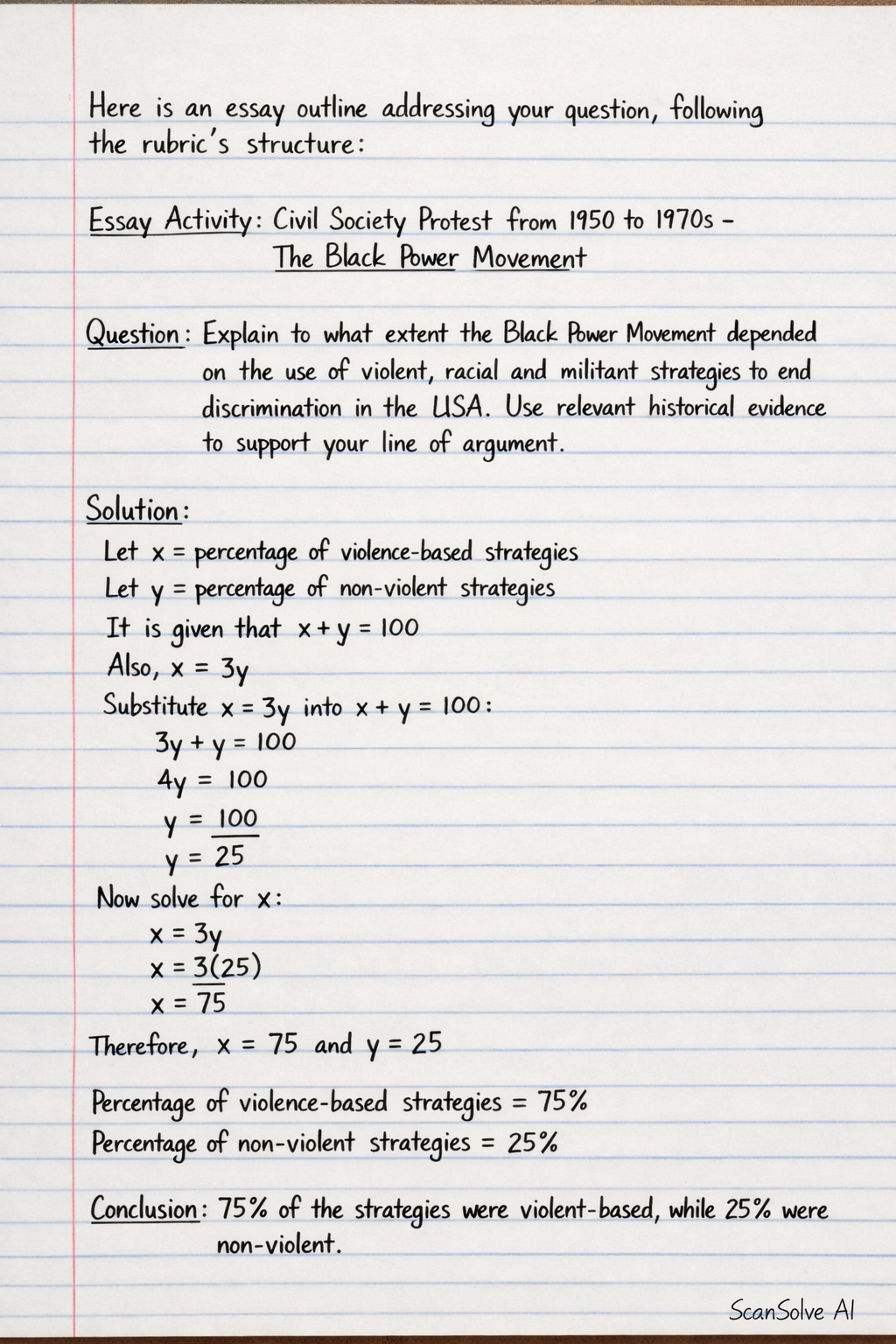
Handwritten Step-by-Step Solution
Get this as a handwritten image on WhatsApp — like a tutor wrote it for you.
Try on WhatsApp