
We read your photo as:
Fill in the blanks in the following sentences with the most appropriate word or phrase:
ScanSolve AI Answer
Answer
Whatever you do
Here are the answers to the grammar questions:
-
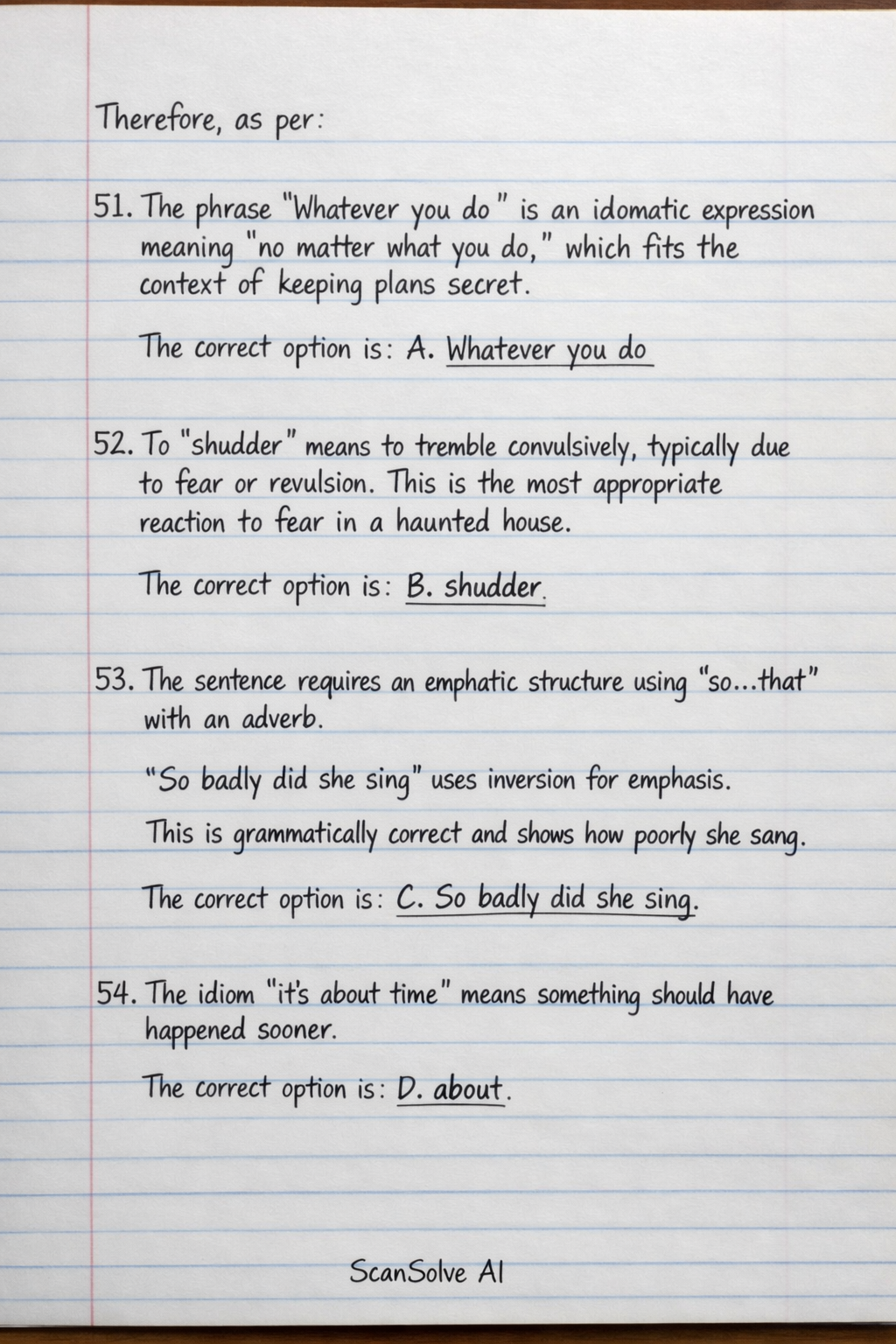
51. The phrase "Whatever you do" is an idiomatic expression meaning "no matter what you do," which fits the context of keeping plans secret.
- The correct option is A. Whatever you do
-
52. To "shudder" means to tremble convulsively, typically as a result of fear or revulsion. This is the most appropriate reaction to fear in a haunted house.
- The correct option is B. shudder
-
53. The sentence requires an emphatic structure using "so...that" with an adverb. "So badly did she sing" uses inversion for emphasis, which is grammatically correct and effectively conveys the degree of her poor singing.
- The correct option is C. So badly did she sing
-
54. The idiom "it's about time" means that something should have happened sooner.
- The correct option is D. about
-
55. The sentence needs a participial phrase to explain why she left a note. "Realizing there was nobody at home" correctly introduces the reason.
- The correct option is B. Realizing there was nobody
-
56. "Should have arrived" expresses an expectation that something would happen in the past, but it didn't. This fits the context of not knowing where he is, implying he was expected to arrive earlier.
- The correct option is C. should have arrived
-
57. The phrase "by Friday" indicates a deadline, requiring the future perfect tense to express an action that will be completed by that time. "Will have finished" is the correct form.
- The correct option is C. will have finished
-
58. This is a conditional sentence. "If you should happen to be passing" is a polite and slightly more formal way to express a casual or less certain condition, inviting someone to drop in if the opportunity arises. "If you happen to pass" (C) is also correct but D adds a nuance of politeness.
- The correct option is D. should happen to be passing
-
59. When referring to the general mode of transport, the preposition "by" is used (e.g., by bus, by car, by train).
- The correct option is C. by
-
60. The relative pronoun refers to "the man" and acts as the object of the verb "met" (you met him). Therefore, "whom" is the grammatically correct choice.
- The correct option is D. whom
-
61. All three options can be used to describe habitual actions in the past. "Used to walk" and "would walk" explicitly denote past habits, while "walked" (simple past) can also describe a repeated action in the past when the context implies habit.
- The correct option is D. all of the above
Try one yourself
A new problem that tests the same skill.
Still stuck on this one?
Ask a follow-up, and the answer starts from this question.
More English Questions
Handwritten Step-by-Step Solution
Get this as a handwritten image on WhatsApp — like a tutor wrote it for you.
Try on WhatsApp