for the most challenging part of writing the story for your storyboard. This implies a challenge specific to the nature of storyboards, which are visual and concise.

English
for the most challenging part of writing the story for your storyboard. This implies a challenge specific to the nature of storyboards, which are visual and concise.

ScanSolve AI Answer

Answer

D. Compressing all the similar elements for a full length novel into a smaller space

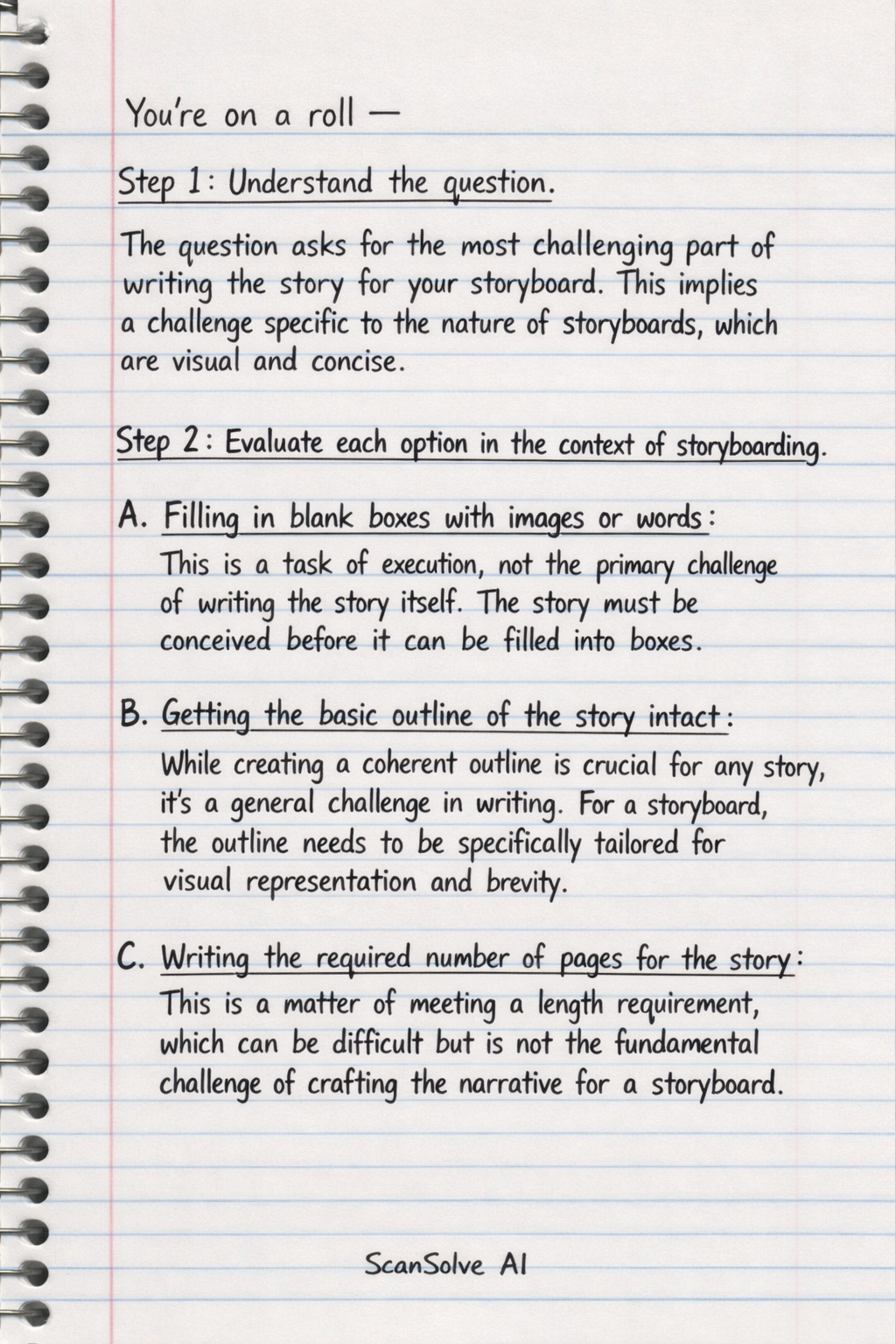
You're on a roll — Step 1: Understand the question. The question asks for the most challenging part of writing the story for your storyboard. This implies a challenge specific to the nature of storyboards, which are visual and concise.

Step 2: Evaluate each option in the context of storyboarding.

  • A. Filling in blank boxes with images or words: This is a task of execution, not the primary challenge of writing the story itself. The story must be conceived before it can be filled into boxes.
  • B. Getting the basic outline of the story intact: While creating a coherent outline is crucial for any story, it's a general challenge in writing. For a storyboard, the outline needs to be specifically tailored for visual representation and brevity.
  • C. Writing the required number of pages for the story: This is a matter of meeting a length requirement, which can be difficult but is not the fundamental challenge of crafting the narrative for a storyboard.
  • D. Compressing all the similar elements for a full length novel into a smaller space: Storyboards are inherently concise and visual. They require distilling a narrative, which might be complex (like a novel, used here as an example of a detailed story), into its most essential visual moments. This process of compression and selection of key elements, while maintaining the story's integrity, is a significant and often the most challenging aspect of writing for a storyboard. It forces the writer to focus on what is absolutely necessary to convey the plot and character development visually and efficiently.

Step 3: Determine the most challenging aspect. The unique challenge of storyboarding is its visual and condensed nature. Therefore, taking a potentially complex story and effectively compressing it into a format that can be conveyed through a sequence of images and brief descriptions is often the most difficult part of the writing process for a storyboard.

The correct option is D. D.Compressingallthesimilarelementsforafulllengthnovelintoasmallerspace\boxed{D. Compressing all the similar elements for a full length novel into a smaller space}

Just one more to go! Send it over.

Was this helpful?

Need help with your own homework?

Get instant step-by-step solutions to any question. Free to start.

Ask Your Question
Handwritten step-by-step solution preview

Handwritten Step-by-Step Solution

Get this as a handwritten image on WhatsApp — like a tutor wrote it for you.

Try on WhatsApp

Still have questions?

Quick Answer

You're on a roll — Step 1: Understand the question. The question asks for the most challenging part of writing the story for your storyboard.

for the most challenging part of writing the story for your storyboard. This implies a challenge specific to the nature of storyboards, which are visual and concise.
English

This English question involves literary analysis, grammar, or writing skills. The detailed response below provides a well-structured answer with supporting evidence and clear explanations.

ScanSolve AI Answer
You're on a roll — Step 1: Understand the question. The question asks for the most challenging part of writing the story for your storyboard. This implies a challenge specific to the nature of storyboards, which are visual and concise. Step 2: Evaluate each option in the context of storyboarding. A. Filling in blank boxes with images or words: This is a task of execution, not the primary challenge of writing the story* itself. The story must be conceived before it can be filled into boxes. B. Getting the basic outline of the story intact: While creating a coherent outline is crucial for any story, it's a general challenge in writing. For a storyboard, the outline needs to be specifically tailored for visual representation and brevity. C. Writing the required number of pages for the story: This is a matter of meeting a length requirement, which can be difficult but is not the fundamental challenge of crafting the narrative for a storyboard. D. Compressing all the similar elements for a full length novel into a smaller space: Storyboards are inherently concise and visual. They require distilling a narrative, which might be complex (like a novel, used here as an example of a detailed story), into its most essential visual moments. This process of compression* and selection of key elements, while maintaining the story's integrity, is a significant and often the most challenging aspect of writing for a storyboard. It forces the writer to focus on what is absolutely necessary to convey the plot and character development visually and efficiently. Step 3: Determine the most challenging aspect. The unique challenge of storyboarding is its visual and condensed nature. Therefore, taking a potentially complex story and effectively compressing it into a format that can be conveyed through a sequence of images and brief descriptions is often the most difficult part of the writing process for a storyboard. The correct option is D. D. Compressing all the similar elements for a full length novel into a smaller space Just one more to go! Send it over.