
We read your photo as:
Hereafter I need all ans in English
ScanSolve AI Answer
Answer
Step-by-step solution
5 stepsIdentify the formula for phase difference in Young's double-slit experiment.
The phase difference () between two waves is related to their path difference () by the formula:
where is the wavelength of light.
Determine the path difference for a bright fringe.
For a bright fringe (constructive interference), the path difference is an integer multiple of the wavelength:
where is the order of the bright fringe ().
Find the order of the third bright fringe.
The central bright fringe corresponds to .
The first bright fringe corresponds to .
The second bright fringe corresponds to .
The third bright fringe corresponds to .
So, for the third bright fringe, .Calculate the path difference for the third bright fringe.
Using , the path difference is:
Calculate the phase difference for the third bright fringe.
Substitute into the phase difference formula:
The wavelength is given but is not required for this calculation as it cancels out.
The final answer is
Try one yourself
A new problem that tests the same skill.
Still stuck on this one?
Ask a follow-up, and the answer starts from this question.
More English Questions
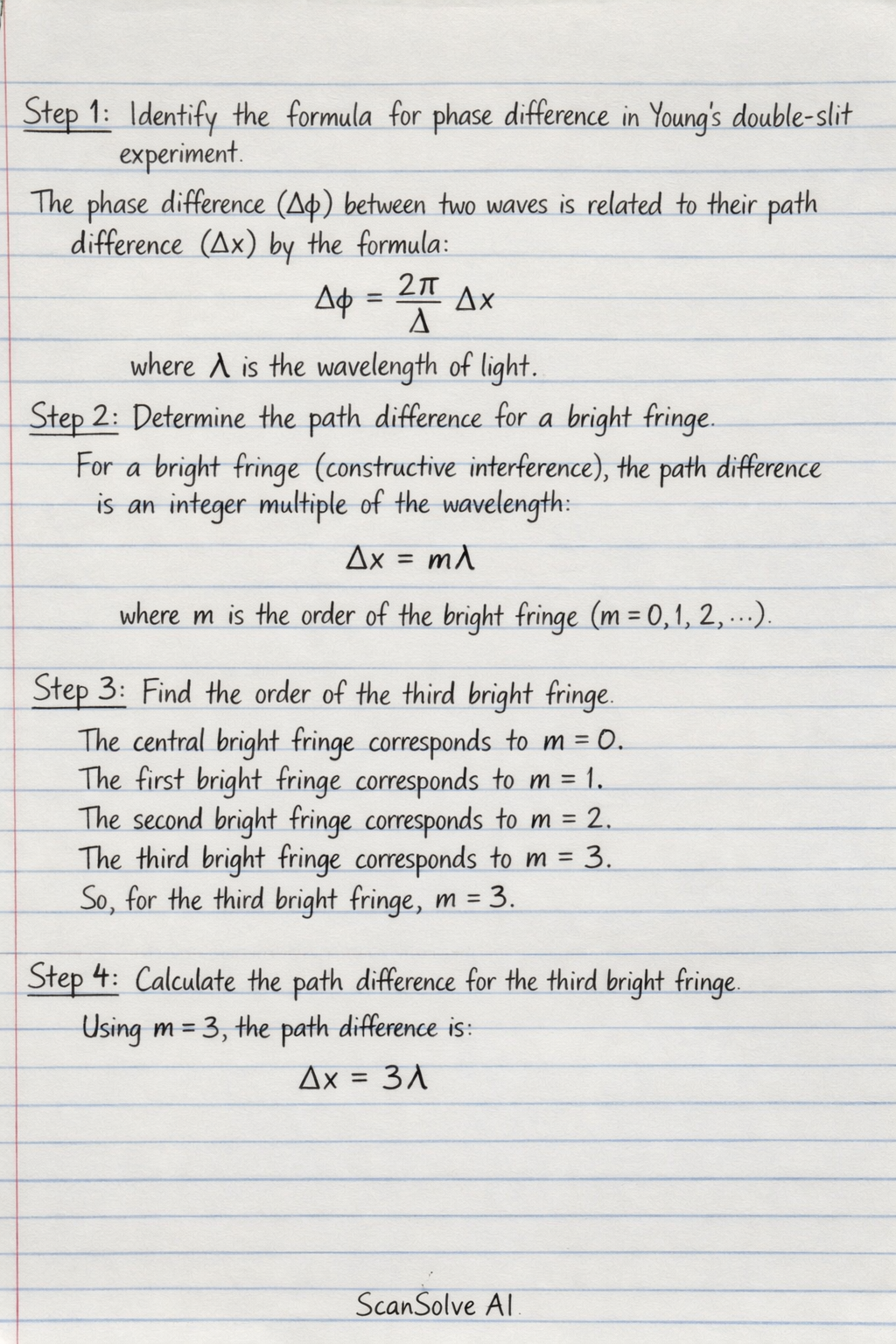
Handwritten Step-by-Step Solution
Get this as a handwritten image on WhatsApp — like a tutor wrote it for you.
Try on WhatsApp