
Here's a summary of the provided lecture notes on Meiosis I (Prometaphase I and Metaphase I), followed by a question and answer: Summary of Meiosis I: Prometaphase I and Metaphase I These stages are crucial for setting up the genetic variation that occurs during meiosis. • Prometaphase I: Kinetochore proteins on the centromeres of each homologous chromosome bind to spindle fiber microtubules. Each homologous chromosome (composed of two sister chromatids) attaches to microtubules from opposite poles. At this point, homologous chromosomes are still held together by chiasmata (sites of crossing over). • Metaphase I: Tetrads (pairs of homologous chromosomes) undergo random orientation and align at the cell's equator. This random alignment means there's an equal chance for a microtubule to attach to either the maternal or paternal chromosome of a homologous pair. This random arrangement is known as independent assortment. Independent assortment is a significant source of genetic variation. The total possible variations can be estimated by the formula 2ⁿ, where 'n' is the number of chromosomes in a haploid gamete cell. For humans, with n=23, the possible variations due to independent assortment are 2²³ = 8,388,608. Together with crossing over (which occurs in Prophase I), independent assortment explains the genetic differences observed among siblings. 7
ScanSolve AI Answer
Answer
Step-by-step solution
3 stepsBased on the provided notes, here is a question related to the calculation of genetic variation due to independent assortment, followed by its answer:
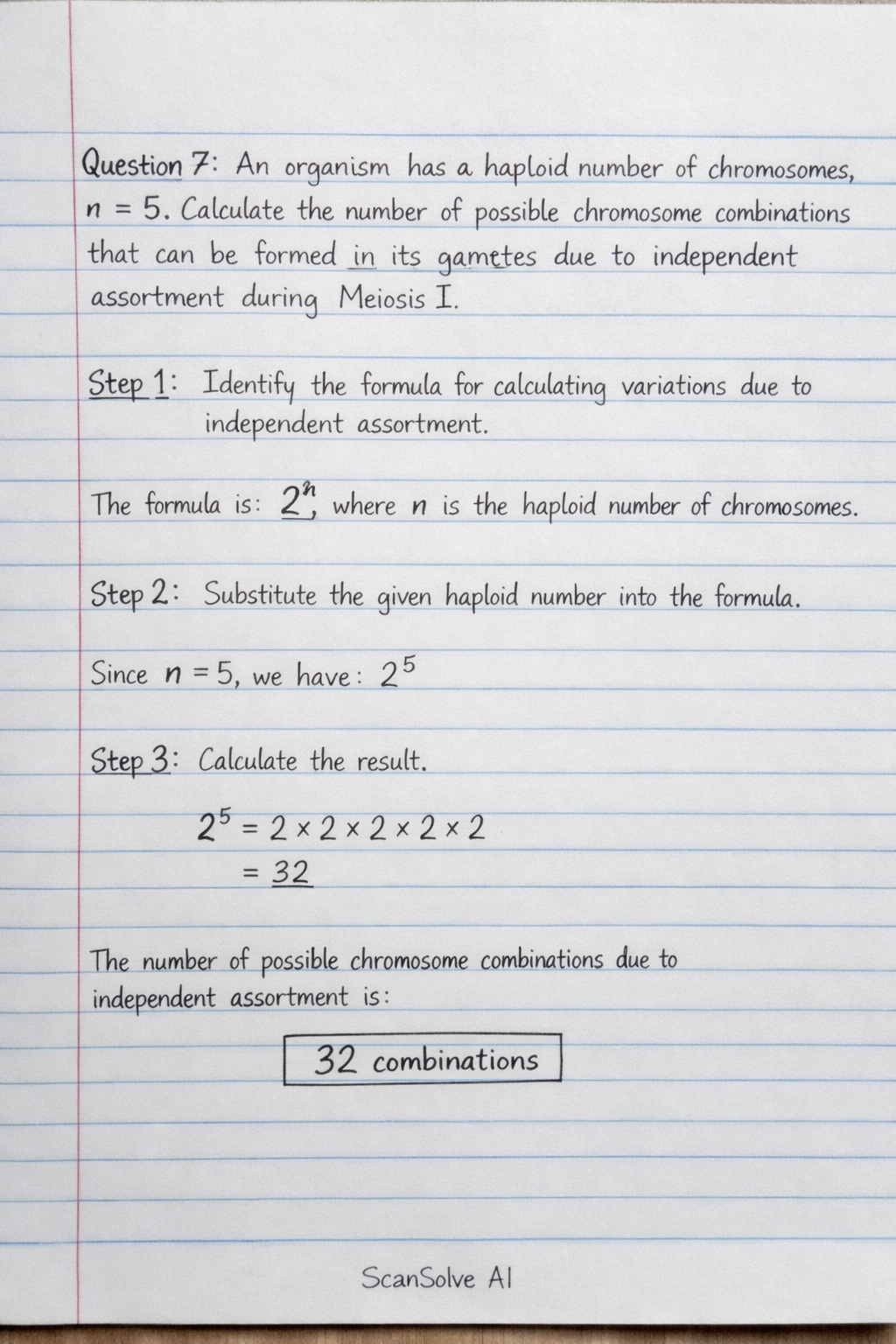
Question 7: An organism has a haploid number of chromosomes, . Calculate the number of possible chromosome combinations that can be formed in its gametes due to independent assortment during Meiosis I.
Identify the formula for calculating variations due to independent assortment.
The formula provided in the notes is , where is the haploid number of chromosomes.
Substitute the given haploid number into the formula.
Given , the formula becomes .
Calculate the result.
The number of possible chromosome combinations due to independent assortment is:
Try one yourself
A new problem that tests the same skill.
Still stuck on this one?
Ask a follow-up, and the answer starts from this question.
More English Questions
Handwritten Step-by-Step Solution
Get this as a handwritten image on WhatsApp — like a tutor wrote it for you.
Try on WhatsApp